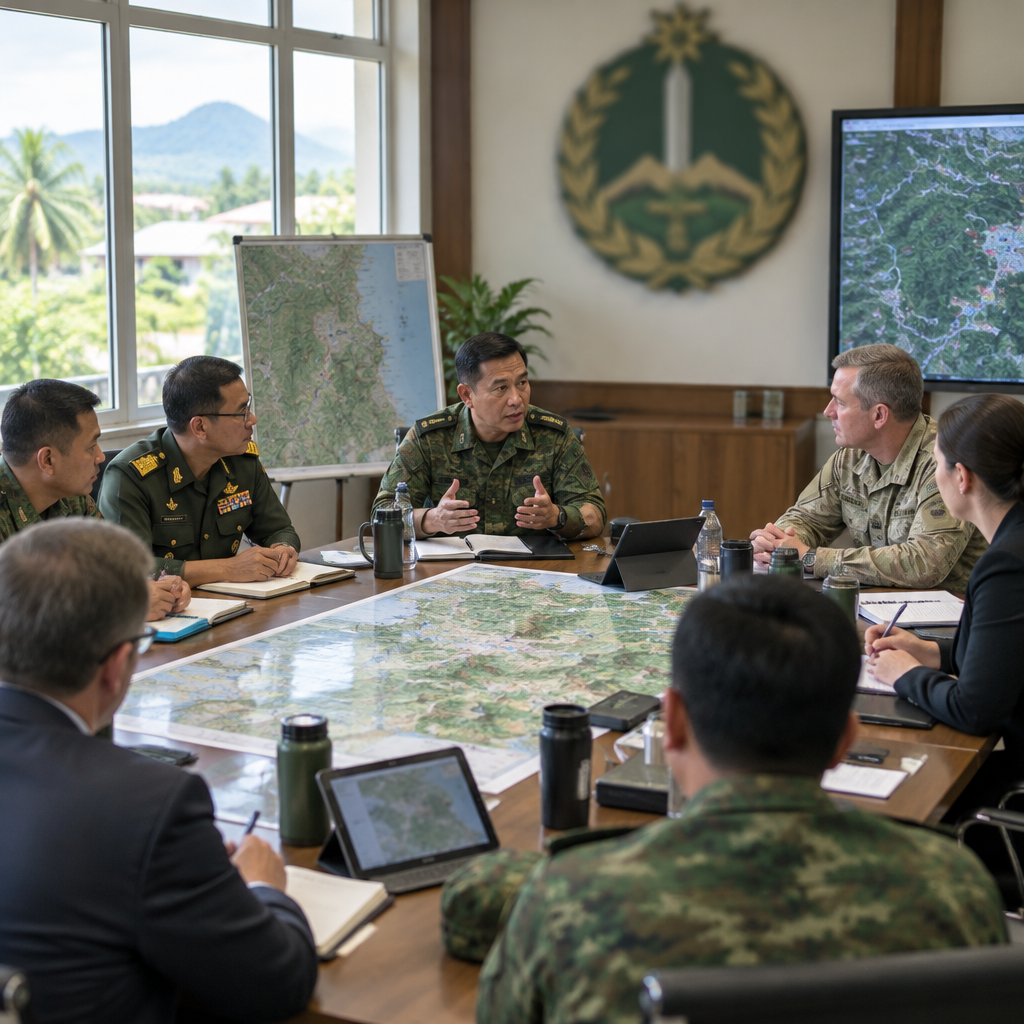
“They asked our advisors, who were in the space of the land force headquarters, ‘Hey, what should we be thinking about? How can we effectively do this?’” — Col. Daniel Hodermarsky.
Col. Daniel Hodermarsky and the 5th Security Force Assistance Brigade
Col. Daniel Hodermarsky, commander of the 5th Security Force Assistance Brigade (5th SFAB), described his unit’s role in mediating a ceasefire that ended months of combat between Thailand and Cambodia. Hodermarsky told Defense One that the Malaysian-hosted talks—led by the Association of Southeast Asian Nations (ASEAN) and the Malaysian Land Forces—sought advice from 5th SFAB advisors embedded with land force headquarters and that his brigade relayed granular reporting to U.S. Army Pacific and other experts to accelerate the process.
Ceasefire talks in Malaysia between Thailand and Cambodia
After months of fighting spurred by a century-old border dispute, Thailand and Cambodia reached a peace deal in Malaysia about a year ago. ASEAN and the Malaysian Land Forces led the discussions; the Malaysian Land Forces asked for and received advice from 5th SFAB members who were already training Thai and Malaysian troops. Hodermarsky said the brigade did not have personnel at the front lines of the conflict but had a team on the ground in Thailand and provided assessments in coordination with the country team there.

This site is the portfolio.
OSINTSights runs on Cloudflare Workers, D1, R2, and Vectorize, with an AI pipeline on Hetzner ARM. Nubivance designed, built, and operates it. We do the same for clients.
See what we buildDefense Secretary Pete Hegseth’s SFAB reductions and the survival of two units
The Security Force Assistance Brigade concept was developed in 2017 to create specialized train-advise-assist units instead of cycling conventional formations into that role. By May 2020, six SFABs existed and were aligned to different geographic commands; the 1st SFAB deployed to Afghanistan in 2018. Last year, Defense Secretary Pete Hegseth ordered the dissolution of most SFABs: units assigned to European and Africa Commands were shuttered, and CENTCOM and National Guard-aligned SFABs were scheduled to disappear by year’s end. The 1st SFAB was reorganized as Army Security Cooperation Group-South (ASCG-S) in January, leaving 5th SFAB as the Army’s only remaining train-advise-assist brigade.
5th SFAB’s footprint across INDOPACOM and exercise support
Hodermarsky described 5th SFAB’s persistent presence across INDOPACOM, working “from Mongolia to the Philippines.” The brigade embeds advisor teams in partner professional military academies, advises senior leadership, and supported the Philippine Army as it shifted focus from counterinsurgency to national defense for its land forces. 5th SFAB’s relationships also helped shape major regional exercises such as Balikatan and Cobra Gold: advisor teams stay involved between planning conferences, identify partner units that will exercise with U.S. formations, and help develop training objectives and progressions. Some division leaders have called the SFAB the “WD-40 of U.S. Army Pacific,” a metaphor Hodermarsky used to describe how adviser teams reduce friction between partner nations and visiting conventional units.
What this means for the DOD, partner militaries, and U.S. Army Pacific
- DOD policymakers: The continued existence of ASCG-S and 5th SFAB signals that train-advise-assist work remains a priority for the department’s top two regions, according to the reporting. Yet critics warn the drawdown may be risky; a 2025 piece in West Point’s Modern War Institute argued that marginalizing the advising mission risks a return to an ineffective “train-and-pray” model and that fully staffed SFABs are “not a luxury; they’re a necessity.”
- Partner militaries (Thailand, Malaysia, the Philippines, Mongolia and others in INDOPACOM): These forces have benefitted from embedded adviser teams that influence training plans, professional military education, and exercise participation—helping some transition capabilities, such as the Philippine Army’s shift toward national-defense tasks.
- U.S. Army Pacific and conventional units: Brigade and division-level formations gain a persistent liaison and assessment capability through 5th SFAB adviser teams, which can smooth planning and integration for exercises and operations with partner units.
The record in this reporting is plain: a single remaining, specialized U.S. Army advisory brigade kept a line of access and influence in INDOPACOM wide enough to help shape a regional peace process and sustain exercise interoperability across multiple partners. Whether that footprint will be enough to meet future demands—particularly amid the broader SFAB reductions ordered last year—remains a concrete question for officials and the partner forces who now rely on those adviser relationships.