"We’re really trying to give the commander the flexibility to have and employ which of those capabilities he or she needs," Col. David Bergmann said, describing the questions driving the effort.
RDEP on small drones: a hardware-and-software approach to “non-kinetic effects”
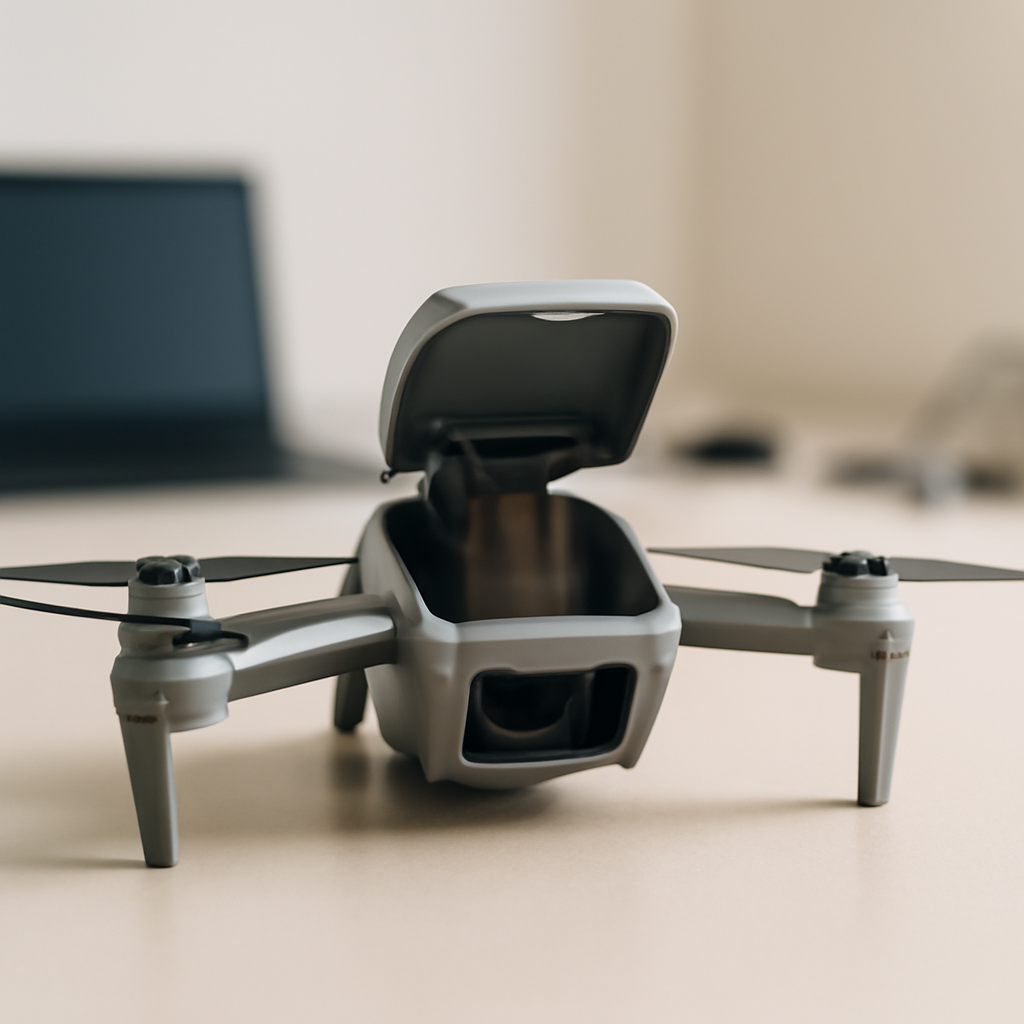
The Army is testing its Radiofrequency Delivery Effects Platform (RDEP) on small drones, combining government-developed and commercial-off-the-shelf payloads to deliver what the service calls “non-kinetic effects,” Col. David Bergmann, project manager for cyber warfare, told Breaking Defense. RDEP is described as a hardware and software capability that allows operators to load exploits onto cards and deliver "digital bullets" to blind or gain access to adversary systems.
Bergmann said the experiments are exploring how RDEP and other payloads can support real-time spectrum monitoring and tailored cyber effects — capabilities that extend the reach of tactical cyber operations while attempting to minimize unintended impacts on friendly systems. While Bergmann did not itemize every function, the Army said those effects typically include jamming capabilities and gaining access to Wi‑Fi systems, among others.
Experimentation tied to the 11th Cyber Battalion and incoming 12th
The work is part of a broader effort to determine standard-issue equipment for the 11th Cyber Battalion and a forthcoming 12th Cyber Battalion. The 11th was established in 2022, building on an earlier 915th Cyber Warfare Battalion that dates to 2019, and conducts tactical-level cyber operations primarily through radio-frequency, electronic warfare (EW) and information operations. Its Expeditionary Cyber Teams (ECTs) are scalable units that operate alongside ground forces and support traditional Army formations by request.
The Army plans to establish the 12th Cyber Battalion in the coming months as a replica of the 11th, increasing capacity to conduct these types of operations. Bergmann, who assumed the new project manager role in July, now leads an acquisition office that combines offensive and defensive cyber efforts and is shepherding the prototype-to-production decision cycle.

Audit-ready is a season. It shouldn't be.
Evidence in spreadsheets, controls drifting between audits, frameworks multiplying on flat headcount. Nubivance runs continuous compliance on Rapid7 Cyber GRC - SOC 2, HIPAA, ISO 27001, PCI, CMMC.
End the scramblePrototypes, form factors and the search for a program of record
The 11th Cyber Battalion does not yet have an established program of record for its standard issue equipment. The Army is still experimenting with different capabilities and configurations before making production decisions. “This next year we have not made decision on what we’re going to go into production with. We’re still doing prototypes across the various different form factors,” Bergmann said.
Options under evaluation include dismounted systems, platform-based payloads and drone-mounted packages capable of delivering cyber and jamming effects. The service has already leveraged existing program-of-record gear within experiments, such as the Terrestrial Layer System Manpack — a backpack-based system that can sense and jam signals — alongside the RDEP. Army Cyber Command has provided initial prototypes to teams and is developing a draft of the kits for further testing.
Bergmann framed the core acquisition questions practically: “How many of these different things does the ECT need? How much of this capability does the 11th need from a cyber perspective, how much EW capability [do] they need? Where do those overlap, and what makes the best sense to outfit the ECTs that are deployed forward.”
Operational lessons: rotating ECT deployments to the southern border
Over the last year, ECTs from the 11th have been deploying on a rotating basis to support operations at the southern border. Those deployments provided lessons to inform the Army’s equipment decisions, helping to assess requirements for ground-based and man-portable capabilities as well as the types of drones and payloads the teams need, Bergmann said.
That field feedback is being used to refine which vehicles each battalion will use, what individual ECTs will be expected to do, and how much of each capability — cyber, EW or overlapping functions — should be assigned to forward-deployed teams.
What this means for technologists, procurement leaders, and ground commanders
- Technologists and security teams: will be asked to evaluate mixed payloads — government-developed and commercial-off-the-shelf — for delivery via small drones, and to prioritize real-time spectrum monitoring and techniques that limit unintended effects on friendly systems.
- Procurement leaders and Army Cyber Command: must convert prototype lessons into a draft kit and ultimately decide a program of record, including form factors and which vehicles and man-portable systems to field as the 12th Cyber Battalion stands up.
- Ground commanders and ECTs: will need clarity on mission sets and on how cyber and EW capabilities overlap, since commanders are being given flexibility to choose which capabilities to employ in support of traditional Army formations.
The Army’s work remains squarely in the experimental phase: prototypes will continue to be tested with the 11th over the next year, and the service has yet to decide what goes into production. The key practical question Bergmann posed — “How many of these different things does the ECT need?” — will shape procurement and operations as the service balances capability, form factor and the imperative to limit unintended impacts on friendly systems.