"We were designed for the China fight," said Covenant President Abby Denburg.
Covenant and the Anthem weapon
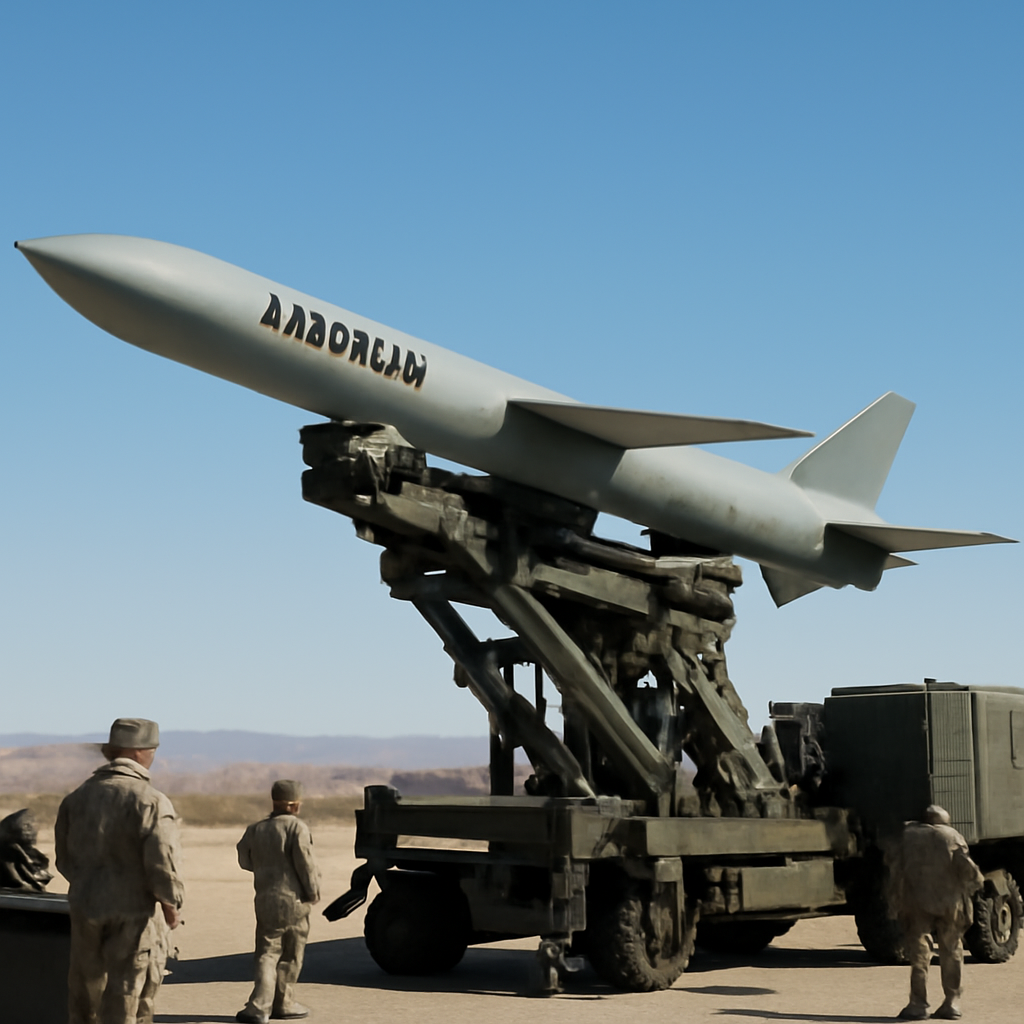
Covenant, a U.S.-Israeli company founded in 2024, has unveiled Anthem, a long‑range precision strike weapon the company calls a "deep precision‑strike munition." Covenant describes Anthem as a lower‑cost, high‑volume alternative to existing cruise missiles, positioning it as a complement rather than a one‑for‑one replacement for more expensive, "exquisite" systems. The company says Anthem can carry a warhead weighing more than 200 kilograms (441 pounds) and uses a solid rocket motor for launch with a heavy‑fuel jet engine, underslung below the missile body, for cruise flight.
Testing, demonstrations, and U.S. Army involvement
Covenant says Anthem has flown more than 200 times over the past year, including testing that involved U.S. government organizations. In August, an unnamed defense‑industry partner ran a live‑fire demonstration at the Africa Multidomain Training and Experimentation Center in Morocco; U.S. Army public material about the event did not name the weapon, though subsequent reporting identified it as Anthem. Covenant also says the system participated in the Army’s Project Convergence Capstone 6 experiments and that the August test helped demonstrate a framework for industry use of the Moroccan range.

This site is the portfolio.
OSINTSights runs on Cloudflare Workers, D1, R2, and Vectorize, with an AI pipeline on Hetzner ARM. Nubivance designed, built, and operates it. We do the same for clients.
See what we buildDesign choices, cost signals, and claimed supply‑chain resilience
Covenant states the system was designed around readily available components and contracts intended to avoid dependence on individual suppliers: it cites multiple solid‑rocket‑motor suppliers and long‑term agreements covering thousands of jet engines. Reuters reported Covenant expects Anthem to eventually cost in the mid‑six‑figure range, though the company has not published a final unit price. Covenant frames the tradeoff plainly: a single Anthem carries substantially less destructive power than larger missiles (the source contrasts Anthem’s warhead to the roughly 1,000‑pound‑class warhead associated with the Tomahawk), but lower unit cost and higher production rates would allow commanders to employ larger numbers of weapons against a given target set.
Production footprint and delivery timelines
Covenant announced a planned production footprint spanning the United States, Germany, and Israel. Its Grand Prairie, Texas, facility covers approximately 105,000 square feet and is slated to begin serial production in the first quarter of 2027 with an eventual stated capacity of 5,000 Anthems per year. The company intends a comparable production rate for a Saxony, Germany, facility and up to 2,000 weapons annually from a smaller Israeli site. That combination yields a stated combined target of up to 12,000 weapons per year if all three plants reach planned capacity. Covenant says it has secured roughly $150 million in orders to date and has raised more than $250 million from investors including Andreessen Horowitz, Founders Fund, Lux Capital, 8VC, Aleph, and Lightspeed.
Maritime Anthem and a Navy contract
Covenant is developing a naval derivative called Maritime Anthem. The company says it holds a roughly $70‑million contract with the Navy’s Rapid Capabilities Office to adapt the system for maritime use and to include Defense Exportability Features intended to make the weapon easier to provide to U.S. allies and partners. Covenant reports its U.S. facility is aimed primarily at American customers while the German operation is being established around a European supply chain; an unidentified international customer is expected to begin receiving German‑built weapons before the end of this year. U.S. Army deliveries are expected in 2027 under an accelerated qualification contract.
What this means for the U.S. Army, European partners, and the U.S. Navy
- U.S. Army: The Army will evaluate Anthem alongside other long‑range strike options under an accelerated qualification contract with deliveries expected in 2027. The service will watch production ramp and test results closely to judge whether Anthem’s production and cost promises translate into operationally useful quantities.
- European partners: Germany is central to Covenant’s European production plan; the company expects German facilities to leverage local manufacturing expertise and to supply an unnamed international customer before year‑end, signaling demand within Europe for higher‑volume strike munitions.
- U.S. Navy and naval planners: The Navy’s Rapid Capabilities Office funded a Maritime Anthem adaptation contract, indicating interest in a maritime variant and exportable design features that could affect naval strike logistics and allied interoperability.
The central, concrete question left by Covenant’s announcement is not whether Anthem can fly—Covenant reports more than 200 flights and has run visible demonstrations—but whether the company can convert those developmental flights into sustained mass production. Turning a planned combined capacity of as many as 12,000 weapons per year into reliable deliveries requires resilient supply chains, propulsion production, test capacity, quality control, and additional contracts from domestic and allied customers. Covenant’s timelines and financing set the stage for a rapid industrial sprint: serial production at Grand Prairie is slated to start in Q1 2027, U.S. Army deliveries are expected in 2027, German‑built weapons are expected to begin flowing to an international customer before the end of 2026, and a Navy‑funded Maritime Anthem effort is underway under a roughly $70‑million contract.
For now, Anthem is an explicit bet on quantity over single‑round capability: a lighter warhead, simpler launch approach, and advertised supply‑chain redundancy intended to produce munitions at scale. Whether that bet pays off for customers and warfighters — and how adversaries and planners will respond — will hinge on Covenant’s ability to meet its production promises and the real‑world performance of Anthem when fielded.