"We’re focused on any vehicle in the motorpool. I want to try to integrate future capability of high-energy lasers into it," Brig. Gen. Guy Yelverton said at the Association of the U.S. Army convention, summing up the Army's push to make laser weapons a broadly available capability rather than a niche asset.
Enduring-High Energy Laser (E-HEL): modularity as strategy
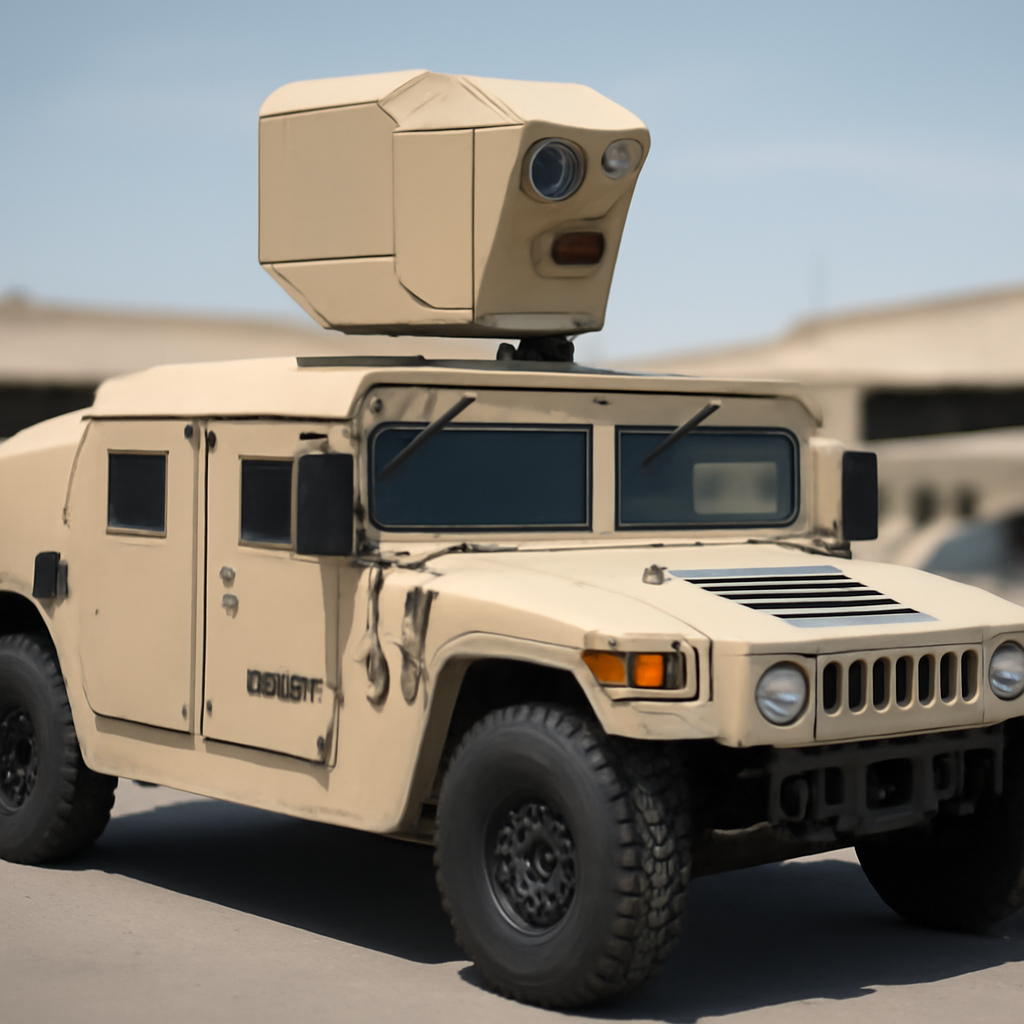
The Army’s Enduring-High Energy Laser (E-HEL) effort is explicitly framed around modularity and scalability: the service wants laser systems that can be fitted to "any vehicle in the motorpool," moved between platforms, and fielded across different formations. E-HEL hardware is being developed with a sled-based approach so a single turreted laser package can be integrated onto a variety of hosts, and the service is emphasizing an open, modular architecture to allow future upgrades and component swaps.
LOCUST X3 and recent contracting
In September the Army awarded AeroVironment the first production contract under E-HEL for the company’s 30-kilowatt-class LOCUST X3 laser directed energy weapon. LOCUST variants previously acquired through experimental programs include vehicle-mounted versions (on 4×4 Joint Light Tactical Vehicles and Infantry Squad Vehicles), palletized configurations, and systems now reported as deployed at forward locations and along the U.S.–Mexico border.
The LOCUST design centers on a turreted beam projector with integrated electro-optical and infrared video cameras for acquisition and tracking. Host-vehicle sensors — such as small-form-factor high-frequency radars and passive radio-frequency detectors — and off-board radars can be used to cue the turret. At 30 kilowatts, LOCUST X3 remains at the lower end of the laser power spectrum and is intended explicitly for countering small uncrewed aerial systems (UAS).

Audit-ready is a season. It shouldn't be.
Evidence in spreadsheets, controls drifting between audits, frameworks multiplying on flat headcount. Nubivance runs continuous compliance on Rapid7 Cyber GRC - SOC 2, HIPAA, ISO 27001, PCI, CMMC.
End the scrambleTechnical limits: power, cooling, single-target engagement and environment
Army engineers and acquisition officials at the panel laid out technical constraints plainly. A single laser can engage only one target at a time, beams attenuate with distance, and weather, smoke and dust reduce effectiveness. Those realities drive demand for greater power and cooling capacity and improvements in optics. Brig. Gen. Yelverton noted the dependence on a system's "magazine" of stored energy, citing battery-limited engagement windows — roughly "around 80 seconds, 120 seconds" depending on the system — after which the weapon must recharge.
Kirk Williams, Chief Engineer at the Army’s Directed Energy Project Office, said the focus now is on making systems reliable, maintainable and repairable in battlefield conditions, while also reducing size, weight and power so systems can be effective on small platforms such as the ISV. Williams also flagged adaptive optics and better tracking — including improved aim-point control — as essential to "get enough energy on the target to kill it as quickly as possible and move on to the next threat." He and others highlighted artificial intelligence–assisted targeting and networking multiple systems together to sort and assign targets more efficiently.
Mobility, installation options, and operational use
Mobility and flexible installation methods are central to the Army’s operational pitch. LOCUST units have been shown slung under helicopters, mounted on light vehicles like JLTVs and ISVs, and set in palletized or containerized packages for point defense ashore or afloat — the U.S. Navy has tested a containerized LOCUST for shipboard use. Brig. Gen. Yelverton envisions E-HEL capability distributed not only within air and missile defense organizations but across different formation types and military occupational specialties, widening the pool of potential operators.
Operational experience is already being used to inform development. The Army says laser systems positioned along the border with Mexico have downed real targets, and imagery released by the Army shows a reported engagement on August 25, 2026. The service expects initial LOCUST X3 systems acquired through E-HEL to reach operational service by early 2028.
What this means for Army formations, industry, and U.S. military partners and competitors
- Army formations and soldiers: The intent to make E-HEL MOS-agnostic and vehicle-agnostic aims to broaden who can operate lasers in the field; commanders will face decisions about where to allocate limited high-energy systems and how to train maintainers for new repair requirements.
- Industry and contractors: The modular, open-architecture requirement creates incentives for vendors to offer swappable components and upgrade paths; AeroVironment's LOCUST X3 contract and nLIGHT’s collaboration on scaling power signal demand for supply-chain capacity and cost competition.
- U.S. military partners and competitors: The Army is pursuing E-HEL alongside joint efforts such as the Joint Laser Weapon System (JLWS) program — JLWS aims for a containerized 150-kilowatt-class laser with plans toward 300- and 500-kilowatt designs — while nLIGHT's CEO, Scott Keeney, has spoken of one-megawatt-class scaling on the horizon. The Army panel explicitly noted activity by other countries in ground- and ship-based directed energy development, underscoring strategic competition in this domain.
The Army’s drive to "operationalize" lasers is now a careful balancing act between the promise of low-cost, magazine-rich intercepts and the engineering realities of power, cooling, pointing, and environmental sensitivity. E-HEL and LOCUST X3 represent a deliberate, modular step: if the Army can shrink, ruggedize, and make these systems repairable, they can spread a new kind of air defense across formations. If not, the service risks another round of promising prototypes that never fully move into everyday use.