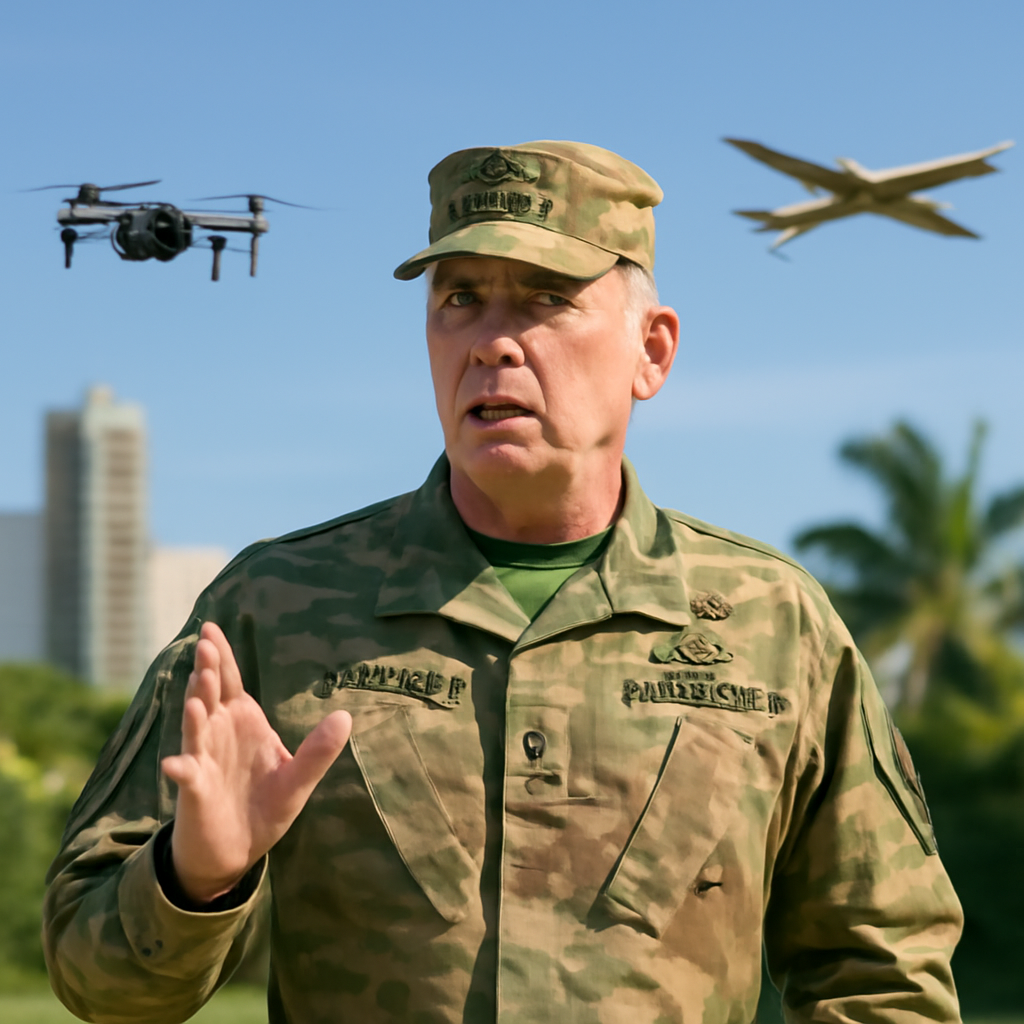
“In today’s fight, we should never send a soldier when we can send an unmanned system,” Gen. Ron Clark said as two drones circled above him at AUSA’s Land Forces Pacific symposium in Waikiki, Hawaii.
Gen. Ron Clark and The Forge Kestrel
Clark, identified in the forum as the USARPAC commander, used the moment to underline how rapidly uncrewed platforms have moved from concept to routine. He pointed to a first-person-view quadcopter called the Kestrel and said, “This drone, the Kestrel, was produced by our soldiers at The Forge,” noting that it can be adapted to drop munitions or used for one-way attack. A second unmanned aircraft hovering nearby, a Skydio X10, was described as “used for short-range reconnaissance and surveillance.”
“For us, innovation is not something we simply talk about, it’s what we put into action every day,” Clark added, framing those in-house and commercial systems as active parts of training and operations rather than theoretical tools.
25th Infantry Division’s simulated amphibious fight
The ubiquity of unmanned systems showed up not only on stage but on the range: the 25th Infantry Division recently used uncrewed vehicles, vessels, and aircraft to fight a simulated battle on a Philippine beach. The example was cited at the symposium to illustrate how units are integrating ground, surface, and air unmanned systems into maneuver and fires exercises.

Audit-ready is a season. It shouldn't be.
Evidence in spreadsheets, controls drifting between audits, frameworks multiplying on flat headcount. Nubivance runs continuous compliance on Rapid7 Cyber GRC - SOC 2, HIPAA, ISO 27001, PCI, CMMC.
End the scrambleLt. Gen. Matthew McFarlane on passive defense
Not all discussion was celebratory. I Corps commander Lt. Gen. Matthew McFarlane, speaking to a small group of reporters, emphasized the defensive challenges created by “the absolute proliferation of drones.” He argued that passive defense measures are rising in importance and highlighted concrete steps: “That includes things like putting command posts underground, or covering them so they are not easily detectable from the air,” McFarlane said. “We’re very conscious of making sure we’re protecting ourselves from the real air threat that we’re seeing around the world.”
Adm. Samuel Paparo on commoditization and “cheap kill”
Adm. Samuel Paparo, the Indo‑Pacific Command leader, placed small unmanned systems within a broader strategic trend he called one of three “meta-trends” reshaping warfare: “the commoditization—and by commoditization, I mean everybody has it—of small, cheap unmanned systems.” He said commoditization has “expanded access to core capabilities once reserved for great powers,” and warned that proliferated unmanned systems “have made cheap kill, at scale more possible, more probable.”
Paparo linked those dynamics to higher costs for traditional assaults, saying commoditization “Has made a traditional assault—ground assault, air assault, airborne assault, amphibious assault—much more costly than is in our formal doctrine.” He pointed to the war in Ukraine as a laboratory for these effects, asserting that Russians lose “approximately 100 human beings per square kilometer of ground that they take and that then they subsequently lose.”
Gen. Xavier Brunson: don’t stop at drones — think commercial space
Other senior commanders urged a broader horizon. Gen. Xavier Brunson, commander of United Nations Command, Combined Forces Command, and United States Forces Korea, pushed back against the idea that the chief lesson from Ukraine is only “drones, drones, drones, drones.” “I beg to differ,” Brunson said. He warned against applying Occam’s razor to strategic problems and urged planners to look beyond surface solutions.
Brunson proposed commercial space as “the next thing,” arguing that fixation on the obvious can leave the force stuck: “We have to keep going forward. Warfare, if nothing, is about offset, and what I continue to think about when I’m awake at night in the bed is, what is the next offset? Because if we don’t think about that, if we don’t give ourselves to the thought of the next offset, we’ll be doing drones 10 years from now, and thinking that’s still the way.” He added that he is “not against…the development of drones,” but warned that stopping there would risk strategic complacency.
How soldiers, commanders, and the defense industry are responding
- Soldiers and units: The 25th Infantry Division’s Philippine-beach exercise and the soldier-produced Kestrel indicate frontline units are adopting both commercial and in‑house unmanned systems for maneuver, reconnaissance, and attack roles.
- Commanders and planners: Leaders such as Clark, McFarlane, Paparo, and Brunson are balancing offensive exploitation of drones with investment in passive defense—covering or subsurface command posts—and strategic planning that looks beyond current unmanned capabilities to commercial space as a potential “next offset.”
- Defense industry and in-house innovators: The visibility of a Skydio X10 alongside a soldier-built Kestrel highlights parallel paths—commercial capability integration and grassroots, unit-level innovation—that industry and services alike must reckon with in procurement and doctrine.
The scene in Waikiki — commanders under buzzing drones, a division testing unmanned vessels and aircraft on a simulated Philippine beach, and senior leaders arguing for both defensive hardening and forward-looking offsets — captures a service at an inflection point. The Army’s appetite for unmanned systems is clear; so is the caution from commanders who say the real test will be whether doctrine, defenses, and thinking about commercial space keep pace with what they call the commoditization of cheap kill.