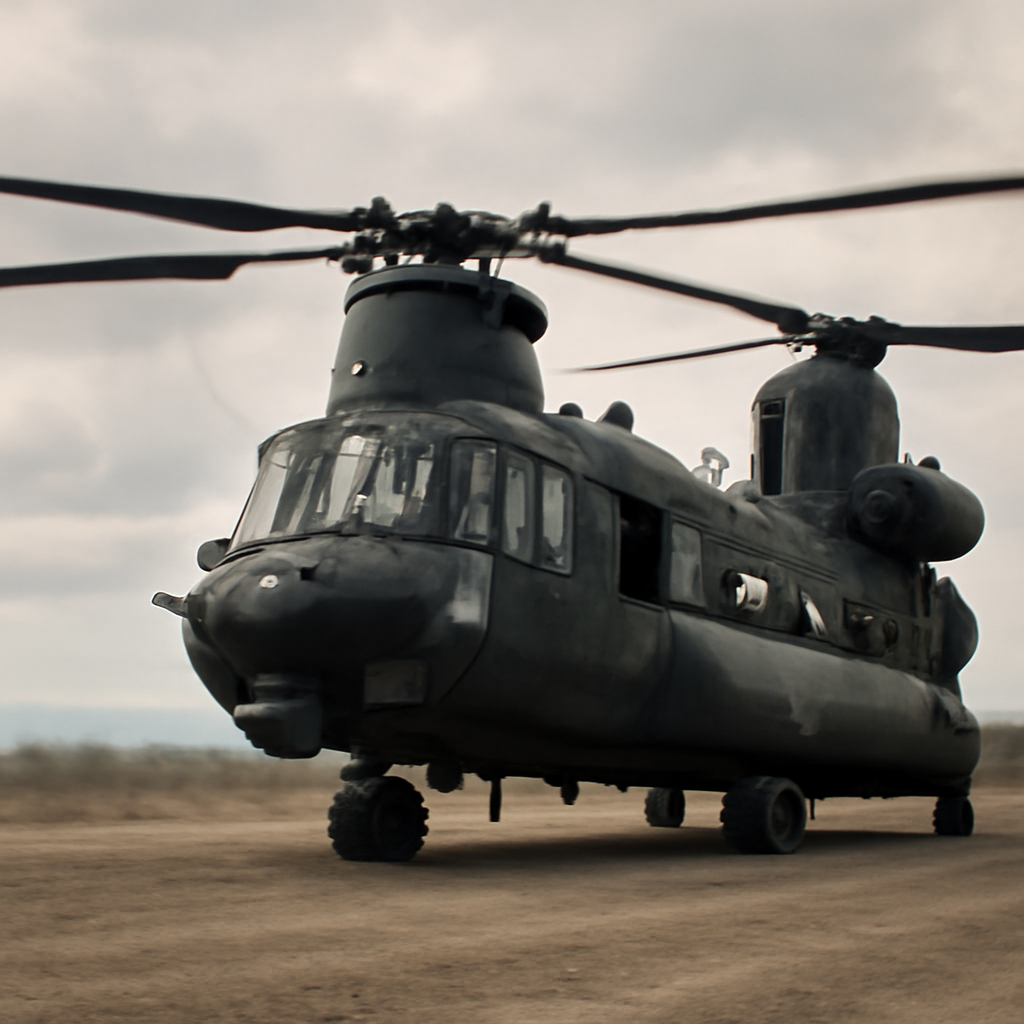
"There might be cases where I want to fill that aircraft with as much fuel as possible, and maybe that MH-47 becomes a flying FARP, and I put it somewhere, and we refuel other aircraft off of them," Dr. Steve Smith told attendees at the annual SOF Week conference.
Dr. Steve Smith on an MH-47 as a "flying FARP"
Dr. Steve Smith, SOCOM’s program executive officer for Rotary Wing, raised the prospect of converting the MH-47G Chinook into an aerial-refueling tanker during public remarks at SOF Week. He described the idea as a possible extension of the Chinook’s existing forward arming and refueling point (FARP) role — currently performed on the ground in the so-called "Fat Cow" configuration — into an airborne capability that could refuel other rotorcraft without landing.
Smith emphasized modularity as an enabling concept: “Anything that we do going forward, we’re going to try to make it as modular as possible. We want to go plug things in when we need them, unplug them, and take them off the aircraft when we don’t need them.” He added that aerial refueling could be implemented in a modular, palletized form that could be rapidly added or removed to conserve allowable combat load when refueling gear is not required.
SOCOM's Block III planning and timelines
SOCOM is beginning to draft requirements for a Block III iteration of the MH-47G, with the Block III expected to come online starting around 2032. Sean Godfrey, product manager for the MH-47 at Army Special Operations Aviation Command, described the current fleet as “Block II” and said “we do not currently have what the Block III looks like, but that aircraft’s not going anywhere. It’s going to have to get upgraded over time.”
Smith and Godfrey framed Block III planning around three priorities: increasing range, increasing payload, and increasing modularity to rapidly reconfigure aircraft to meet mission requirements. They noted trade-offs among range, payload, speed, and flight-hour costs, and stressed that future changes must balance those competing demands.

Audit-ready is a season. It shouldn't be.
Evidence in spreadsheets, controls drifting between audits, frameworks multiplying on flat headcount. Nubivance runs continuous compliance on Rapid7 Cyber GRC - SOC 2, HIPAA, ISO 27001, PCI, CMMC.
End the scrambleModularity, recapitalization, and sustainment — Sean Godfrey
Godfrey outlined how special-operations Chinooks are modernized today: selecting legacy airframes, removing mission and software equipment, and shipping aircraft to Delaware for tear-down and recapitalization before returning to the Boeing production line. After a multi-year process the recapitalized airframe is repainted, mission equipment is fitted, and the aircraft is delivered to the unit.
That same process, the speakers said, could govern how a Block III MH-47 is fielded. Modularity is central to the concept: removing protection systems or certain navigation systems in permissive environments to free up allowable combat load; or adding palletized fuel tanks or airborne-refueling kits for missions that prioritize range over protection.
How the MH-47 tanker idea sits alongside MC-130/HC-130, MV-75A, and MQ-25
- SOCOM currently relies on Air Force MC-130 and HC-130 fleets for organic air-to-air refueling support; an aerial-refueling-capable MH-47 would give SOCOM an internal tanker option instead of depending entirely on those external assets.
- The Army’s forthcoming MV-75A Cheyenne II tiltrotors will be delivered with the capacity to have a probe fitted, the Army has confirmed. Bell, the MV-75’s prime contractor, and the Army have suggested tanker drones such as the Navy’s MQ-25 Stingray could help extend the Cheyenne II’s reach.
- SOCOM officials noted that an adapted MH-47 would offer a different performance profile than other tanking options, and that whether a palletized or modular aerial-refueling capacity comes to the Chinook “remains to be seen.”
What this means for SOCOM, the Army, and the Air Force
- SOCOM: An MH-47 tanker would reduce dependence on external tanker sorties, potentially allowing faster sortie generation and fewer high-risk FARP ground operations in contested environments.
- The Army (including MV-75A planning): The Army confirmed MV-75As will be able to accept probes, and Army/Bell discussions about tanker drones indicate the service is weighing multiple pathways to extend tiltrotor range; SOCOM’s modular approach could inform cross-service equipment commonality if funding and requirements are approved.
- The Air Force: If SOCOM fields organic MH-47 tankers, the Air Force’s MC-130/HC-130 tanker support posture could be complemented — or in some scenarios substituted — by SOCOM assets, changing operational planning for joint refueling support.
Operational statements at SOF Week made clear the idea is exploratory. Smith described the aerial-tanker concept as one of several possibilities being “thrown up against a wall,” and Godfrey stressed Block III is still in requirements development. Key, concrete constraints noted by SOCOM are funding and formal requirements: at present there is no appropriated funding or formal requirement to port MV-75A mission equipment to MH-47s or other fleets.
The MH-47 already uses probe-and-drogue in-flight refueling and carries enlarged sponson fuel tanks that make it the 160th’s longest-range helicopter; whether that existing foundation will be turned into a palletized or modular tanker capability will depend on the Block III concept definition, funding decisions, and the trade-offs between fuel, protection, and payload that SOCOM leaders highlighted.
Source: The War Zone — Night Stalker MH-47 Chinooks May Get Aerial Refueling Tanker Role