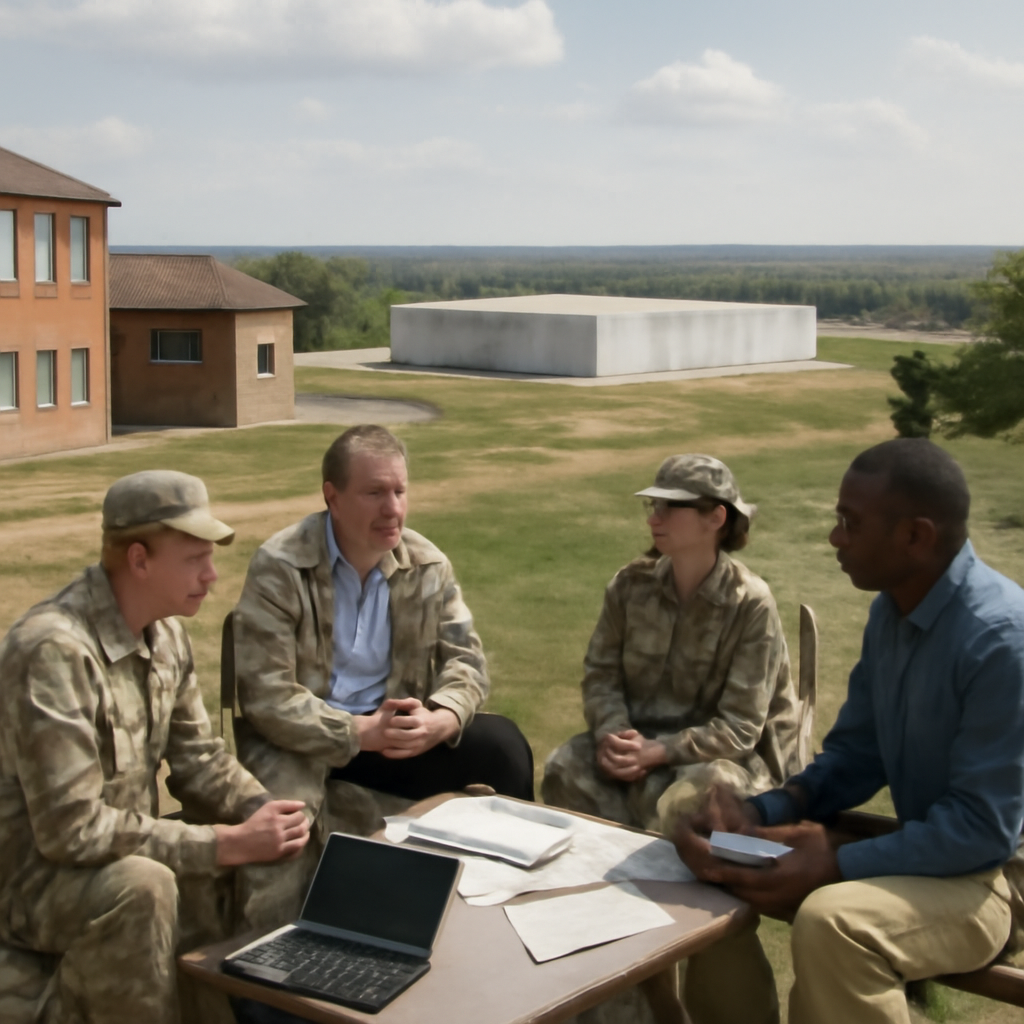
"So I think the difference between us, the Army, doing a data center, and say Meta or Google, is we're part of the communities that are there, and we are going to engage with them on a routine and regular basis to look for solutions that work for everyone, right?” said Col. John Oliver, describing how the service plans to proceed as it studies proposals to site data centers on Army posts.
Where the Army is looking to build: four installations under study
The Army received more than 200 responses to a March request for private‑industry ideas; officials narrowed the pool to about 120 proposals judged executable, and among those were plans to build data centers on four Army installations: Fort Bliss, Texas; Dugway Proving Ground, Utah; Fort Hood, Texas; and Fort Bragg, North Carolina, the service says. Carlisle — the company that has proposed funding the Fort Bliss site — is working with the Army on that option, which would sit on nearly 1,400 unused acres.
Power and water: explicit constraints set by the Army
Officials told Defense One the Army is requiring proposed centers to include a power plan that "does not draw on the local energy grid" and to achieve net‑zero water usage. Col. John Oliver said the solicitation must include those elements as the service attempts to head off community concerns about electricity demand and water consumption.
Oliver described one suggested solution at Fort Bliss: encouraging Carlisle to drill a new well to feed the company’s desalination plant so that the project could offset the water used to cool a data center and “actually make it net‑positive.” He cautioned the Army does not yet know whether that is an engineering solution it can reach but said the service is actively working toward it.
The Army also plans to leverage energy resilience work already under way on installations — microgrids built or planned for dozens of posts — when planning data‑center power. And it intends to issue a June 15 request for proposals for power‑generation ideas that could include geothermal, small modular nuclear, gas turbines, or other approaches, Oliver said: “We’re not looking for a specific type of power.”

This site is the portfolio.
OSINTSights runs on Cloudflare Workers, D1, R2, and Vectorize, with an AI pipeline on Hetzner ARM. Nubivance designed, built, and operates it. We do the same for clients.
See what we buildCommunity engagement and noise, as framed by the Army and outside experts
Recognizing that community pushback has become a recurring public story, Army officials have been meeting with local residents and utilities. Six weeks ago the deputy undersecretary visited Fort Bliss for a listening session with the 1st Armored Division commander, community members, El Paso Water, El Paso Electric, and Carlisle, according to Defense One.
Darrell M. West, a Brookings Institution senior fellow quoted in the story, said transparency on energy sources, water use, costs and noise can determine whether communities accept data centers. “People want to know up‑front, you know, where the energy is coming from, how much water is being used, how much the overall cost is going to be, and what the noise levels are,” West said. The Army notes it has some siting advantages: installations often have vast tracts of land set apart from neighborhoods, and Dugway is about an hour’s drive from the nearest community, a fact officials cite when discussing noise concerns.
Strategic Capital Initiative: other early projects and new partners
The data centers are one strand of the Army’s Strategic Capital Initiative (SCI). Army Secretary Dan Driscoll told reporters on May 28 that the service started with more than 200 responses to its RFI and winnowed them to about 120 executable proposals, with roughly 20 projects in various stages of execution.
More than 95 percent of respondents were vendors the Army had not previously worked with, Oliver said, and included firms such as FedEx and private capital partners like Apollo, along with mineral processing and manufacturing companies and consortiums organized by industry. Early approved proposals include: a turboshaft engine modernization plant at Corpus Christi Army Depot, Texas; an additive energetics load and assembly packing facility at McAlister Army Ammunition Plant, Oklahoma; a heavy‑duty forklift servicing hub at Red River Army Depot, Texas; and public‑private partnerships at Pine Bluff, Arkansas, for energetics and explosives manufacturing. Three weeks ago the Army issued an RFP on critical mineral refinement.
What this means for local communities, the organic industrial base, and Army energy planners
- Local communities: Residents and local utilities will scrutinize where data‑center power will come from and how water use will be mitigated; the Army has begun in‑person listening sessions and is demanding off‑grid power plans and net‑zero water from proposers.
- Organic industrial base (depots and ammunition plants): The SCI is already directing investments toward depot modernization and new manufacturing capacity — projects that promise construction work and longer‑term production roles at installations named in the RFI responses.
- Army energy planners: The service will need to evaluate whether proposed on‑post generation (from geothermal to small modular nuclear to gas turbines) and site‑specific water solutions such as new wells and desalination can deliver the required resilience without creating new local strains; a June 15 RFP for power ideas is a near‑term test of those options.
The Army has moved deliberately from a wide open call for ideas toward specific asks: net‑zero water, off‑grid power plans, and a June power RFP. The service has begun pilot modernization projects at depots and is studying multiple data‑center sites, but key technical questions remain on the table — notably whether proposals such as a Carlisle‑driven well and desalination approach can be engineered to be net‑positive, and whether proposed on‑post power systems will meet operational and community resilience goals. The Army’s next steps — and the responses to its June 15 power RFP — will determine whether its approach to data centers becomes a model for resolving the tensions that have marked other civilian projects, or another test of how military scale and local concerns can be reconciled.
Source: Defense One — The Army wants to build a better data center. Can they do it?