8th Theater Sustainment Command’s Pacific posture
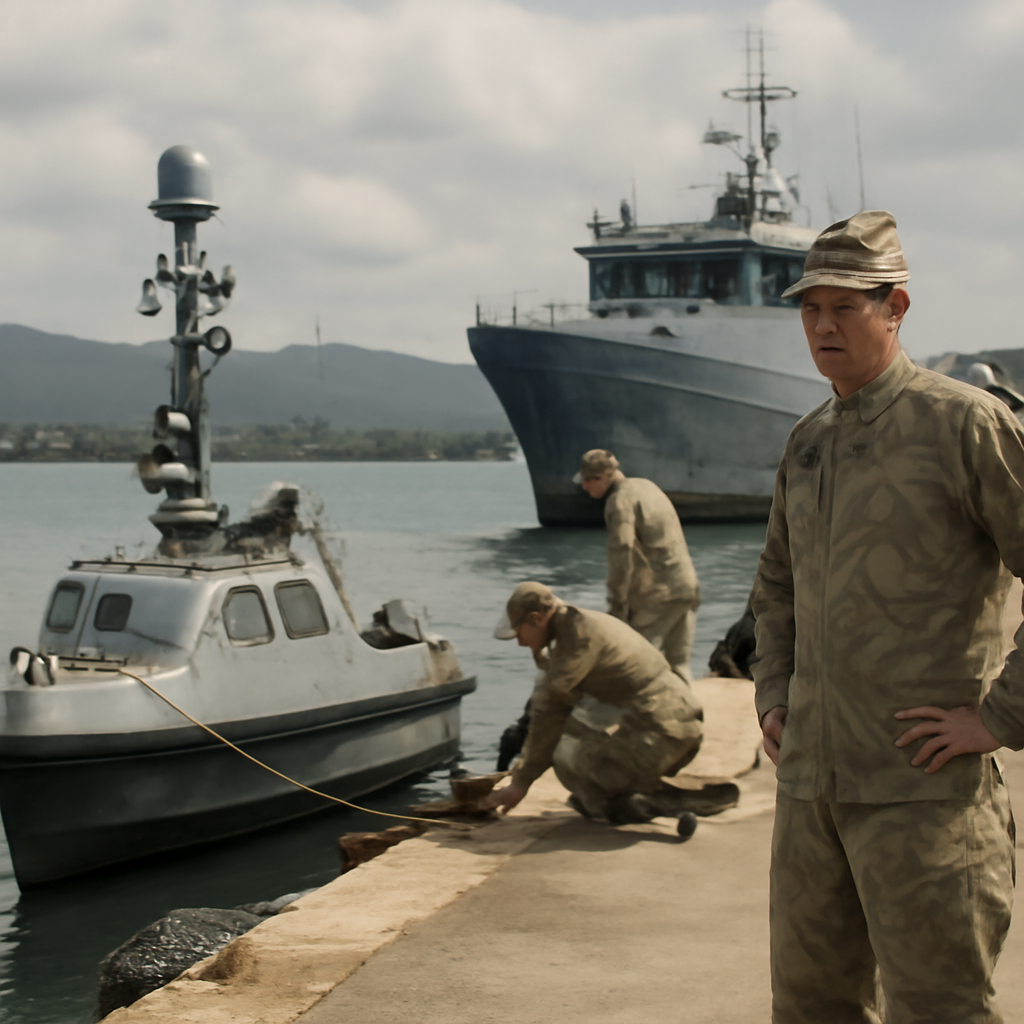
8th Theater Sustainment Command (8th TSC), headquartered at Fort Shafter in Hawaii, is driving the effort to make Army watercraft more autonomous. The command manages much of U.S. military logistics across the Pacific and has forward-deployed elements in Japan, including the 5th Transportation Company organized as a composite watercraft company. According to the Government Accountability Office, as of 2024 that unit held a pair of General Frank S. Besson class Logistics Support Vessels (LSV), 10 Landing Craft Utility (LCU)-type vessels, and four small tugs. The Army owns eight LSVs in total; the two youngest, acquired in the mid-2000s, are optimized for long-distance open-ocean operations.
Earlier this month the Army reflagged the 10th Support Group (Regional) into the 45th Sustainment Brigade. As Maj. Gen. Crist explained at AUSA, the force design includes the standup of a second composite watercraft company in Yokohama North Dock on Honshu, yielding an end state with two composite watercraft companies west of the International Date Line under the 45th Sustainment Brigade’s command and control.
HOS Resolution and the Sea Machines SM300 retrofit
In August, U.S. Army Pacific experimented by retrofitting a commercial vessel—the HOS Resolution—with Sea Machines’ SM300 autonomy software. Sea Machines integrated the package in nine days for the demonstration. The HOS Resolution is a 257-foot offshore support vessel often used in oil-and-gas work; it has a stern ramp and four jack-up legs that make it suitable for loading and unloading at remote beaches. In Army demonstrations the ship moved vehicles and cargo and was shown with an Army truck driving off the ramp while fitted with the autonomy kit.
Maj. Gen. Crist characterized that retrofit as a potential stepping stone: adding navigation autonomy to reduce crew workload and safety risk, then progressing to autonomy for propulsion and engine-room functions, and ultimately to fully uncrewed operations where desired.

This site is the portfolio.
OSINTSights runs on Cloudflare Workers, D1, R2, and Vectorize, with an AI pipeline on Hetzner ARM. Nubivance designed, built, and operates it. We do the same for clients.
See what we buildUSV experimentation: Magura, Saronic Corsair, Rampage
The Army has tested a range of smaller uncrewed surface vessels (USVs) in exercises this year. The 7th Infantry Division experimented with a Ukrainian-developed Magura-series USV during Exercise Bayonet Quest 2026 in Michigan; that Magura was configured to launch a quadcopter-type drone. A Magura-series craft was also observed in a one-way-attack configuration used by U.S. Army Special Forces during Balikatan in the Philippines.
U.S.-designed USVs have also featured in drills. A Saronic Corsair appeared in the Michigan exercise; the same Corsair type was used by the Navy to rescue the crew of an Army AH-64 Apache helicopter in the Gulf of Oman in June. The source notes that explosive-laden Corsairs carried out the first known U.S. kamikaze USV attack against a coastal target in Iran in July.
During Salaknib 2026 in the Philippines, Army forces used unarmed Rampage USVs from U.S. firm Havoc to escort a crewed General Frank S. Besson class LSV, with the USVs operating ahead of the landing craft to spot hazards.
What this means for the 5th Transportation Company, USTRANSCOM, and commercial operators
- 5th Transportation Company: The unit’s current mix of LSVs, LCUs, and tugs provides a platform set that can be augmented by autonomy retrofits and new Maneuver Support Vessel (Light) landing craft. Reduced manning from autonomous navigation could ease manpower pressures on a small force already described as underappreciated.
- USTRANSCOM (U.S. Transportation Command): Maj. Gen. Crist said the Army plans to leverage USTRANSCOM’s contracting capability to access commercially owned and operated operational support vessels—potentially manned by Army mariners—creating a “broad portfolio of systems of systems.”
- Commercial operators and vendors: The Army’s earlier experiments and its interest in purpose-built USVs create demand signals for autonomy kits and larger drone boats. Maj. Gen. Gavin Gardner earlier this year advocated rapidly acquiring as many as 100 drone boats, including larger USVs able to carry eight to 10 standardized shipping containers and be forward-berthed across partner ports in the theater.
Parallels, force structure choices, and next steps
The Army’s autonomous-watercraft push comes amid broader service and Pentagon activity. The piece notes that the Navy retrofitted the USNS Apalachicola with autonomous features before its 2023 commissioning but placed the ship into service without an operational plan to use those features; the Navy struck the four oldest Spearhead-class ships from the rolls last year and shifted several others to reduced operating status while continuing to acquire new Expeditionary Fast Transports, including Expeditionary Medical Ship variants. In September, Secretary Pete Hegseth announced initiatives to expand uncrewed platforms across the U.S. military, and the Pentagon is laying groundwork for an Autonomous Warfare Command (AUTOWARCOM) it hopes to stand up next year.
The Army is pursuing both retrofit and new-build paths: demonstrations like the HOS Resolution-SM300 integration, small-boat experiments with Magura, Corsair, and Rampage, and a stated buying vision that could include up to 100 drone boats. The practical questions the Army will face next are concrete and technical—how to scale autonomy kits across existing hulls, how to operate mixed fleets of crewed, optionally-crewed, and uncrewed vessels across partner ports from Korea to Australia, and how to combine USTRANSCOM-sourced commercial shipping with Army mariners. Those answers will determine whether the modest, often overlooked “Army Navy” becomes a more autonomous backbone for Pacific logistics—or remains a laboratory full of demonstrations.