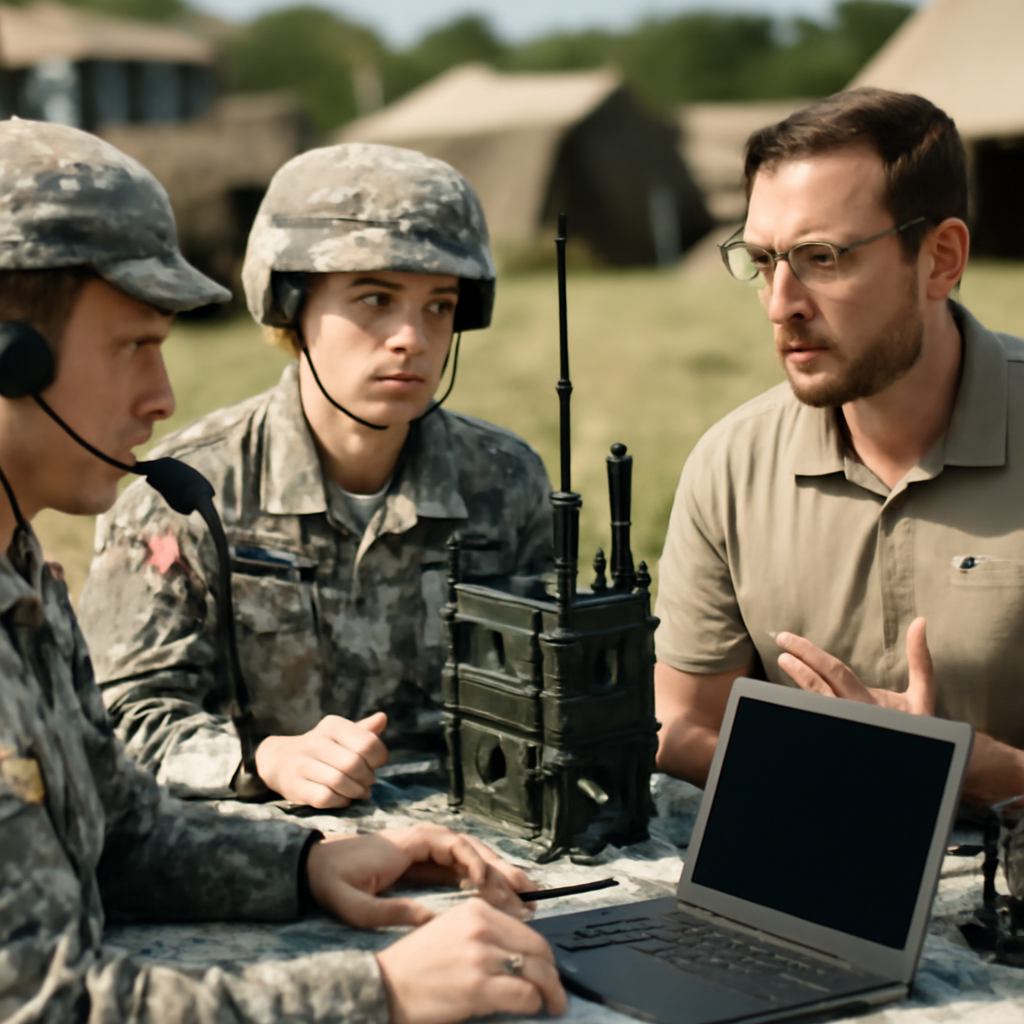
"We don’t want to have to interact with the screen. We want to just talk into the microphone and have the system understand the commands," soldiers at Schofield Barracks told Lockheed Martin engineers, according to Chandra Marshall.
Chandra Marshall on NGC2’s mission-centric shift
Chandra Marshall, vice president and general manager for Multi-Domain Combat Solutions at Lockheed Martin, framed Next Generation Command and Control (NGC2) as a move to a mission-centric, composable architecture. NGC2 is intended to replace platform-specific systems and long development cycles with a Modular Open Systems Approach (MOSA) and common applications and core services so new software, sensors, and weapons can be inserted quickly without rework. Marshall said the architecture is designed to break down silos and stovepipes across all echelons of the Army and to use AI to compress decision timelines "from minutes to seconds."
Lightning Surge demonstrations: sensors, fires, airspace, and cross-domain sharing
The 25th Infantry Division (ID) in Hawaii has served as an operational test bed, running a series of Lightning Surge exercises that put the open architecture into use. Lightning Surge 1 and 2 established foundations; Lightning Surge 3 and 4 demonstrated the architecture in action. Marshall described Lightning Surge 3 as the exercise that "fused sensors, fires systems, and airspace into a single cloud enabled picture," enabling a real-time view of the battlefield and compressing sensor-to-shooter timelines. That effort spanned locations including the 25th ID in Hawaii, the Philippines, and across PACOM, and Marshall characterized the Lightning Surge 3 activity as the first demonstration of cross-domain data sharing in the 25th ID environment across multiple locations.

Audit-ready is a season. It shouldn't be.
Evidence in spreadsheets, controls drifting between audits, frameworks multiplying on flat headcount. Nubivance runs continuous compliance on Rapid7 Cyber GRC - SOC 2, HIPAA, ISO 27001, PCI, CMMC.
End the scrambleFrom soldier feedback to fielded change: the AI-driven hand mic
Marshall emphasized rapid iteration based on soldier feedback. During Lightning Surge 4, troops requested hands-free interaction; within days Lockheed Martin and partners delivered an "AI-driven hand mic" integrated with an Army edge device so soldiers could speak commands rather than touch a screen. Marshall said the Army provided objectives rather than a strict requirements list, enabling teams to make software changes "within minutes, hours, days, depending on the complexity of the feature." She framed Lightning Surges as delivering "operational fight-tonight capability" rather than prototypes, and noted that in under 10 months, with an "efficient budget," the team delivered NGC2 solutions the 25th ID used operationally across PACOM and exercised during Balikatan.
Open architecture, MOSA, and supplier on- and offboarding
Lockheed Martin serves as the Full Stack Operational Implementation Lead for the Army’s 25th ID and described a strict onboarding and offboarding process for vendors. Marshall said the open architecture makes it easy to switch out components if they are not the best fit, contrasting that with traditional, hard-to-remove suppliers in single-winner programs. She said the Army’s NGC2 effort brings together a broad spectrum of small businesses, non-traditional innovators, and commercial technology, and that more than 60 companies "have contributed or are under analysis" for the NGC2 ecosystem.
Named components and partners in the 25th ID implementation
- The data platform for the 25th ID was based on the Raft Data Platform ([R]DP) product.
- Amazon Web Services provided cloud tooling and the team used Wickr Chat for cyber collaboration.
- Rune Technologies delivered TyrOS for contested logistics.
- Striveworks supplied Stag, which assists with the fires mission and AI modules or models.
What this means for Lockheed Martin, the 25th Infantry Division, and small technology vendors
- Lockheed Martin: as the Full Stack Operational Implementation Lead, the company is positioned to orchestrate architecture integration, rapid software updates, and vendor swaps under the MOSA approach.
- 25th Infantry Division: the division is functioning as an operational test bed, using delivered NGC2 capabilities across PACOM and in exercises such as Balikatan to validate cross-domain data sharing and compressed sensor-to-shooter timelines.
- Small tech vendors and non‑traditional innovators: the open architecture and strict onboarding/offboarding process create opportunities to plug into the NGC2 ecosystem, with the stated possibility of being replaced if a component is not the best fit.
Marshall’s closing point was that NGC2 is "all about speed and quality" — a modular, future-ready ecosystem that already demonstrates AI decision aids and that the team plans to extend beyond the 25th ID into other divisions. The next steps Marshall cited are additional Lightning Surge events in support of the 25th and potential extension of the developed capability to other Army divisions.
Original reporting: https://breakingdefense.com/2026/08/island-surge-the-armys-next-generation-command-and-control-in-action/