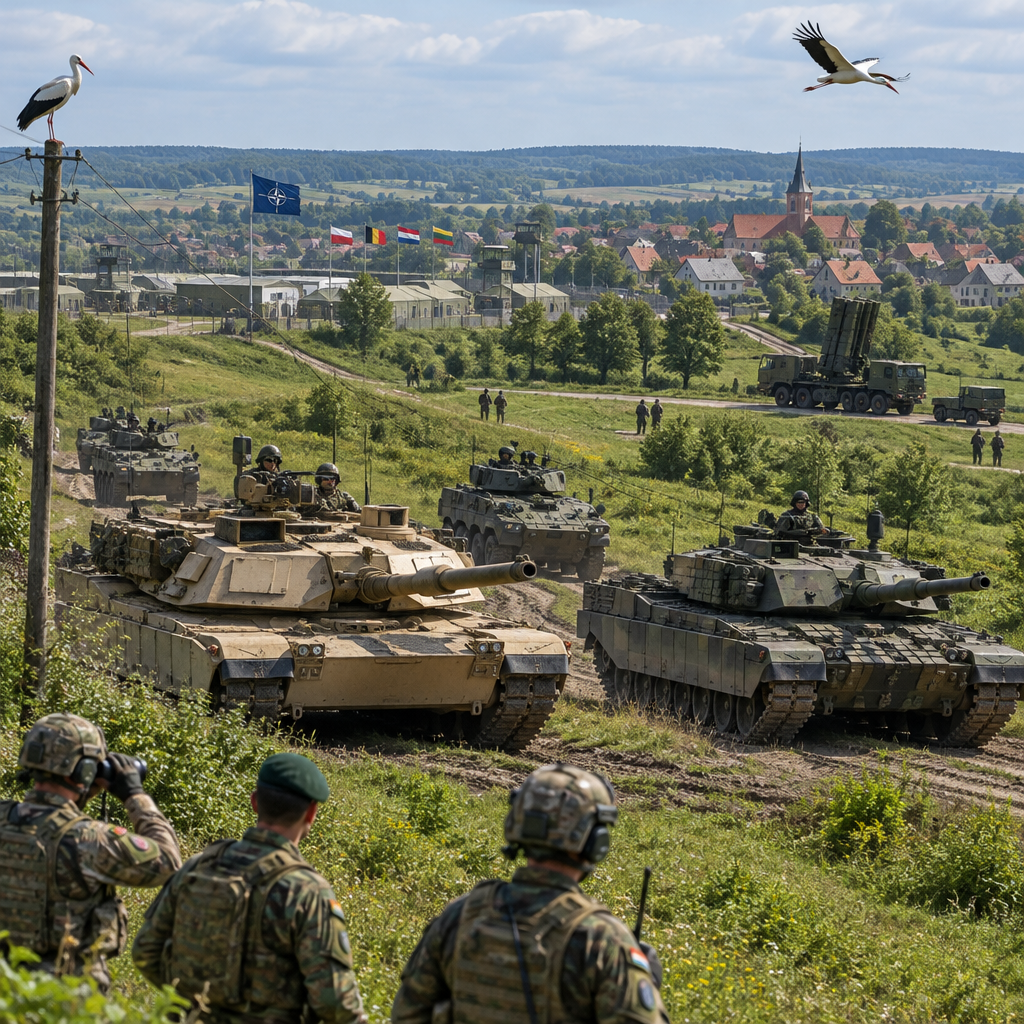
"The national bird of Lithuania is Ciconia ciconia, better known as the white stork," U.S. Army Lt. Col. Michael Wynn said into his mic.
How Operation Baltic Protector fused steel, software, and sensors
In the Useful Fiction scenario, a NATO armored battlegroup launched the vanguard of Operation Baltic Protector to retake territory claimed by a newly proclaimed Rus-Republic of Lithuania (RRL). The Article V vote was "quick and unanimous," and the multinational task force — including Croat, Romanian, and British units hubbed from a joint NATO-Polish base in Elblag, Poland — pushed across marked digital lines (ORACLE, TROPICANA, BUSCH, FENWAY) to seize a mobile S-1000 air-defense system that had turned Lithuanian airspace into an anti-access/area-denial bubble.
Lt. Col. Michael Wynn and HQ66: a tank crew in a networked fight
Wynn rode in an M1A3 Abrams designated HQ66 beneath an unmanned turret, using augmented-reality (AR) goggles and battle-management software to fuse feeds from vehicles, drones, and infantry. His crew — driver Cpl. Arnold Glover and gunner Sgt. Margaret Butarski — monitored traction-control updates, battery charge for a hybrid-electric propulsion system, multilayer armor health, and electronic signatures while moving at speed toward Kaunas. Wynn’s screens routed a mesh of imagery, biometric alerts, and mission clocks that drove decisions at “machine speed.”

Audit-ready is a season. It shouldn't be.
Evidence in spreadsheets, controls drifting between audits, frameworks multiplying on flat headcount. Nubivance runs continuous compliance on Rapid7 Cyber GRC - SOC 2, HIPAA, ISO 27001, PCI, CMMC.
End the scrambleRobotic Combat Vehicles, M-30s, and the hard choices of tempo
The battalion formation paired a tank company of M1A3s with a human-machine integrated company of Robotic Combat Vehicles (RCVs) and controllers in Armored Multipurpose Vehicles, plus a company of mechanized infantry in M-30 combat vehicles. RCVs screened bridges, mimicked signatures to bait enemy sensors, and provided strike and retrieval functions; the M-30s offered silent electric drives, integrated AR for dismounts, and command variants for electronic warfare. When a bridge that the column needed showed explosives, an RCV crossed first and drew a disabling missile, then its follow-on RCV mapped the shooter for counterfire — a sequence that illustrates the tactical tradeoffs of robotic screening under electronic attack.
FENWAY and the S-1000: a mobile A2AD node in urban cover
Task-force intelligence located six mobile S-1000 launchers, a command vehicle, a long-range radar vehicle, and an engagement radar vehicle distributed in a residential courtyard near the Nemunas River in Kaunas. The S-1000’s emissions and accompanying EW contributed to the aerial kill zone that had driven NATO air losses and prevented C-17 and F-35 operations. Ground forces concluded that destroying the S-1000’s command and EW elements from close urban positions would collapse the enemy jamming and open the corridor for resupply and air support.
Urban tactics: drones, top-attack missiles, and combined arms effects
The narrative details a high-tempo urban fight: a swarm of more than 300 drones (including micro-drones, quadcopters with downward-firing missiles, and Lancet IV and Eaglet cruise-like drones) attacked as the column approached Kaunas; automated counterdrone systems, 50‑mm guided fire from M-30s, and active protection systems (APS) engaged threats. Top-attack antitank missiles and recoilless rifle teams struck from concealed floors and balconies. Dismounted infantry used helmet-mounted AR, biometric sensors, handheld hummingbird-size UAS, and casualty-evacuation by RCV to press street-by-street. A precision sabot round fired from HQ66’s 120‑mm gun passed through apartment facades to destroy a command vehicle, after which local jamming dropped and NATO strike and resupply flights appeared.
What this means for NATO battlegroups, RCV operators, and frontline infantry
- NATO battlegroups: Deception, speed, and sequenced ground strikes were essential to piercing a mobile A2AD bubble and enabling follow-on C-17 and F-35 operations; the task force’s decision to bypass encircled friendly elements to strike the S-1000 at the right time underscores timing and cross-domain sequencing as mission-critical.
- RCV operators and human-machine teams: RCVs provided reconnaissance, signature deception, and casualty recovery but also attracted lethal fire (an RCV was disabled by a missile). These systems must be integrated with EW and handoff procedures that preserve the broader formation’s tempo when munitions and batteries are expended.
- Frontline infantry (M-30 dismounts): Helmet AR, micro-UAS, biometric monitoring, and close coordination with armored platforms allowed infantry to locate concealed Armata tanks and support urban clearance; casualty evacuation depended on robotic and vehicle assets working in concert under jamming conditions.
The story closes on a small human detail amid the technology: after clearing the S-1000 and opening the corridor for C-17s, Lt. Col. Wynn paused to watch a white stork on the riverbank — a reminder that the new battlespace married century-old machines of war with sensors and autonomy, and that operational success still hinged on timing, coordination, and human judgment. Read the original piece at Defense One.