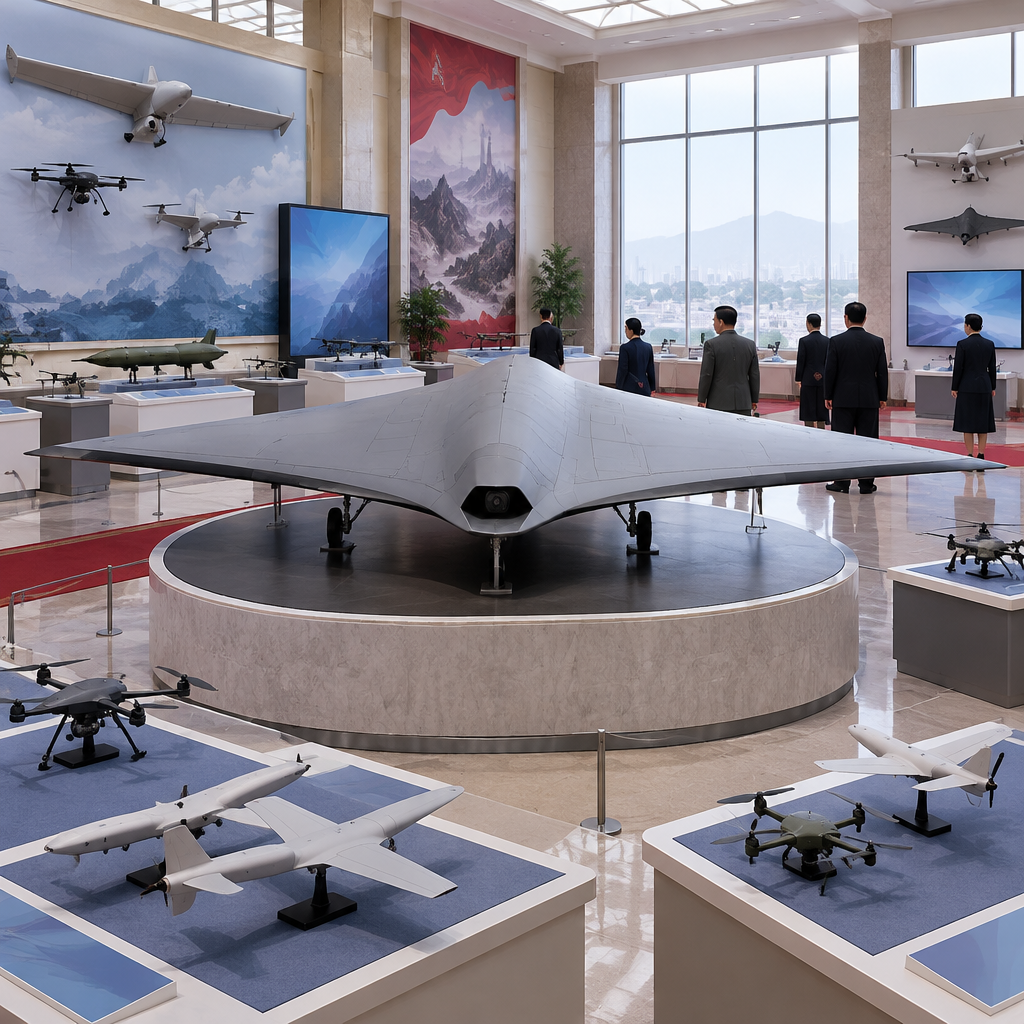
“Absolute superiority” in drone technology, Kim Jong Un declared, and he positioned a large tailless flying-wing mockup at the center of North Korea’s Unmanned Aeronautical Technology Development-2026 exhibition — a visual statement of ambition that mixed demonstrable progress in small systems with unproven claims for high-end, low-observable aircraft.
Unmanned Aeronautical Technology Development-2026: the show and the claims
The exhibition, held on Thursday and illustrated in images published by the ruling Workers’ Party newspaper Rodong Sinmun and other North Korean state media, displayed more than 30 types of UAVs and included live-fire demonstrations involving UAVs, cruise missiles, and multiple rocket launchers. According to state reports, missiles launched from drones and other systems struck an island target “with 100 percent accuracy.” Kim Jong Un used the event to call for unspecified measures to accelerate the development of uncrewed aviation systems and military artificial intelligence.
The flying-wing mockup: dimensions, design cues, and unanswered technical questions
Photographs released by North Korean state media show a tailless flying-wing mockup with a dorsal air intake, a relatively large center fuselage integrated into the wing, and retractable tricycle landing gear. Hong Min, a senior research fellow at the Korea Institute for National Unification, estimated the wingspan at roughly 56 to 66 feet and its height at around 10 to 11.5 feet based on available photos.
Visually, the mockup bears parallels to advanced UCAVs such as Northrop Grumman’s X-47B, China’s GJ-11 Sharp Sword, and Russia’s S-70 Okhotnik. But the external shape is only one element of a genuinely low-observable system. The exhibition provided no technical information about propulsion, payload, sensors, command-and-control, or performance, and there is currently no evidence that Pyongyang can produce the materials, manufacturing tolerances, inlet/exhaust arrangements, radar-absorbing treatments, or other capabilities required for operational stealth.

The cyber insurance questionnaire just landed. Now what?
SOC 2, HIPAA, insurance renewals - someone has to own security strategy. Nubivance provides fractional CISO leadership without the full-time salary.
Get a security leadSaetbyol-9, loitering munitions, quadcopters, and fiber-optic control
Smaller, lower-end systems dominated the exhibition and are the most consequential from an operational standpoint. The show included previously seen designs such as the Saetbyol-4 and Saetbyol-9 — described in appearance as clones of the U.S. RQ-4 Global Hawk and MQ-9 Reaper, respectively. Imagery of the Saetbyol-9 showed it carrying and firing multiple air-to-ground weapons, including a Hellfire-like laser-guided missile, smaller rockets, and other possible guided munitions.
Also displayed were loitering munitions resembling Israel’s Harop and Russia’s Lancet and smaller drones with configurations similar to the U.S.-made Switchblade family. Hundreds of small quadcopter drones were staged on storage racks; some appeared to carry cylindrical containers associated with fiber-optic control systems, a technology that, the exhibition noted, is largely immune to conventional radio-frequency jamming of control links. North Korean leaders emphasized interest in artificial intelligence, but the show did not disclose the actual maturity of autonomous navigation, target recognition, or engagement systems.
Russian and Iranian precedents, and the question of technology transfer
The event invited comparison with past cases: Iran displayed a U.S. RQ-170 Sentinel lookalike after recovering the original in 2011 and later offered Shahed-171 Simorgh and Shahed-191 derivatives that fall short of replicating the Sentinel’s low-observable qualities and avionics. The source notes that Russia has developed and flown the S-70 Okhotnik and exposed it to operational trials in Ukraine. North Korea’s growing military relationship with Moscow — including the deployment of North Korean troops to support Russia’s war in Ukraine and the presence of tens of thousands of North Korean workers sent to Russia as additional labor for its drone-production efforts — creates plausible avenues for exchange of knowledge. Yet the reporting stresses there is so far no proof of technology transfer from Russia and that even provided expertise might not be sufficient to produce an operational UCAV quickly.
What this means for technologists, policymakers, and Seoul
- Technologists and security teams: Monitor proliferation of fiber-optic control links and mass-produced small attack drones and loitering munitions; these systems — not high-end stealth mockups — are the most likely to be fielded in quantity.
- Policymakers and defense planners: Note that the country is explicitly investing in military artificial intelligence and large-scale uncrewed production; the combination of mass-produced one-way attack munitions and lessons drawn from conflicts such as Ukraine could require new procurement and countermeasure strategies.
- Seoul and South Korean defenses: The report highlights that inexpensive UAVs offer opportunities to strike military infrastructure while avoiding crewed aircraft, and that massed one-way attack drones could create a major interdiction problem for Seoul, prompting consideration of countermeasures such as directed-energy weapons and cheap interceptors noted in the source.
North Korea’s exhibition mixed demonstrable progress in large numbers of simpler platforms with a high-profile—but technically thin—mockup of a flying-wing UCAV. The clear near-term consequence is an expanding arsenal of small, mass-producible drones and loitering munitions; the central unanswered questions are whether Pyongyang can turn the flying-wing concept into a functional, low-observable UCAV and whether any external assistance will materially accelerate that leap.