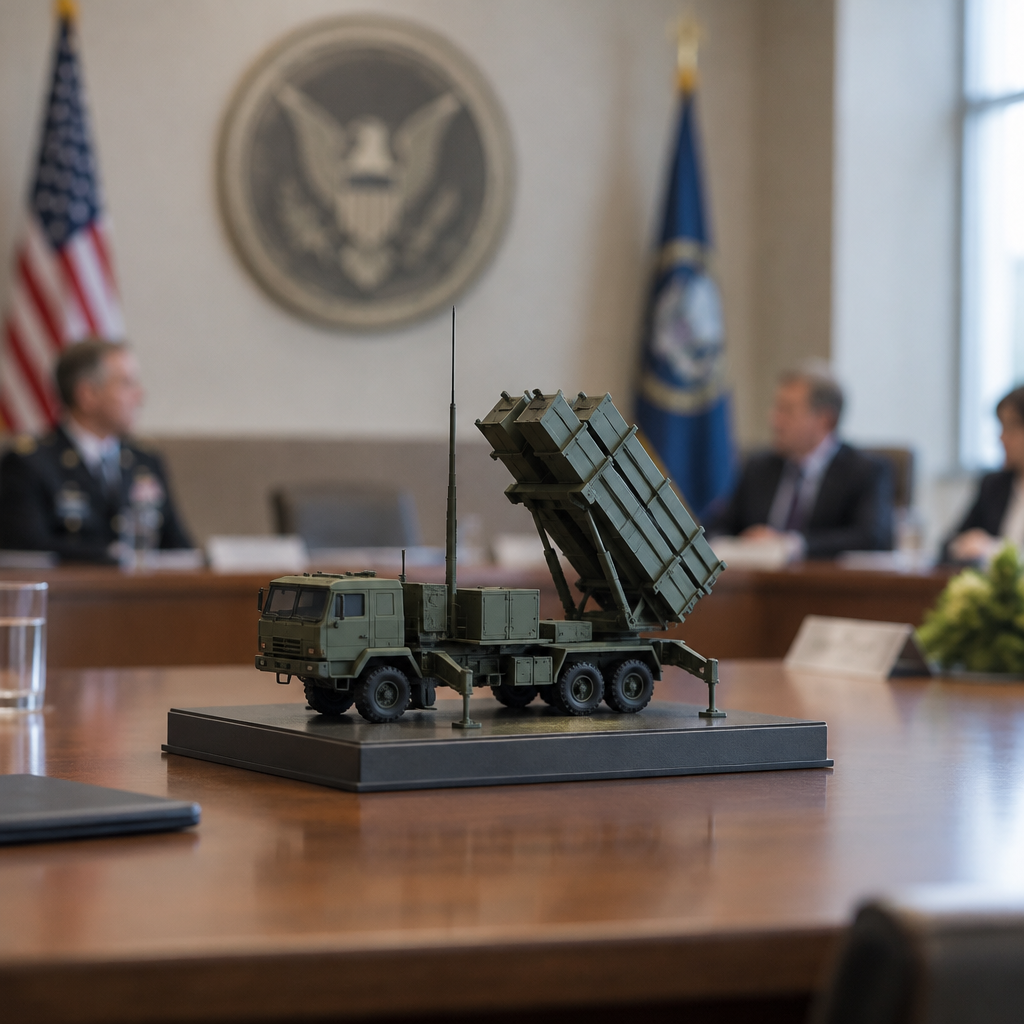
Five hundred Patriot Advanced Capability-3 (PAC-3) Missile Segment Enhancement (MSE) interceptors, with an estimated price tag of $2.1 billion “to be paid entirely by partners and allies,” were approved today in a U.S. State Department congressional notification for potential sale to Ukraine.
What the notification says
The State Department’s notice, posted online, states that “The Government of Ukraine has requested to buy five hundred (500) PATRIOT Advanced Capability-3 (PAC-3) Missile Segment Enhancement (MSE) missiles” together with classified and unclassified parts. The notification frames the potential sale as bolstering U.S. foreign policy and national security objectives “by improving the security of a partner country that is a force for political and economic stability in Europe.”
Who will pay and how the funding is structured
The notification makes clear that “No U.S. funds are involved in this sale.” Instead, Kyiv could buy the missiles “with donations from Canada, Germany, and Norway via the JUMPSTART program and national funds, financed by the European Union’s Ukraine Support Loan.” The notice defines JUMPSTART as the Joint Ukrainian Multinational Program–Services, Training and Articles Rapid Timeline program, established in 2022 as a mechanism for third-party countries to fund Ukrainian purchases of American equipment.

The cyber insurance questionnaire just landed. Now what?
SOC 2, HIPAA, insurance renewals - someone has to own security strategy. Nubivance provides fractional CISO leadership without the full-time salary.
Get a security leadTiming, diplomatic tensions, and operational urgency
The announcement arrives against a backdrop of reported disagreements and operational strain. The Washington Post reported on Oct. 19 that the U.S. appeared to have delayed the transfer of Patriot interceptors to Ukraine amid a falling out between U.S. President Donald Trump and Ukrainian President Volodymyr Zelenskyy. A separate report from CNN, published a few days earlier, said Kyiv had run out of interceptors and was increasingly vulnerable to Russian missile and drone attacks.
President Volodymyr Zelenskyy told reporters on Oct. 25 that two other recent disputes — disruptions in Starlink/Starshield connectivity and in U.S.-provided missile warning information — had been resolved, but he singled out Patriot deliveries as still lagging. “The issue of air defense remains. There is progress on missiles for Patriot systems, but things are moving very slowly. More slowly than Russian missiles fly,” he said. The president has previously told ABC News that Ukraine would need 350 interceptors per month to properly defend its territory.
How Foreign Military Sales (FMS) notifications work and possible next steps
The State Department notice is a Foreign Military Sales congressional notification — an early step in a process that can take years. The item notes that FMS deals are typically not final when announced: quantities and prices “can change as contract negotiations continue.” The notice also acknowledges a domestic check on the process: lawmakers could step in and delay or block the deal, though officials characterized that as less likely “considering the remaining bipartisan support for Ukraine.” The State Department did not immediately respond to a request for comment on how today’s announcement may affect Kyiv’s near-term interceptor shortfall.
How Ukraine, Canada/Germany/Norway, and U.S. policymakers are positioned
- Ukraine: Kyiv has requested 500 PAC-3 MSE missiles and faces an acute operational need, with public statements noting interceptor shortages and a cited requirement of 350 interceptors per month to maintain adequate defense.
- Canada, Germany, Norway, and the European Union: These partners are named as funders — Canada, Germany, and Norway “via the JUMPSTART program and national funds,” with financing tied to the European Union’s Ukraine Support Loan — signaling continued multinational financial support rather than direct U.S. financing.
- U.S. policymakers and Congress: The FMS notification starts a process that could change as negotiations proceed; while congressional delay or blockage is possible, the notice frames that outcome as less likely given ongoing bipartisan support for Ukraine.
The State Department’s approval of a $2.1 billion package of 500 PAC-3 MSE interceptors ties together multinational funding mechanisms and a highly visible operational need in Kyiv. What remains unclear in the notification is the delivery timeline and whether the initial FMS step will move fast enough to close the shortfall Zelenskyy has described; officials have noted that FMS deals can change and that congressional review remains a check on any final contract. For now, the announcement signals a coordinated funding approach by allies — and leaves the most consequential question open: when those missiles will arrive where the Ukrainian government says it needs them.