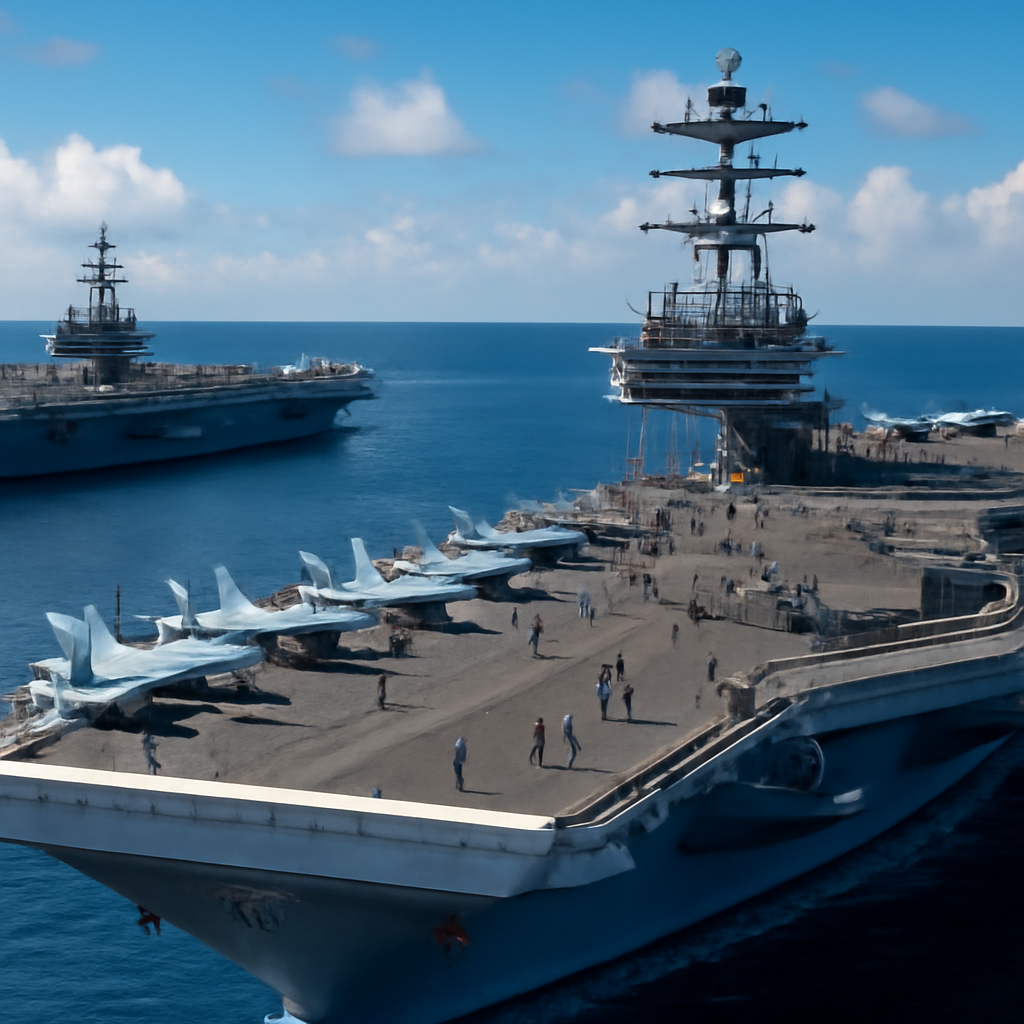
Since reinstating the blockade on July 14, U.S. Central Command announced it has redirected 17 commercial vessels, disabled two kinetically, and boarded another two “to ensure compliance.”
CENTCOM blockade activity and carrier presence
The blockade that CENTCOM restarted on July 14 remains the most visible naval action in this week’s tracker. CENTCOM’s tally—17 commercial vessels redirected, two disabled kinetically, and two boarded—was published in an update posted Monday morning. Two carrier strike groups are explicitly tied to that mission: USS Abraham Lincoln and USS George H.W. Bush “remain on station ‘to support maritime security and stability in the Middle East,’” the tracker reports.
USS George Washington’s transit into the South China Sea after an incident at Second Thomas Shoal
In the U.S. Pacific Command AOR, USS George Washington transited the Luzon Strait westbound and entered the South China Sea on July 22, escorted by guided‑missile cruiser USS Robert Smalls and destroyers USS Benfold and USS Shoup. That repositioning followed a serious incident between the Philippine Navy and China Coast Guard at Second Thomas Shoal that required the medical evacuation of a Filipino Navy SEAL. USNI News described the clash as “the most severe incident between Beijing and Manila to date,” adding it was “the first time the two forces directly engaged each other beyond rammings, water cannon blasts and other coercive activities.”

Audit-ready is a season. It shouldn't be.
Evidence in spreadsheets, controls drifting between audits, frameworks multiplying on flat headcount. Nubivance runs continuous compliance on Rapid7 Cyber GRC - SOC 2, HIPAA, ISO 27001, PCI, CMMC.
End the scrambleRIMPAC 2026: USS Theodore Roosevelt leads a large group sail
USS Theodore Roosevelt was underway in the Pacific and led a large group sail as part of the final stages of Exercise Rim of the Pacific (RIMPAC) 2026. Public AIS data placed the group sail and PHOTOEX on July 22 about 100 nautical miles northeast of Kauai, Hawaii, with more than 20 American and allied warships participating. The exercise is scheduled to wrap up at the end of the month.
Logistics and amphibious movements: Dwight D. Eisenhower, Tripoli, and Boxer
Back in the Atlantic, USS Dwight D. Eisenhower departed Naval Station Norfolk on July 22 to conduct an ammunition onload with USNS Medgar Evers; MH‑60S Seahawks from Helicopter Sea Combat Squadron (HSC) 11 were observed transporting ammunition while operating in the Atlantic. The carrier “returned to homeport yesterday,” the tracker notes.
Amphibious movements included USS Tripoli returning to Sasebo, Japan, over the weekend after a deployment lasting more than six months across the CENTCOM and PACOM AORs. Tripoli stopped at White Beach Naval Facility in Okinawa last week to disembark elements of the 31st Marine Expeditionary Unit before proceeding to Sasebo. USS Boxer, the flagship of the sole ARG currently deployed, conducted a vertical replenishment with USNS Carl Brashear on July 20.
How the U.S. Navy, the Philippines, and commercial shippers are affected
- The U.S. Navy: The tracker lists three carriers deployed, three training or in port in varying states of readiness, four in maintenance, and one used primarily for training. One ARG is deployed, five are training or in port, and three are in maintenance. Those distributions reflect a mix of blockade enforcement, forward presence in the South China Sea, and routine training cycles.
- The Philippines: The George Washington Carrier Strike Group’s arrival prompted a public acknowledgement from U.S. Ambassador to the Philippines Lee Lipton, who wrote on X that “The USS George Washington Carrier Strike Group’s advanced capabilities, including the F‑35, are upholding FREEDOM of Navigation and Overflight in the South China Sea. We challenge excessive maritime claims around the world.” That statement ties U.S. carrier posture directly to the diplomatic dispute arising from the Second Thomas Shoal incident.
- Commercial shipping: CENTCOM’s reported redirections and kinetic actions—17 ships redirected, two disabled, two boarded—are concrete, immediate consequences for commercial operators transiting CENTCOM waters and underline the direct operational effect a naval blockade can have on merchant traffic.
The week’s movements sketch a navy balancing simultaneous objectives: enforcing a CENTCOM blockade, maintaining a visible freedom‑of‑navigation posture in the South China Sea, and completing large multinational exercises in the Pacific. The public record shows carriers and amphibious platforms shifted from training and regional deployments into roles tied to specific operational tasks—blockade enforcement, maritime security, and allied exercises—leaving open how long those tasks will demand sustained presence and what logistic strains they may place on the fleet.