As a June memorandum of understanding between Washington and Tehran moves toward a 60-day deadline with less than one week remaining, U.S. naval posture in two theaters reflects both pressure and restraint. Two Nimitz-class supercarriers are sustaining a maritime blockade in the northern Arabian Sea while other carrier strike groups and amphibious formations balance presence, maintenance and family reunions across the Pacific and home ports.
Dual carriers backing a blockade in the northern Arabian Sea
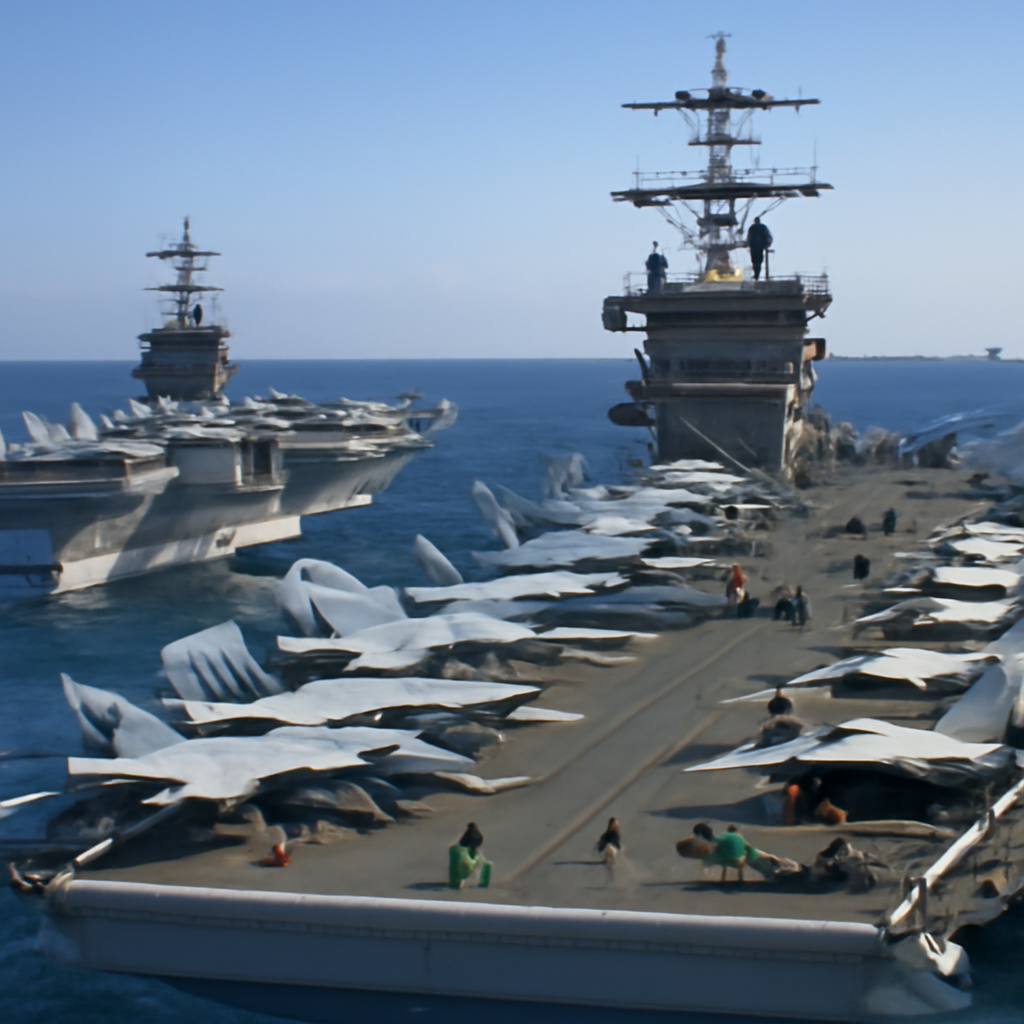
The blockade of Iranian ports and coastal cities remains “on in full force,” supported by the USS Abraham Lincoln and USS George H.W. Bush, two of more than 20 U.S. Navy warships enforcing the blockade and conducting wider missions in the region. Both supercarriers are on station in the northern Arabian Sea. As of August 9, U.S. Central Command reported it had redirected 55 commercial vessels, kinetically disabled two, and boarded another two to ensure compliance with maritime controls tied to the operation.
USS Abraham Lincoln is approaching nine months deployed. Family members of crew told MS Now that conditions aboard the ship have been difficult; Cmdr. Joseph Hontz responded that while “more than 250 days on deployment is challenging,” the ship remains “fully capable of meeting all mission tasking” and that ships in theater “currently have an adequate supply of food and supplies to sustain operations.” TWZ has not independently verified the family accounts.
USS George Washington operating in the South China Sea
To the east, USS George Washington is operating in the South China Sea after a five-day port call in Vietnam. Open-source flight tracking placed the four-ship strike group to the west of the Philippines, roughly 100 nautical miles off the coast of Luzon. A CMV-22B Osprey with Carrier Air Wing 5, callsign “RUDY73,” was recorded making a round trip to Clark Air Base, a Philippine Air Force base located 40 miles northwest of Manila.
George Washington is being escorted by the guided-missile cruiser USS Robert Smalls and two guided-missile destroyers, USS Shoup and USS Benfold, a configuration signaling routine escort and local interoperability operations rather than escalatory maneuvers.

This site is the portfolio.
OSINTSights runs on Cloudflare Workers, D1, R2, and Vectorize, with an AI pipeline on Hetzner ARM. Nubivance designed, built, and operates it. We do the same for clients.
See what we buildUSS Theodore Roosevelt returns to San Diego after RIMPAC 2026
USS Theodore Roosevelt returned to its homeport in San Diego after two months away following participation in the Rim of the Pacific (RIMPAC) 2026 exercise. The flattop was pierside at Naval Air Station North Island and hosted nearly 2,000 friends and family for a “tiger cruise” that included a large air-power demonstration. Capt. William Mathis, the commanding officer, framed the event as a showcase of Sailors’ “talent, pride and professionalism” and said the cruise helped loved ones better understand the crew’s work.
Whether Theodore Roosevelt’s strike group will shift to the Middle East to relieve Abraham Lincoln and maintain dual-carrier coverage in CENTCOM, or continue routine Western Pacific patrols augmenting George Washington, will depend on how negotiations with Iran resolve before the memorandum’s deadline.
The Gator Navy: amphibious readiness and distributed approaches
Demand for the Navy’s big-deck amphibious assault ships — the so-called “Gator Navy” — remains high and resources thin. Gen. Eric Smith, the commandant of the U.S. Marine Corps, said combat commanders request “well north of three… like double that” ARG-MEUs. The Navy replaced the Iwo Jima ARG in U.S. Southern Command with Littoral Combat Force-24, described as a single amphibious transport dock paired with distributed land‑based nodes to deliver greater flexibility.
Two ARGs are working up: USS Makin Island completed ARGMEUEX on July 31, and USS Essex departed Pearl Harbor last week after RIMPAC participation. Overall, TWZ reports one ARG deployed, five in training or in port, and three in maintenance availabilities.
Fleet readiness: counts and the narrowing diplomatic timeline
TWZ’s tally shows three U.S. carriers deployed, three working up or at homeport in varying states of readiness, four in maintenance, and one used for training. These force-distribution choices sit against diplomatic dynamics: the Wall Street Journal reported President Donald Trump is reportedly leaning toward applying economic leverage rather than returning to all‑out war as the June memorandum’s 60‑day timetable draws to a close and progress remains limited.
What this means for the president, CENTCOM, and carrier crews’ families
- The president: Faces a near-term decision point as the memorandum’s deadline approaches; the White House posture outlined in reporting favors economic leverage over returning to full-scale conflict.
- CENTCOM: Continues active maritime enforcement — redirecting dozens of commercial vessels and conducting kinetic measures — while sustaining dual-carrier coverage in the northern Arabian Sea.
- Carrier crews’ families: Public accounts from about a dozen family members have raised concerns about prolonged deployments; the 5th Fleet spokesperson acknowledged supply pressures but affirmed mission capability.
As the diplomatic clock ticks, U.S. naval distribution — two carriers enforcing a maritime blockade in the Arabian Sea, another carrier group in the South China Sea, and amphibious forces juggling deployments and maintenance — will stay tightly linked to the outcome of negotiations and operational demands at sea. The immediate question is concrete: will the Theodore Roosevelt or another strike group relieve Abraham Lincoln before that 60-day window closes, or will the naval posture change only with a shift in diplomacy? The coming days should answer which lever Washington chooses to pull.
Original TWZ report: Where Are The Aircraft Carriers: August 11, 2026