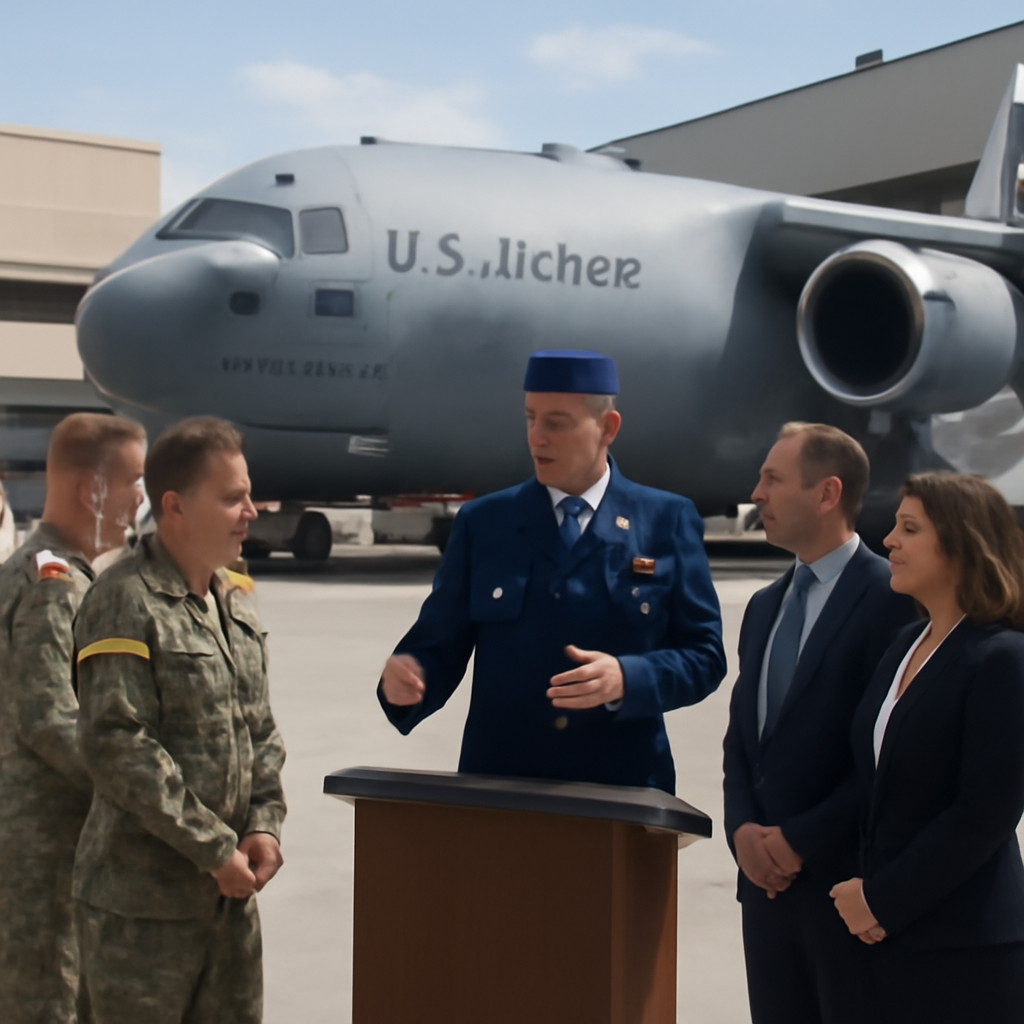
"The C-17 is the most amazing airplane ever made. I have a lot of time in it, so I can say that." — Air Force Lt. Gen. Rebecca Sonkiss
House Committee on Armed Services directs an Air Force briefing by March 1, 2027
The House Committee on Armed Services added a provision to its report accompanying the latest draft of the National Defense Authorization Act directing the Secretary of the Air Force to provide a briefing assessing the feasibility of restarting C-17 production. The committee framed the requirement by noting that the existing C-17 fleet "continues to bear significant operational demands supporting combatant commander requirements, humanitarian assistance missions, and global mobility operations" and expressed concern that "future operational demands may place additional strain on the existing C-17 fleet."
The committee specified the minimum content of the briefing, requiring: an assessment of the technical and industrial feasibility of restarting the C-17 line (including tooling status, supplier base viability, workforce availability, and potential reconstitution costs); an estimate of the timeline to reestablish production and deliver the first newly produced aircraft; a cost estimate for restarting production and procuring additional aircraft (with options for limited procurement and multi-year procurement); an evaluation of alternative approaches to increasing strategic airlift capacity (including service life extension programs, modernization of existing aircraft, procurement of commercial derivative cargo aircraft, and expansion of the Civil Reserve Air Fleet); and an assessment of potential international partner interest in participating in or contributing to a restarted production line.
Boeing has been "encouraged" by operator engagements; talks previously described as "early infancy"
Operators of the C-17 Globemaster III have been contacting Boeing about the possibility of restarting the product line, and Boeing said it has been “encouraged” by these engagements. A Boeing spokesperson told the reporting outlet: "Our goal is to help our customers be successful, and we work with them to develop innovative solutions to meet their mission needs, including development and production partnerships." The company added it is "proud of our continued support for the unique, mission-proven capabilities that the C-17 Globemaster III delivers to the U.S. Air Force and eight allied nation partners."
At the Paris Air Show last year, Turbo Sjogren, Vice President and General Manager of Boeing Global Services–Government Services, told Shephard Defense that talks with an unnamed country about a possible production restart were in their "early infancy" and described such an effort as "very extraordinary" and "reflective of the utility of the aircraft." Earlier in 2025, then-Japanese Prime Minister Shigeru Ishiba had expressed interest in buying Globemaster IIIs, which raised questions about where any new-production aircraft might come from.

The cyber insurance questionnaire just landed. Now what?
SOC 2, HIPAA, insurance renewals - someone has to own security strategy. Nubivance provides fractional CISO leadership without the full-time salary.
Get a security leadRAND's 2011 analysis gives a baseline for potential restart costs — in 2011 dollars
Independent analysis by the RAND Corporation in 2011 examined options for resuming production of the baseline C-17A, a Boeing-proposed C-17B variant, and a significantly revised C-17FE derivative. RAND estimated that restarting C-17A production could cost between $2.1 billion and $2.7 billion in 2011 dollars depending on retained tooling. For the proposed C-17B, RAND estimated $4.6 billion to $6.4 billion to begin new production, and for the C-17FE derivative it estimated $6.2 billion to $7.0 billion. RAND noted that billions more would be required to procure aircraft and that unit prices would depend heavily on production quantities.
The RAND figures came with explicit caveats: they were decade-old dollar estimates and would be significantly higher today purely because of inflation, and the final costs would hinge on factors such as tooling retention, workforce knowledge, third‑party supply chain health, and physical production space—areas the House committee has asked the Air Force to assess.
U.S. Air Force fleet condition, upgrades, and NGAL planning
The Air Force took delivery of its last C-17 in 2013 and currently operates some 222 C-17 airlifters. Allied and partner operators with smaller fleets include Australia, Canada, India, Kuwait, Qatar, the United Arab Emirates, and the United Kingdom; three additional aircraft are operated under the Strategic Airlift Capability multinational initiative.
Recent operational tempo and "a succession of crises" have placed serious strain on the fleet, triggering questions about the viability of the plan to keep C-17s flying through 2075. The Air Force's Next Generation Air Lift (NGAL) plans currently envision a single aircraft replacing both the C-5 Galaxy and the C-17; the stated plan would replace C-5s first and keep C-17s in service until 2075, by which time the type would have been in service for roughly 80 years.
The Air Force has pursued upgrades to prolong and modernize the fleet: installation of 3D‑printed microvanes across the fleet—which yield about a one percent drag reduction and associated fuel savings—is expected to be completed by the end of next year. Communications and data-sharing upgrades are ongoing across airlift and tanker fleets, and Boeing holds a contract for a more extensive flight-deck upgrade intended to resolve avionics obsolescence and integrate open systems architectures. The prospect of re-engining has been raised in the past, but the Air Force downplayed its value earlier this year. Concerns have also been raised about C-17 survivability in a high-end fight, prompting the Air Force to work on bolstering defensive capabilities across airlifters and tankers as a key NGAL consideration.
What this means for Air Mobility Command, Boeing, and allied operators
- Air Mobility Command (AMC): AMC leadership, represented in public comments by Lt. Gen. Rebecca Sonkiss, has emphasized the need to avoid any gap in strategic airlift and to accelerate conversations about next-generation lift—expect AMC to press for robust analysis of timelines and sustainment options in the Air Force briefing.
- Boeing: The company has not ruled out a restart and says it will work with customers to "understand the requirements and needs"—Boeing will need to assess retained tooling, workforce capability, and supplier readiness to move forward.
- Allied operators and potential partners: Nations that operate C-17s or have expressed interest, such as the set of seven named air arms plus the Strategic Airlift Capability participants, are explicit targets for assessing international partner interest to help defray restart costs or participate in procurement.
The clock now runs to the committee's March 1, 2027 deadline for a formal Air Force briefing that must assemble technical, industrial, timeline, cost, alternative, and partner‑interest analyses. Whether the Air Force will recommend new-production C-17s, opt for life-extension and modernization, expand commercial airlift options, or accelerate NGAL decisions remains to be seen; Boeing, operators, and Congress will be watching that briefing closely.
Source: The War Zone — "Boeing 'Encouraged' By C-17 Production Restart Discussions"