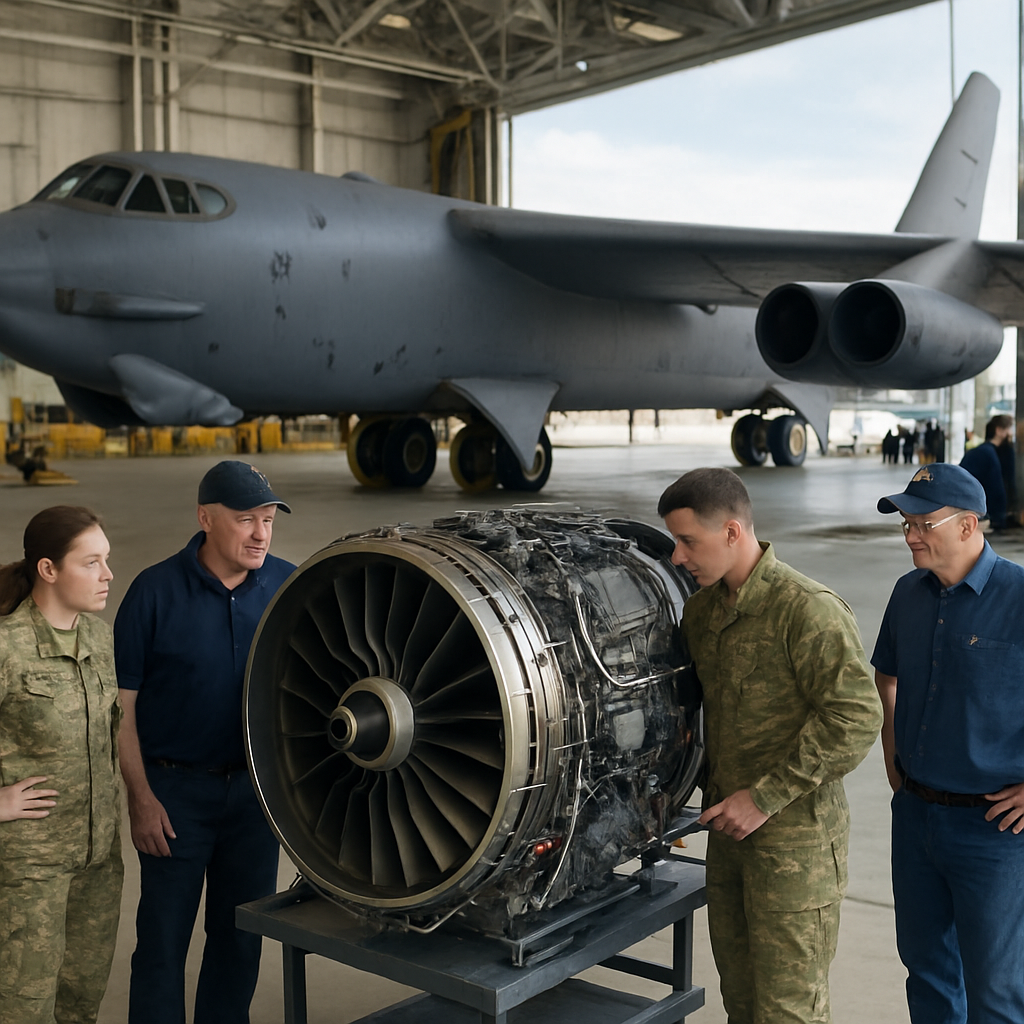
"This CERP critical design review is the culmination of an enormous amount of engineering and integration work from Boeing, Rolls Royce, and the Air Force that will enable the B-52J to remain in the fight for future generations," Air Force Lt. Col. Tim Cleaver, the CERP Program Manager within the Bombers Directorate at the Air Force Life Cycle Management Center (AFLCMC), said in a statement.
AFLCMC CDR milestone and the first bomber delivery
The Air Force announced that the Commercial Engine Replacement Program (CERP) reached its Critical Design Review (CDR) and said the first B-52 will be delivered to Boeing’s San Antonio facility later this year to begin modification work. The Air Force selected Rolls‑Royce’s F130 turbofan in 2021 to re‑engine its B-52H fleet, and Boeing is responsible for CERP integration, including new twin‑engine pods and associated subsystems. Under the upgrade plan the type will eventually be redesignated B‑52J.
Engine design work: inlet distortion, wind tunnels, and redesign
The program’s path to CDR was not linear. According to a June 2025 Government Accountability Office (GAO) report cited by the program, officials identified a critical issue with engine inlet distortion — a non‑uniform airflow that can affect engine performance and operability — and that finding prompted a redesign of the inlet. The GAO said the program used a digital model during rapid prototyping, but test data showed the initial design did not meet requirements. Boeing completed wind tunnel testing to verify the redesigned inlet, with officials stating those data were essential to completing the CDR. The report said wind tunnel testing would be finished in summer 2025.

Audit-ready is a season. It shouldn't be.
Evidence in spreadsheets, controls drifting between audits, frameworks multiplying on flat headcount. Nubivance runs continuous compliance on Rapid7 Cyber GRC - SOC 2, HIPAA, ISO 27001, PCI, CMMC.
End the scrambleTesting, schedule milestones, and production pacing (DOT&E schedule)
The Pentagon’s Office of the Director of Test and Evaluation (DOT&E) provides the program schedule the Air Force is following: system development is extended until Fiscal Year 2033 (FY33), with a system‑level CDR in FY26 and modification of two low‑rate initial production (LRIP) aircraft in FY27 for testing. DOT&E places developmental and integrated flight testing beginning in FY29, leading to initial operational test and evaluation (IOT&E) in FY32. The proposed production plan would award LRIP contracts to procure engines and modify 51 of the 74 B‑52 aircraft (69 percent) prior to IOT&E’s planned completion in FY32, using the two fully modernized B‑52J LRIP aircraft for IOT&E. Two full‑rate production decisions are planned for FY33 and FY34 to address the remaining 23 aircraft.
Costs, contract actions, and fleet numbers
Program cost estimates have shifted and remain unclear in public reporting. Media reports in 2024 placed program cost growth from $8 billion to $9 billion. In December 2025 Boeing received just over $2 billion under an existing CERP contract; the Pentagon said that award would go toward “completing system integration activities after Critical Design Review and modifying and testing two B‑52 aircraft with new engines and associated subsystems.” Defense One reported in February that Rolls‑Royce had confirmed the first F130s intended for installation on an actual B‑52 would not be delivered to the Air Force until sometime in 2027. The program’s timeline has slipped repeatedly: CDR was expected three years earlier, initial operational capability was once hoped for in 2030 but slipped to 2033, and full fleet re‑engining could take several years after that.
How the Air Force, Boeing, and Rolls‑Royce are positioned
- Air Force (AFLCMC, Air Force Global Strike Command): AFLCMC framed CDR as the transition from concept to production, and said the upgrade will add new subsystems such as a modern generator for each engine to increase electrical power capacity. The Air Force plans to test two modified LRIP aircraft at Edwards AFB to validate systems before broader fleet modification. Operational constraints — a small fleet with high readiness demands — shape how many aircraft can be sidelined for modification at any one time.
- Boeing: Boeing leads integration and will perform modifications at its San Antonio facility. GAO reporting blamed part of the schedule growth on Boeing’s lag in submitting proposals needed to mature cost and schedule baselines; program officials said Boeing submitted qualified proposals in summer 2024 that the program is reviewing.
- Rolls‑Royce: As the engine supplier, Rolls‑Royce’s F130 offers better fuel economy and reduced maintenance demands compared with the TF33s that currently power the B‑52. Rolls‑Royce had confirmed vendor delivery timing that places the first engines for aircraft integration in 2027, per published reporting.
The record in the public record is precise about sequence but not yet about timing for hands‑on work: the first B‑52 is slated for delivery to Boeing later this year, but reports and program documents place many critical events — flight test, engine deliveries, and IOT&E — years into the future. The program’s immediate next steps are digital and physical verification of the redesigned inlet, modification and ground testing of LRIP aircraft, and the staged ramp into production; how long each will take will determine when the fleet’s tired TF33 engines — out of production since 1985 and tracing to designs from the late 1950s — are finally replaced by eight F130s per aircraft.