Flight test: what Pakistan showed on November 3
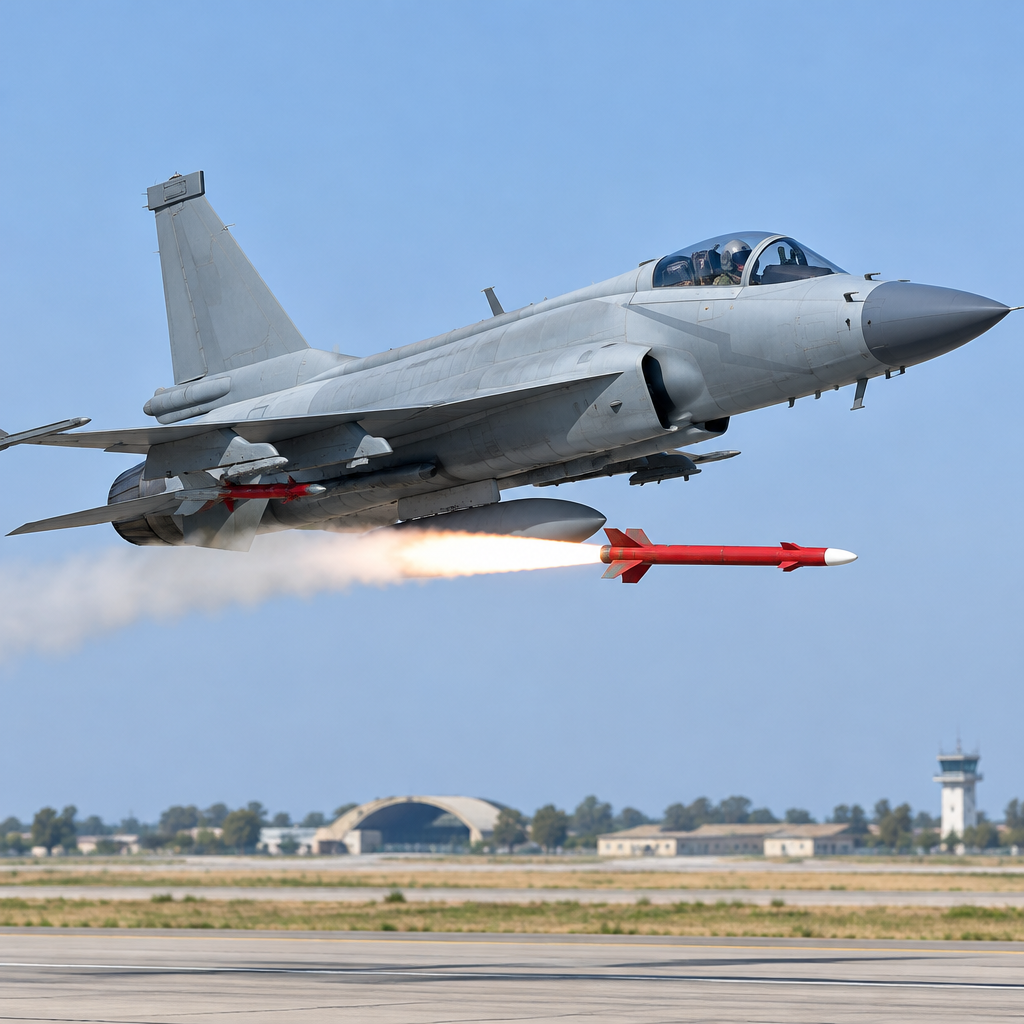
On November 3, Pakistan’s military announced the successful flight test of the Fa’az air-to-air missile and released video footage of the event. The footage shows a Pakistan Air Force JF-17 Thunder launching a red-painted Fa’az-IIR from a pylon beneath its wing. The military described Fa’az (Urdu for “Victorious”) as an indigenous weapon equipped with an advanced terminal guidance system capable of engaging aerial targets at longer ranges. Senior Pakistani military officers, along with scientists and engineers involved in the program, witnessed the launch; senior civilian and military leadership subsequently congratulated those involved. The defence public relations account for the Air Force (DGPR PAF) posted a tweet announcing the flight test on November 3.
Variants, prior displays, and advertised performance
The Fa’az program has been publicly visible for several years. Pakistan’s state-owned Global Industrial & Defense Solutions (GIDS) displayed mockups of two Fa’az variants at the International Defense Industry Fair (IDEF) in Turkey in 2023: the Fa’az-RF, an active radar-guided missile, and the Fa’az-IIR, fitted with an imaging infrared seeker. GIDS previously described both versions as medium-range air-to-air missiles with advertised ranges exceeding 100 kilometres and maximum speeds of about Mach 3.5. The company also advertised seeker detection ranges of 25 kilometres for the radar-guided version and 40 kilometres for the infrared-guided variant. As the reporting notes, those figures are manufacturer specifications and will vary in operational conditions.

This site is the portfolio.
OSINTSights runs on Cloudflare Workers, D1, R2, and Vectorize, with an AI pipeline on Hetzner ARM. Nubivance designed, built, and operates it. We do the same for clients.
See what we buildSensor options, LOAL, and how the IIR variant operates
The missile visible in the test footage was the Fa’az-IIR — the imaging infrared (IIR) variant — not the radar-guided Fa’az-RF. Unlike an active radar-guided weapon, an imaging infrared missile relies on a target’s thermal signature for terminal guidance. Achieving engagements at distances of 100 kilometres or more would require the launching aircraft to provide initial targeting information; the missile would travel toward a predicted intercept area using inertial navigation and potentially datalink updates, then activate its infrared seeker for terminal acquisition. That launch-and-acquire approach is known as lock-on after launch (LOAL) and is used by other beyond-visual-range infrared designs.
Lineage, outside suppliers, and expert commentary
The Fa’az design has been compared with China’s SD-10/PL-12 family, and the development record includes contested elements. GIDS has maintained that it developed Fa’az locally and owns the intellectual property rights, while the exact degree of technological influence from existing foreign missile designs remains unclear. Douglas Barrie of the International Institute for Strategic Studies raised the possibility — not confirmed by Pakistan — that the seekers used in Fa’az could have been supplied by China, saying the Chinese imaging infrared seeker “is likely up there with the best.” The program sits against the background of a close military relationship between China and Pakistan.
How Fa’az could sit alongside PL-15E, AIM-120s, and Pakistan’s fighters
Pakistan is already fielding advanced foreign air-to-air missiles. The Pakistan Air Force operates China’s PL-15E on its J-10C fighters and JF-17 Block III jets; Pakistan’s F-16s are armed with the U.S. AIM-120 Advanced Medium-Range Air-to-Air Missile, though the reporting notes that use of AIM-120s is reportedly subject to U.S. restrictions. The PL-15E features an active electronically scanned array (AESA) radar seeker and a two-way datalink, with a published maximum range of about 145 kilometres; Pakistan was reportedly the first export customer for the PL-15E, which received attention after its reported use during the May 2025 India–Pakistan air conflict, and at least one largely intact PL-15E rear section reportedly came down in India during that engagement.
In operational terms, the Fa’az-IIR could complement radar-guided systems such as the PL-15E. The article notes a doctrinal pattern from Soviet and Russian practice: following a radar-guided missile launch with an infrared-guided shot at the same target can increase kill probability and complicate countermeasures, and the same tactic could apply to PL-15E plus Fa’az-IIR pairings. Infrared guidance also provides advantages against low-observable targets that may evade radar lock-on; when paired with an infrared search-and-track (IRST) system and networked targeting data, an IIR missile can be a potent option against more stealthy aircraft.
Where this leaves the program and the region
Pakistan has not released detailed engagement parameters for the November 3 test, nor has it indicated when the Fa’az-IIR might enter operational service or provided an update on the Fa’az-RF radar-guided variant. Nonetheless, the flight test moves the program beyond mockups and into live testing — a material step toward establishing an indigenous air-to-air missile capability. That capability would affect procurement and sustainment choices for Pakistan’s JF-17 fleet and could provide a future export product if production and certification follow.
Key open questions — left unanswered in the official material — include the provenance of critical seeker components, the operational envelope demonstrated in the test, and the timeline to fielding. The test itself, however, is a clear signal that Pakistan is seeking greater self-reliance in advanced aerial weapons and that the Fa’az program will be a development to watch in the coming years.