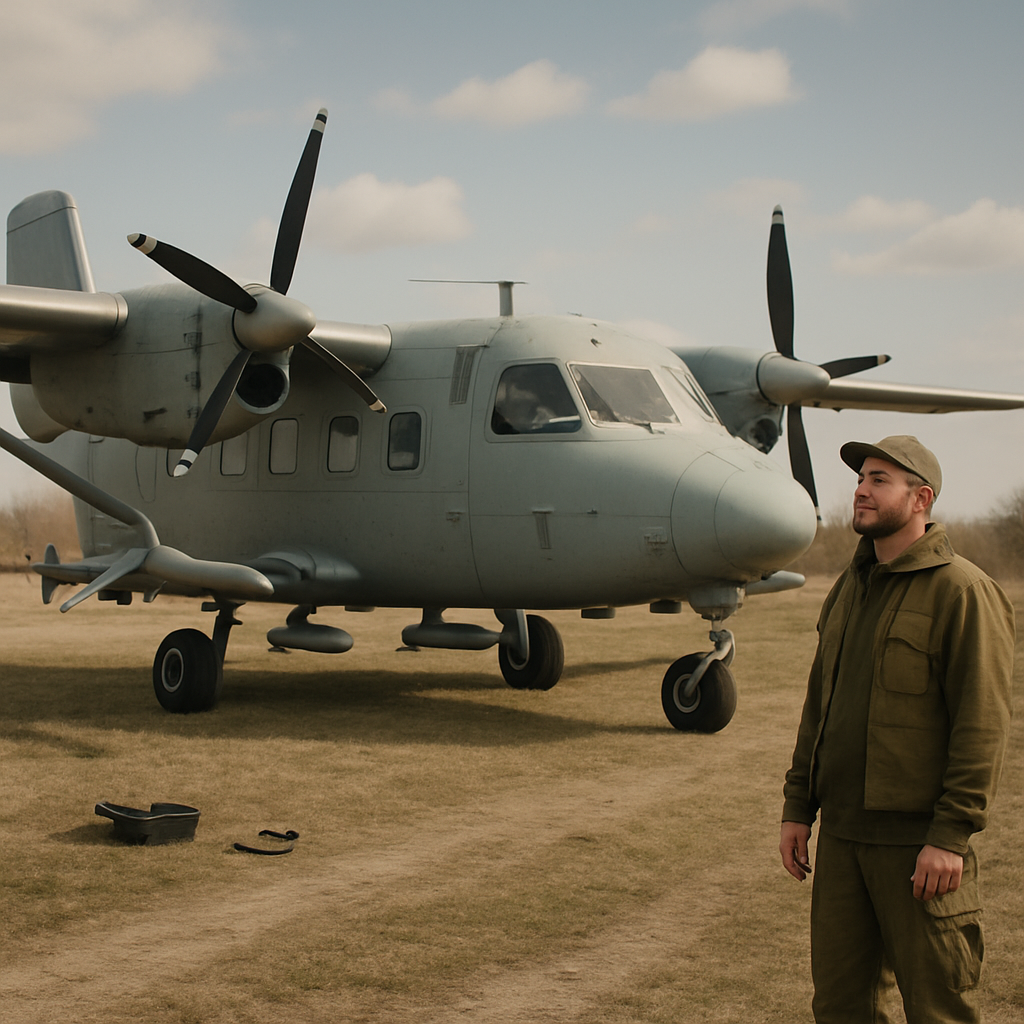
222 Russian drones: that is the number Ukrainian pilot and volunteer Tymur Fatkullin says the converted Antonov An-28 has additionally shot down using gun armament, a tally that frames the latest modification to the aircraft’s role — now also launching interceptor drones in flight.
The An-28’s evolution into a “Shahed hunter”
The civilian Antonov An-28 has been modified into an airborne counter-drone platform, mounting underwing hardpoints that now carry two types of Ukrainian-made interceptor drones: the SkyFall P1-Sun and the Merops AS-3 Surveyor. Volunteers operate the turboprop on anti-drone patrols, using an infrared camera monitored by a “camera operator,” night-vision goggles for nocturnal spotting, and an M134 Minigun for kinetic engagements. French TF1 and other outlets have documented crews of civilian volunteers flying these missions and painting kill marks below the cockpit.
SkyFall P1-Sun: a fast, modular interceptor
The P1-Sun is a small, relatively inexpensive interceptor built with a modular, 3D-printed airframe. It can fly up to 16,400 feet (5,000 meters) and reach speeds of as much as 280 miles per hour (450 km/h), capabilities the source says are sufficient in some circumstances to intercept jet-powered targets such as the Geran-3. Fatkullin described aircraft-launched P1-Sun interceptors as “a cheap air-to-air missile,” and said the method had “already proven effective in real combat conditions.” The An-28’s air-launch capability brings these interceptors closer to threats and shortens response times.

Audit-ready is a season. It shouldn't be.
Evidence in spreadsheets, controls drifting between audits, frameworks multiplying on flat headcount. Nubivance runs continuous compliance on Rapid7 Cyber GRC - SOC 2, HIPAA, ISO 27001, PCI, CMMC.
End the scrambleMerops AS-3 Surveyor: costs, lethality, and prior use
The Merops AS-3 Surveyor is presented as a more capable and more expensive option. It can operate autonomously or under remote control, carries onboard sensors for target tracking, and is fitted with an explosive warhead that destroys targets by direct collision or a proximity detonation. The U.S. Army provided cost figures, saying a single Merops example costs around $15,000 today, with the potential to drop to between $3,000 and $5,000 if production is scaled up. By comparison, the source cites an estimated Shahed price of $30,000–$50,000, making the interceptor-to-target cost equation potentially compelling. The source also notes the Merops has been used effectively by the U.S. military to counter Iranian Shahed attacks in the Middle East.
Operational benefits of air-launching interceptors from the An-28
Launching interceptors from an An-28 yields multiple tactical advantages. Air-launch places the interceptor closer to the target, gives it additional starting altitude and range, and allows the An-28 to use its own sensors to help locate threats. The turboprop’s loiter time suits standing patrols or screening missions where drones are expected, and its STOL (short takeoff and landing) capability lets it operate from shorter, austere airstrips. Having a choice of responses — different small interceptors, gun armament, and potentially rockets — provides flexibility against varying drone threats. The source also notes that lighter aircraft and helicopters have already accounted for roughly 10–12 percent of all drones claimed by Ukrainian air defenses, a figure that underscores the contribution of crewed light platforms.
What this means for the U.S. Army, Ukrainian An-28 crews, and Russian Shahed production
- U.S. Army: The service’s cost estimates for the Merops — roughly $15,000 apiece, with potential scale savings to $3,000–$5,000 — frame a procurement trade-off. Affordable interceptors that can be fielded in numbers could reduce reliance on more expensive surface-to-air munitions when countering Shahed-type threats.
- Ukrainian An-28 crews and volunteer aviators: Flight crews gain a broader palette of tools. Air-launched interceptors reduce time-to-engage and extend the reach of patrols, complementing the An-28’s existing gun armament and sensor setup that has, per Fatkullin, helped bring down hundreds of drones.
- Russian Shahed production effort: Moscow’s manufacturing rate — cited in the source as roughly 2,000 Shahed/Geran drones per month with plans to nearly triple production — intensifies the volume challenge. Less costly airborne interceptors change the economic calculus by preserving higher-end interceptors for the most critical targets.
The adaptation of a modest twin-turboprop into an airborne “mothership” for interceptor drones captures a recurring theme in this phase of the conflict: inexpensive, rapidly fielded tools can blunt high-volume, one-way drone attacks. If the air-launched P1-Sun and Merops AS-3 prove reliable in sustained operations, the concept is likely to spread to other light platforms and to be scaled wherever the cost dynamics favor small interceptors over pricier missile interceptors.