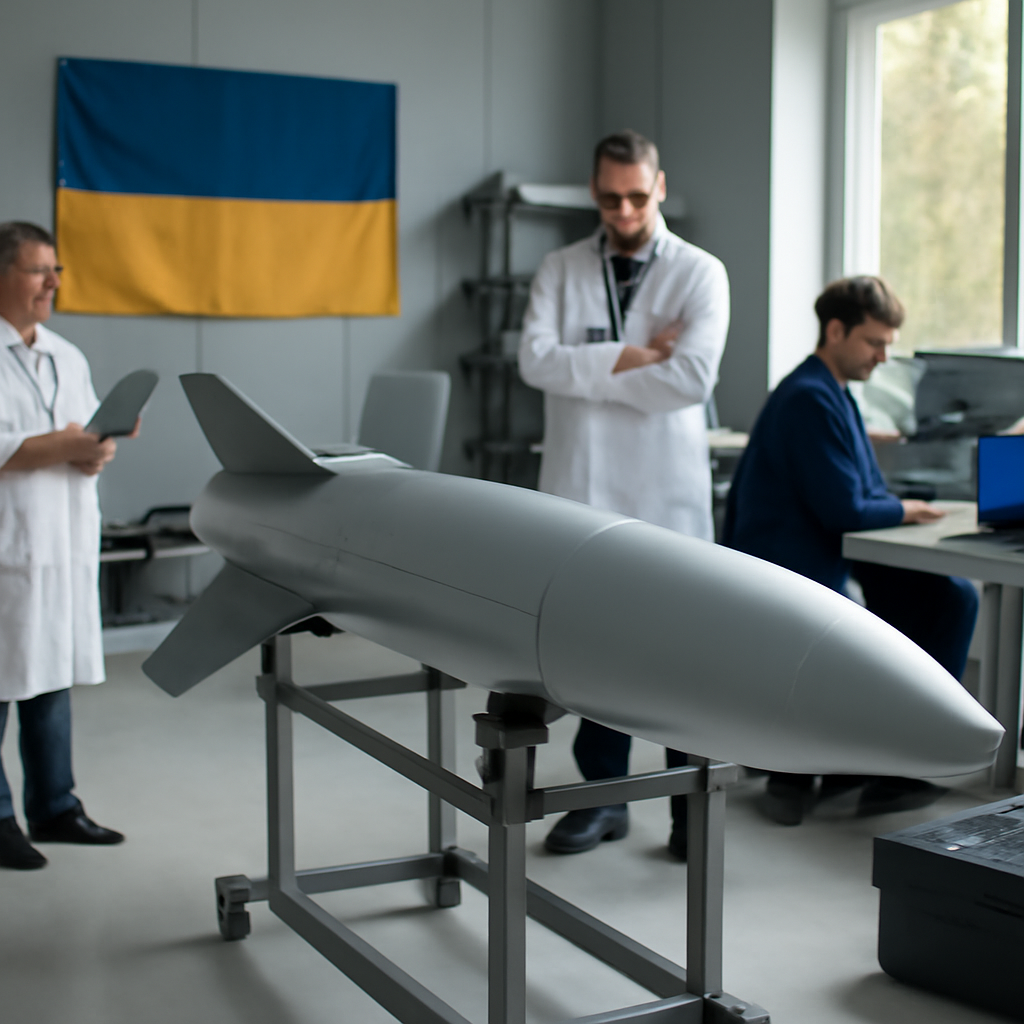
"The first Ukrainian glide bomb from @BRAVE1ua is ready for combat deployment," tweeted Mykhailo Fedorov on May 18, 2026.
What the developers and Kyiv say: timeline, trials, and a 250‑kg warhead
Brave1 — the defense technology arm of the Ukrainian government — and the Ukrainian Minister of Defense say the weapon took 17 months to develop and now "has completed all required trials." Both Mykhailo Fedorov and Brave1 stated the munition carries a 250‑kilogram (551‑pound) warhead and is ready for combat after development that the reporting places as beginning in December 2024. The Ukrainian Ministry of Defense has placed an initial order, and pilots are reported to be rehearsing with the weapon, making combat deployment "imminent," according to the public statements.
What the imagery shows: air release, wings, and tailfins
Ukraine has released imagery and video of the munition in flight. The footage shows the glide bomb being released from a Ukrainian Air Force Su‑24 swing‑wing attack jet, the weapon assuming an aerodynamic profile shortly after release, and its range‑extending wings deployed immediately. The munition is painted red in test footage and features notably large cruciform tailfins. Visible lugs under the weapon's body suggest — as the reporting notes — that it may 'topple over' to reach the correct attitude before wing deployment, a mechanism similar to those seen on some glide bombs operated elsewhere.

The cyber insurance questionnaire just landed. Now what?
SOC 2, HIPAA, insurance renewals - someone has to own security strategy. Nubivance provides fractional CISO leadership without the full-time salary.
Get a security leadDesign, guidance, and unanswered technical specifics
Brave1 and Ukrainian officials describe the system as a conventional warhead fitted with a wing kit and a guidance system, but the exact nature of that guidance has not been disclosed publicly. The reporting notes that a satellite navigation‑assisted inertial guidance system would align with Ukraine’s experience and inventory of longer‑range glide and kamikaze systems, and that additional seekers are possible but "not probable at this time." It is likewise not clear from the released material whether the glide bomb carries any onboard powerplant; the reporting points out that Ukraine does operate jet‑powered kamikaze drones and that some Western‑supplied glide munitions used by Ukraine, such as the French AASM‑250 Hammer, include a rocket booster.
Where the weapon fits: platforms, Western munitions, and Russian equivalents
The new glide bomb joins a roster of standoff precision munitions already used by the Ukrainian Air Force, including the U.S. Joint Direct Attack Munition‑Extended Range (JDAM‑ER), the U.S. Small Diameter Bomb (SDB), and France’s AASM‑250 Hammer. Imagery and reporting indicate Ukraine has used such systems on MiG‑29s, Su‑27s, Su‑25s and Su‑24s; the size of the new weapon should allow carriage by those types as well as by Su‑25 attack jets. The reporting also places the new munition in the context of a growing Russian practice of fitting larger dumb bombs with add‑on guidance kits and of Russia’s refinement of glide bombs.
How the U.S. ERAM program and domestic production interact with Ukraine’s needs
The article notes parallel U.S. efforts to meet Ukrainian demand for low‑cost standoff munitions. The U.S. Air Force launched a project to develop Extended Range Attack Munitions (ERAM) and in August 2025 Washington approved the transfer of thousands of ERAM‑class weapons to Ukraine. Examples developed under ERAM cited in the reporting include the Rusty Dagger from Zone 5 Technologies and the Rapidly Adaptable Affordable Cruise Missile (RAACM) developed by CoAspire. The reporting adds that evidence of ERAM items being used by Ukraine has yet to emerge.
What this means for the Ukrainian Air Force, the U.S. Air Force, and the Russian Aerospace Forces
- Ukrainian Air Force: gains a domestic source of air‑launched, standoff precision capability that Kyiv describes as unrestricted in employment and designed "from scratch," easing dependence on limited Western stocks.
- U.S. Air Force / ERAM program: faces a real‑world comparator to its ERAM deliveries; the reporting notes transfers were approved but that ERAM use by Ukraine has not been confirmed, underscoring continued demand for affordable standoff options.
- Russian Aerospace Forces: the reporting frames the Ukrainian munition as a response to Russian reliance on guided upgrades and larger glide bombs, narrowing a capability gap and altering the calculus of strike options on both sides.
The public record released so far is specific about developmental claims, a photographed test profile, and operational intent: a 250‑kg warhead, 17 months of development, completed trials, and pilots training for imminent deployment. Whether the glide bomb will be employed widely, what exact guidance and range it achieves, and how quickly it will be integrated across Ukrainian airframes remain the immediate, observable questions. For now, Kyiv has declared a new indigenous standoff option ready — and the next, decisive evidence will be whether it appears in operational footage.
Source: https://www.twz.com/air/ukraines-homegrown-glide-bomb-breaks-cover