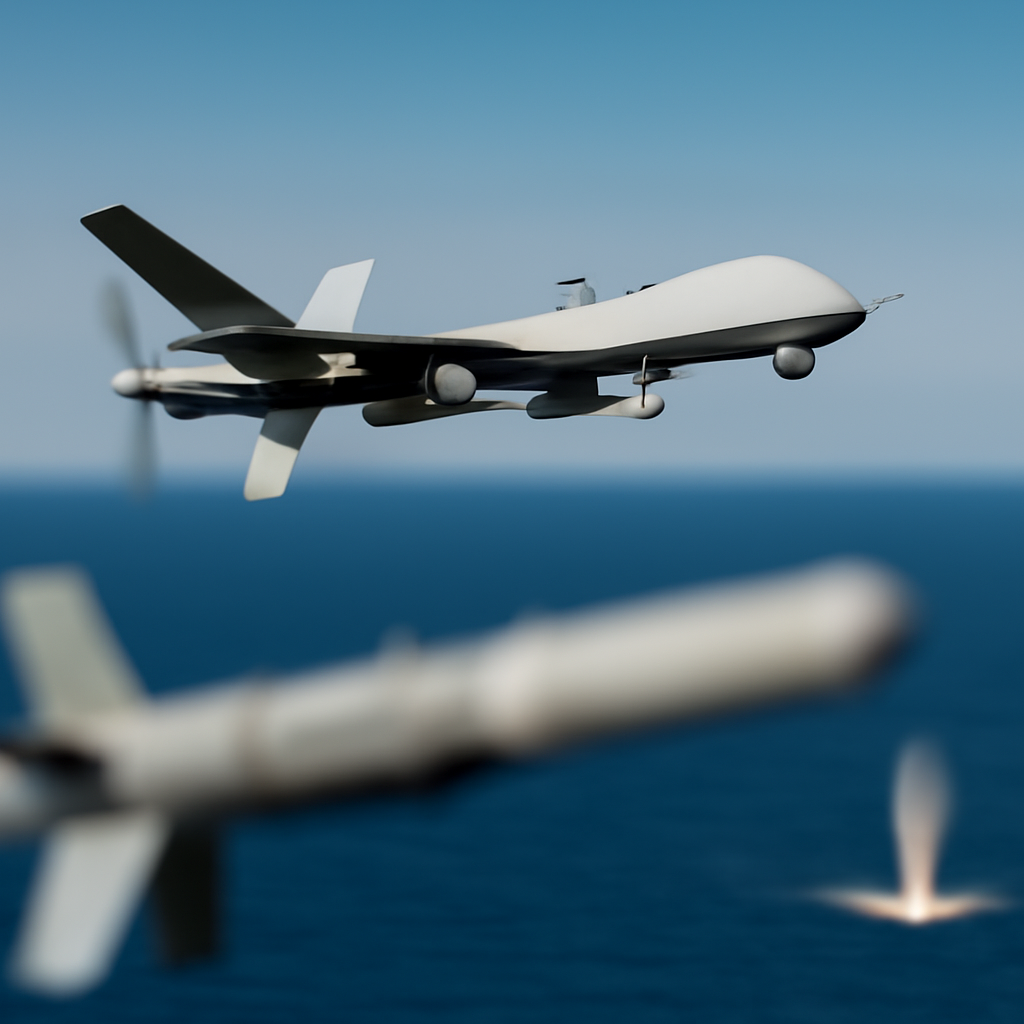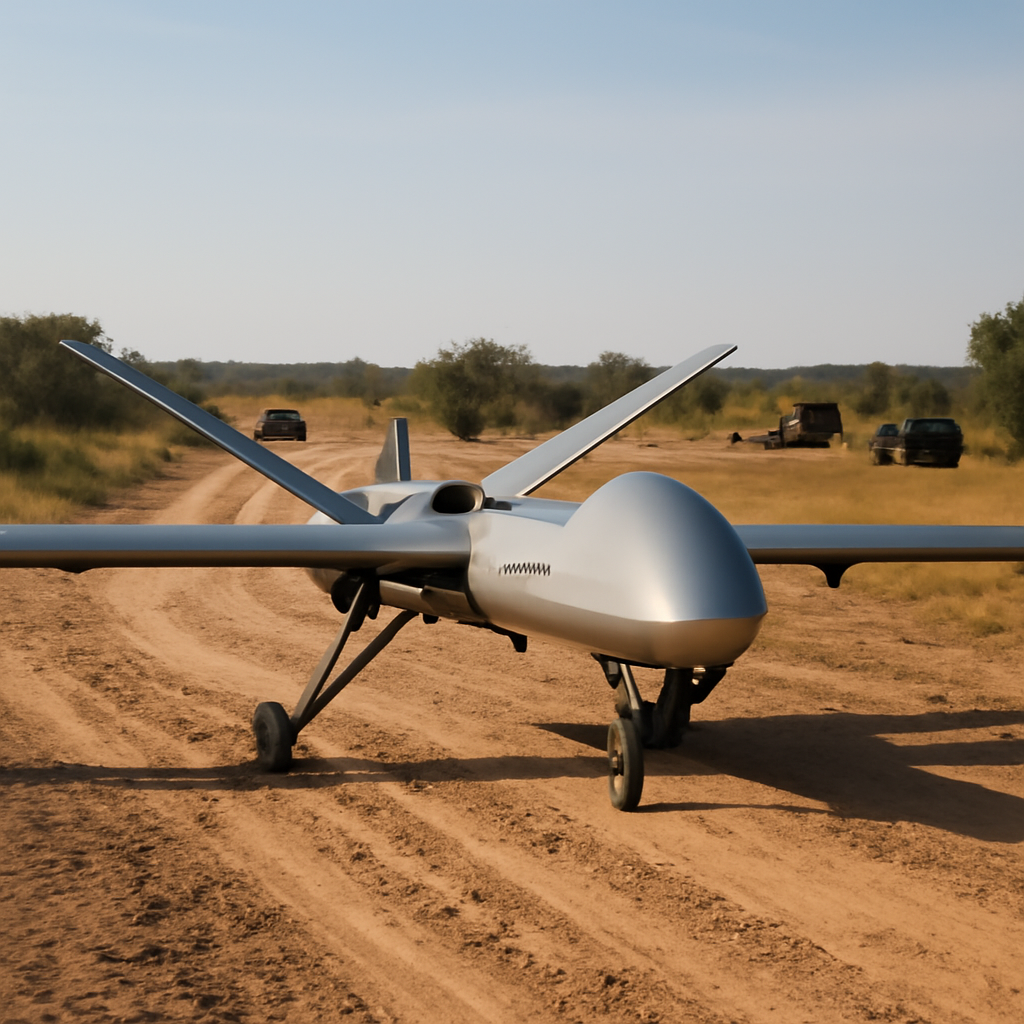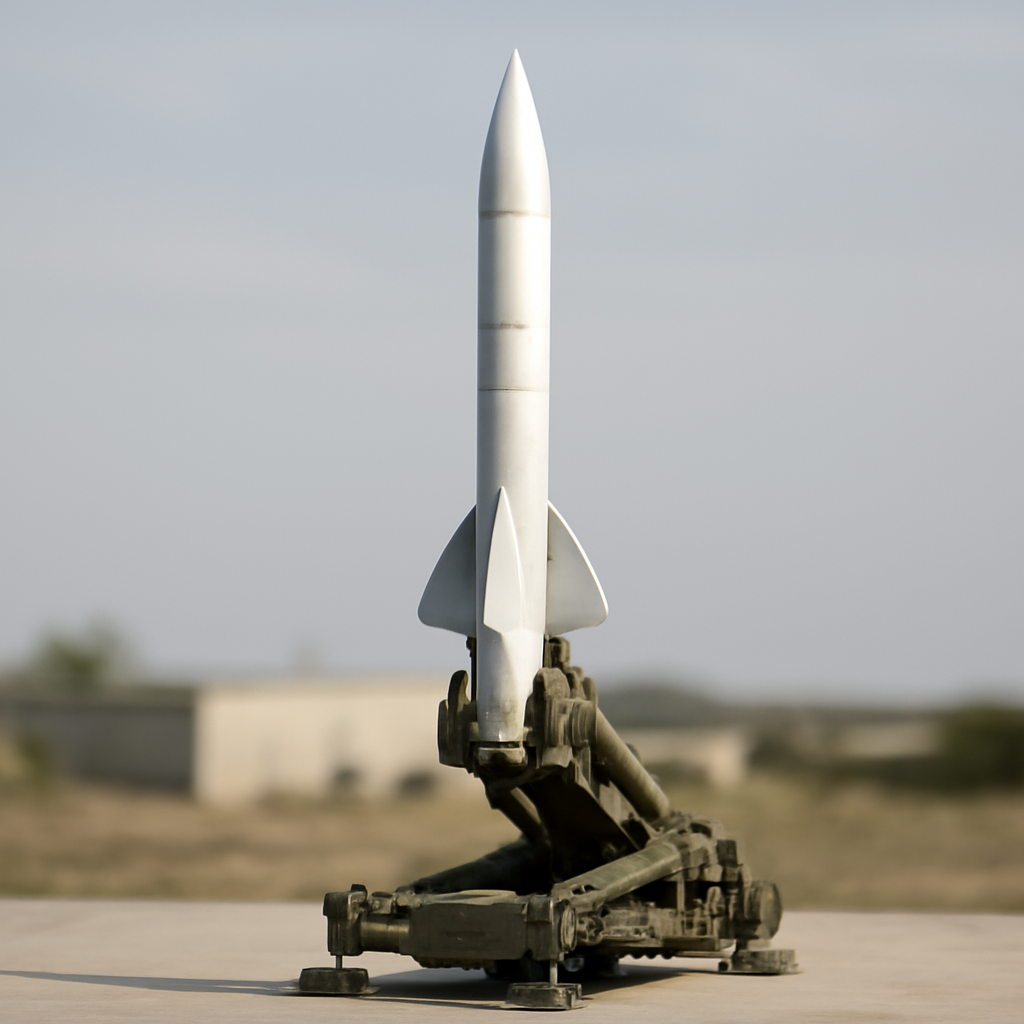
Fire Point has placed at the centre of its case an estimated cost per intercept of under $1 million, set against the several million dollars that a single Patriot PAC-3 engagement is generally understood to consume.
Fire Point's FP-7.x and the Freya concept
Fire Point, a Ukrainian missile and drone manufacturer, has repurposed its FP-7 tactical ballistic missile airframe into an anti-ballistic interceptor called the FP-7.x, forming the core of a broader “Freya” air- and missile-defence architecture. The FP-7.x is described as 7.25 m long with a fuselage diameter of 0.53 m, and Fire Point credits it with a speed band between 1,500 and 2,000 m/s — a figure the company says puts it beneath the roughly 2,100 m/s attributed to the Russian 9M723 Iskander-M at the close of its powered phase but still sufficient to engage a tactical ballistic missile during terminal descent (Militarnyi; Quwa).
The 48N6 lineage, composites, and hot-launch tradeoffs
Fire Point’s design draws visible lineage from the Soviet-era 48N6 interceptor — chiefly the external aerodynamic shape and dimensional envelope — but the company has rebuilt nearly everything inside that envelope. The airframe has been reconstructed in carbon-fibre composite rather than the original metallic structure, lowering claimed unit cost and reducing radar signature; propulsion is an in-house solid-fuel motor with composite casings; and Fire Point abandoned the 48N6’s cold-launch method in favour of a hot-launch from a lightweight mobile launcher mounted on an ordinary truck or trailer (Defense Express; Quwa; Defence Industry Europe; Militarnyi).

Audit-ready is a season. It shouldn't be.
Evidence in spreadsheets, controls drifting between audits, frameworks multiplying on flat headcount. Nubivance runs continuous compliance on Rapid7 Cyber GRC - SOC 2, HIPAA, ISO 27001, PCI, CMMC.
End the scrambleSensor, command layers, and seeker choices
Rather than inventing new sensors and command systems from first principles, Fire Point proposes to stitch the FP-7.x into existing European systems. Long-range detection would rely on radars such as the Hensoldt TRML-4D, Thales Ground Master 400, or SAAB Giraffe; target illumination and guidance could use Leonardo’s Kronos Land or Weibel sets; command-and-control would sit on a Kongsberg Fire Distribution Center; and the whole would exchange data over NATO Link 16, which Ukraine secured the right to use in 2025. Terminal guidance is to be handled by an imaging infra-red seeker, with a German-supplied Diehl Defence semi-active seeker reportedly planned as a complementary option (Quwa; Militarnyi).
Financing, production scale, and the economics of cheap interception
Fire Point’s corporate story matters to its technical claims. The company began in 2022 as a maker of long-range one-way attack drones — notably the FP-1, a system priced at about $55,000 and credited with roughly 1,600 km reach — and scaled rapidly from a small founding team to roughly 3,700 employees and tens of thousands of units in production (United24; Foreign Policy). Early development of the FP-1 was privately funded to about $2 million before a large government order at the close of 2024 measured in the hundreds of millions transformed the company’s prospects; Fire Point then reinvested regulated profits (up to 25%) into further development (Ukrainska Pravda).
The company says it will hold interceptor unit costs down by using a composite airframe, an in-house motor, a dedicated solid-rocket-fuel plant in Denmark, and off‑the‑shelf European sensors and command nodes — and by reusing the same FP-7 airframe for both strike and intercept variants so “one production line and one supply chain” can serve two missions. Quwa, however, cautions that the sub‑$1‑million figure is Fire Point’s own claim and that true economics will depend on production volumes and integration costs not yet visible externally (Militarnyi; Quwa).
What this means for Pakistan’s services, private firms, and foreign partners
- Pakistan’s services (Pakistan Air Force, Pakistan Army): The article argues Pakistan faces a similar cost‑exchange problem and that a cheaper, scalable interceptor could sharpen national air defence resilience against saturating threats — a vulnerability the source links to reliance on foreign-controlled inventory and replenishment cycles for Chinese systems such as HQ-9/P, HQ-9BE, HQ-16/LY-80 and HQ-16FE (Quwa).
- Private Pakistani firms (Woot-Tech, Sysverve): Quwa highlights domestic companies already producing loitering munitions and other systems as precedents that could be scaled under an industrial model resembling Fire Point’s trajectory, if matched with procurement pathways that favour private suppliers over a default state-only route.
- Foreign partners and investors (EDGE Group, “Danish model” funders): The piece notes how foreign financing and equity — EDGE Group’s reported pursuit of a 30% stake worth roughly $760 million and the use of direct foreign funding under the so-called “Danish model” — were central to Fire Point’s rapid scale, suggesting that Gulf or Turkish partners may prefer co‑ownership arrangements with private firms rather than state arsenals (United24; Ukrainska Pravda).
Fire Point’s FP-7.x is not presented as a finished, front-line substitute for the highest‑end interceptors; its top speed sits beneath the Iskander‑M’s, and terminal interception of manoeuvring warheads remains technically demanding (Militarnyi). The larger argument the company and Quwa advance is institutional: a cheap, scalable platform and a financing model that blends private velocity with foreign capital can change the arithmetic of saturation warfare. For Pakistan — where Quwa locates a similar dependence on expensive, foreign‑sourced interceptors and a nascent private supply base — the critical test will be whether partnership frameworks and procurement oversight can be arranged so private‑sector speed and public accountability march in step, rather than whether any single design can immediately displace high‑end systems (Quwa).