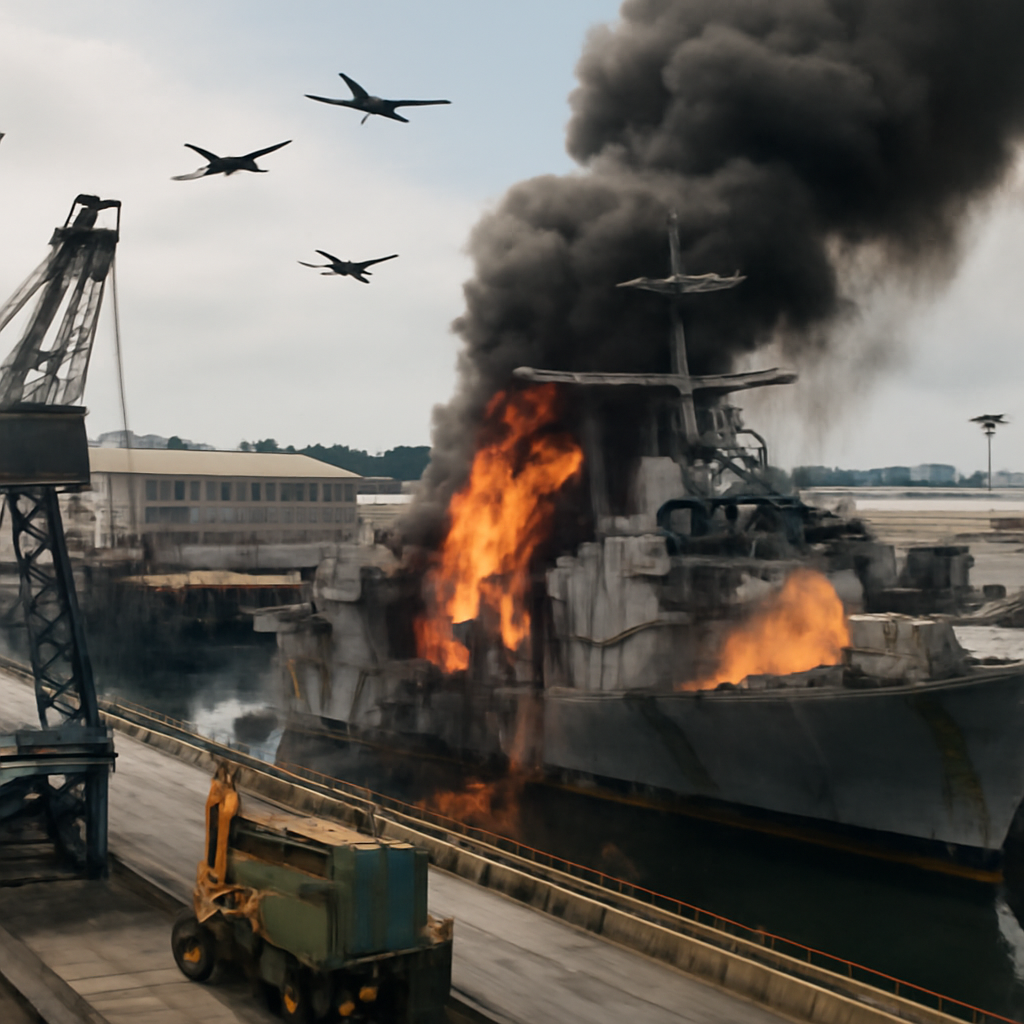
The strike at Kronstadt’s Veleshchynskyi dry dock
Video and official Ukrainian posts say the Project 20380 Steregushchiy‑class corvette Boikiy was set ablaze while in the Veleshchynskyi dry dock in Kronstadt, where it reportedly entered scheduled maintenance in February. The Ukrainian 414th Separate Unmanned Strike Aviation System Brigade posted footage on X showing the vessel burning from multiple angles; multiple drones were said to have been involved, producing seeker feeds that captured different approaches to the ship.
Who Ukraine says conducted the attack and how the drones reached the target
Ukrainian sources named the 1st Separate Center of Ukraine’s Unmanned Systems Forces and the 414th brigade as perpetrators. Reports and video from the strike show drones identified in other footage as FP‑1/2 types operating low over the Gulf of Finland. Observers noted that seeker video was available from long range, which the source material says indicates either a local operator near the target recorded the feed or that a satellite communications link relayed it; while autonomous guidance is conceivable, the footage implies someone nearby or connected via satcom recorded the drone perspective. The source also allows for the remote possibility that shorter‑range drones participated, although that was judged less likely.

This site is the portfolio.
OSINTSights runs on Cloudflare Workers, D1, R2, and Vectorize, with an AI pipeline on Hetzner ARM. Nubivance designed, built, and operates it. We do the same for clients.
See what we buildAttacks across Saint Petersburg: oil terminals, districts, and the economic forum
The Kronstadt strike was part of a broader barrage against military and energy infrastructure in and around St. Petersburg. Several long‑range drones reportedly crashed into oil storage facilities after Russian air defenses failed to intercept them; footage showed loud explosions and thick black smoke rising from what was described as one of the largest oil terminals on Russia’s Baltic coast. Saint Petersburg governor Alexander Beglov confirmed strikes on the Kirovsky and Krasnoselsky districts. Video circulated showing FP‑1 drones skimming meters above the Gulf of Finland and flying in formation above an oil terminal, one dive‑bombing into storage facilities.
The attacks occurred hours before the St. Petersburg International Economic Forum (SPIEF 2026) opened; attendees arrived under a pall of smoke and the city’s airport was temporarily closed. President Vladimir Putin was scheduled to deliver a keynote at the event on Friday, according to the source. Zelensky also listed a weapons factory in the Tambov region among the facilities hit.
Why Kronstadt and the Boikiy matter to naval operations and oil exports
Kronstadt, on Kotlin Island in the Gulf of Finland about 18 miles west of St. Petersburg, is described in the source as a principal base for the Baltic Fleet — hosting corvettes, patrol vessels, support ships, training units, and maintenance facilities — and acting as the maritime gateway to Russia’s second‑largest city. Ukraine’s Unmanned Systems Forces said the Boikiy had been involved in escorting vessels from Russia’s so‑called shadow fleet, a collection of older tankers operating under foreign flags used to export Russian oil despite Western sanctions. That linkage made the corvette, according to Ukrainian statements, a direct participant in protecting sanctioned oil shipments.
The source notes the Steregushchiy class as among Russia’s more modern corvettes, with a standard displacement of 1,800 tons, a length of 343 feet, a helicopter flight deck, two quadruple Uran anti‑ship missile launchers, a 12‑cell Redut vertical‑launch air‑defense system, and two quadruple Paket‑NK anti‑torpedo/anti‑submarine tubes. The reporting frames the attack as opening a new front in the drone war by striking Baltic Fleet assets while in port.
What this means for Ukraine’s Unmanned Systems Forces, the Baltic Fleet, and SPIEF attendees
- Unmanned Systems Forces: The public attribution and video feeds underline Kyiv’s intent to showcase long‑range strike capability and remote targeting integration — whether via local operators or satcom relays — and to project operational reach toward maritime targets far from frontline zones.
- The Baltic Fleet and shadow‑fleet escorts: Striking a corvette tied to escorts for tankers signals increased vulnerability of ships conducting protection, monitoring, and security missions for tankers carrying sanctioned oil; the attack demonstrates that such missions can be contested even while ships are in home ports or maintenance.
- SPIEF attendees and Russian civil authorities: The strikes produced visible disruption — smoke over the city, temporary airport closure, and impacts near the forum venue — highlighting the risk to civilian and diplomatic gatherings when military and energy infrastructure are targeted in proximity to major events.
The source places the targets roughly 680 miles from Ukraine’s nearest border, underscoring the range involved in these strikes. Whether the overnight strike caused decisive physical damage to the Boikiy and other targets is not settled in the material; nevertheless, the reporting concludes the strategic message was unmistakable: by reaching Kronstadt, Ukraine demonstrated the Baltic Fleet is within reach of its long‑range unmanned arsenal. The immediate operational and political responses — from changes to naval basing and convoying practices to upgrades in local air and maritime defenses — remain the next steps the facts leave open.



