“A new era of war begins with the decisions of courageous commanders,” the 123rd Separate Territorial Defense Brigade declared on its Telegram page after publishing video of an operation that, the reporting says, represents the world’s first known combat mission in which a sea drone transported and deployed an armed ground robot behind Russian lines on the occupied Kinburn Spit.
How the Kinburn Spit operation unfolded
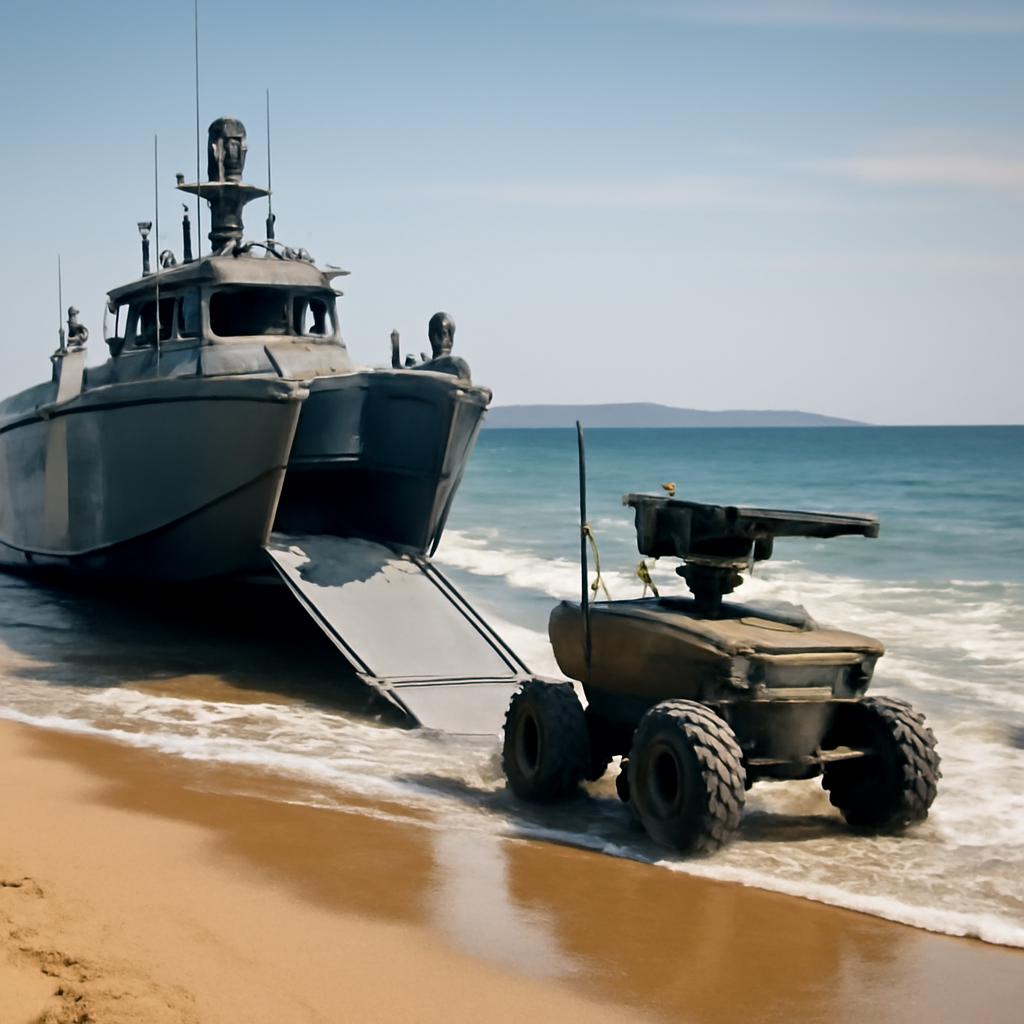
The brigade published footage showing an uncrewed surface vessel (USV) approaching and beaching on the Kinburn Spit before lowering a bow ramp. A wheeled uncrewed ground vehicle (UGV) then drove ashore, armed with a 7.62mm machine gun, and engaged a target beyond the beach. The USV later departed; the footage does not make clear whether any attempt was made to recover the UGV.
The mission was carried out by Ukraine’s 123rd Separate Territorial Defense Brigade and led by its commander, Col. Oleg Makukha, with the 1st Unmanned Systems Battalion under Maj. Denys Gipik identified as the unit responsible for the operation. Video sources shown by the brigade included views from an overhead aerial drone, from the UGV itself, and from the transporting vessel.
The robotic systems used: Rys UGV and a motor-powered USV
The ground vehicle seen in the footage appears to be a member of the Rys family produced by Roboneers and equipped with a 7.62mm machine gun. The reporting notes that Rys platforms typically incorporate a ballistic computer for accurate fire and artificial intelligence that assists with autonomous target detection, tracking, and engagement.
The Rys family is described as already widely used in Ukraine for logistics, casualty evacuation, combat engineering, and combat support missions, with variants configured for minelaying and demining. The broader record cited alongside the Kinburn operation includes examples such as a robotic evacuation vehicle that rescued a wounded soldier despite striking two mines on its return route; the vehicle’s armored capsule reportedly protected the wounded occupant.
The transporting surface vessel in the published footage was powered by an outboard motor and performed a beaching and bow-ramp deployment sequence that allowed the wheeled UGV to disembark directly onto the spit.

This site is the portfolio.
OSINTSights runs on Cloudflare Workers, D1, R2, and Vectorize, with an AI pipeline on Hetzner ARM. Nubivance designed, built, and operates it. We do the same for clients.
See what we buildKinburn Spit as operational context
The roughly six-mile-long Kinburn Spit overlooks the mouth of the Dnipro River and has been heavily contested. Russian forces occupied the spit in the summer of 2022 and reportedly used it as a base for electronic warfare systems and for missile and artillery strikes. Concrete bunkers and a reported drone control station were constructed there.
Ukraine has repeatedly targeted the spit since late 2022 with reconnaissance, raids, and precision strikes. The Institute for the Study of War reported in June that Russian troops had withdrawn from the spit under sustained Ukrainian pressure, and Ukrainian marines later flew a national flag there using a drone. Ukraine’s Southern Defense Forces said on June 25 that Russian forces “retreated under heavy fire, with the evacuation of surviving personnel continuing.” Whether Russian forces have since returned in some capacity is not clear from the published material; the latest operation may have been reconnaissance, a technology demonstration, or both.
What this means for Roboneers, Ukraine’s Defense Forces, and Russian forces
- Roboneers: The apparent combat deployment of a Rys-family UGV ashore from a USV showcases the company’s hardware in a combined maritime–ground uncrewed role, underscoring the Rys variants’ modularity for gunnery, logistics, casualty evacuation, and engineering tasks.
- Ukraine’s Defense Forces: Kyiv’s leadership has signaled prioritization of UGVs. President Volodymyr Zelenskyy tweeted on April 27 that UGVs are “one of the most urgent needs of our Defense Forces” and called for higher volume contracting; the Kinburn operation demonstrates an operational use-case for reducing troop exposure in hazardous coastal approaches.
- Russian forces: The spit’s geography and previous use as an observation, EW, and strike base make it a logical target for Ukrainian experimentation with uncrewed approaches; published accounts note Russian occupation in 2022, later withdrawal under pressure, and uncertainty about any subsequent return, meaning robotic raids could complicate defensive calculations on exposed coastal terrain.
Conclusion
The Kinburn Spit footage offers a clear proof-of-concept: a motor-powered USV can deliver a weaponized UGV ashore, the UGV can self-deploy and engage, and the operation can be filmed from multiple uncrewed platforms. The 123rd Brigade’s prediction — “It’s going to get even more interesting” — frames the deployment as both tactical experiment and demonstration. Whether similar missions will be repeated, whether UGVs will be routinely recovered after such landings, and how opposing forces will adapt remain open questions tied to developments the footage itself documents.
Original reporting: Ukraine Lands Armed Robot Ashore In Russian-Held Territory Via Drone Boat — TWZ