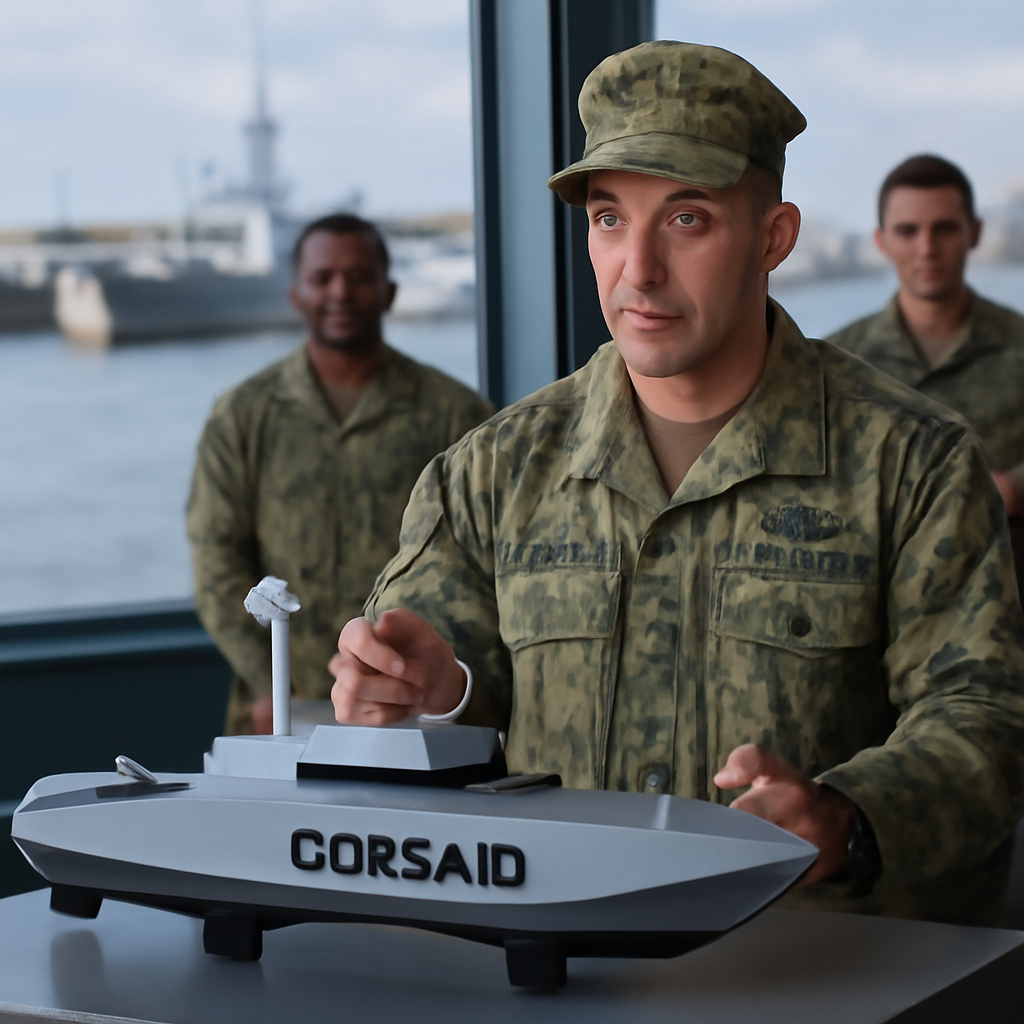
"Yesterday, using multiple one-way attack surface drones, CENTCOM forces successfully struck a submarine and ship maintenance facility in Iran," U.S. Central Command (CENTCOM) stated on X.
CENTCOM: three Corsair USVs struck Bandar Abbas Naval Base
On July 12, CENTCOM said three Saronic Corsair unmanned surface vessels (USVs) struck the port at Bandar Abbas Naval Base, marking, the command said, "the first time American forces have employed sea drones in combat operations." CENTCOM described the targets as a submarine and a ship maintenance facility and said the strikes "degraded Iran’s ability to continue attacking commercial shipping." The command published video footage that CENTCOM later said appears to show one of the Corsair USVs attacking what looks to be a Ghadir class diesel-electric midget submarine.
Saronic, Task Force 59 and the operational use of Corsair USVs
Saronic confirmed CENTCOM’s account in a company statement, saying three "military variant Corsair unmanned surface vessels (USVs) struck a submarine and ship maintenance facility at Bandar Abbas Naval Base" and that the company was "proud that our technology supported this mission and helped degrade threats to commercial shipping." The use follows an earlier reported employment of a Corsair USV in a non‑kinetic but operational role: last month a Corsair rescued the crew of a U.S. Army AH-64 Apache that crashed in the Gulf of Oman. U.S. Navy Capt. Tim Hawkins, a CENTCOM spokesman, told TWZ that the surface drone that assisted in that rescue "was a U.S. Navy Corsair unmanned surface vessel operated by U.S. 5th Fleet’s Task Force 59" and that the task force "began fielding these drones in theater in late March."

Audit-ready is a season. It shouldn't be.
Evidence in spreadsheets, controls drifting between audits, frameworks multiplying on flat headcount. Nubivance runs continuous compliance on Rapid7 Cyber GRC - SOC 2, HIPAA, ISO 27001, PCI, CMMC.
End the scrambleTask Force 59’s role and the broader push to field autonomy
Task Force 59, established in 2021, is described in CENTCOM and TWZ reporting as a testbed unit tasked with experimenting with the integration of uncrewed and artificial intelligence capabilities into day‑to‑day naval operations across the Middle East. Observers in the source material argue that the move from testbed experimentation to a combat strike role signals the task force is "starting to operationalize" those technologies more broadly. Saronic co‑founder Rob Lehman—while declining to discuss mission details—told TWZ that the operation's success will ripple through the USV industry, saying autonomous systems are now perceived "as real credible capabilities rather than a science and technology kind of sideshow."
Precedent and operational lineage: Iran, the Houthis, and Ukraine
The CENTCOM strike joins a string of prior operational cases for kamikaze and one‑way unmanned systems cited in the reporting. The piece notes that Houthi rebels pioneered operational use of kamikaze USVs, including a January 2017 incident in which an explosive‑laden Houthi USV struck a Saudi frigate. Iran is described as having developed crude kamikaze USVs that later migrated to Houthi proxies. The account also references Ukraine's use of USVs—specifically the Magura line—against the Russian Black Sea Fleet, and it notes that the Pentagon has earlier fielded one‑way attack drones loosely based on Iran's Shahed‑136 design.
President Trump's statements and CENTCOM's resumption of a blockade
The strikes took place amid a breakdown in a ceasefire framework and public remarks by the president. The president told Fox News, "We hit them very hard last night," and said, "We’ll become the guardian of the Strait," adding, "Maybe we’ll call it the guardian angel of the Strait." He also posted on Truth Social that the United States is "reinstating the naval blockade on Iranian ports" and proposed a toll, writing that "The U.S.A. will be, from this point forward, known as 'THE GUARDIAN OF THE HORMUZ STRAIT,' ... and as a matter of FAIRNESS, will be reimbursed, at the rate of 20% on all cargo shipped." CENTCOM followed with formal operational direction: it said CENTCOM forces will resume blockading maritime traffic entering and exiting Iranian ports on July 14 at 4 p.m. ET, enforcing the blockade against vessels transiting to or from Iranian ports and coastal areas while continuing to "support traffic flow through regional waters for all vessels not violating the blockade."
What this means for Saronic, U.S. 5th Fleet Task Force 59, and commercial mariners
- Saronic: The company framed the mission as validation—its statement said Corsairs helped "degrade threats to commercial shipping" and reaffirmed the firm’s commitment to delivering autonomous maritime systems that "strengthen the security of the United States and its allies."
- U.S. 5th Fleet Task Force 59: Reporting ties the strike to the task force’s recent transition from experimentation to operational use, noting that fielding began in late March and that the unit's mandate is to integrate uncrewed and AI capabilities into naval operations.
- Commercial mariners: CENTCOM advised mariners to monitor Notice to Mariners broadcasts and to contact U.S. naval forces on bridge‑to‑bridge channel 16 when operating in the Gulf of Oman and Strait of Hormuz approaches; the command also said additional information will be provided through a formal notice.
The July 12 strikes mark the first recorded use of American sea drones in a strike role and, per CENTCOM and industry commentary in the reporting, establish a new operational precedent. CENTCOM’s video, the Saronic statement, the earlier Corsair rescue, and the command’s scheduled resumption of a blockade on July 14 together illustrate how uncrewed surface vessels have moved from testbed experiments to active tools in theater. The immediate practical questions—how frequently Corsairs will be employed in strikes, how blockade enforcement will be conducted in practice, and how Iran’s remaining coastal assets will be affected—remain to be answered by subsequent operational reporting.
Original story: TWZ — Kamikaze Drone Boats Used By U.S. In Combat For The First Time (Updated)