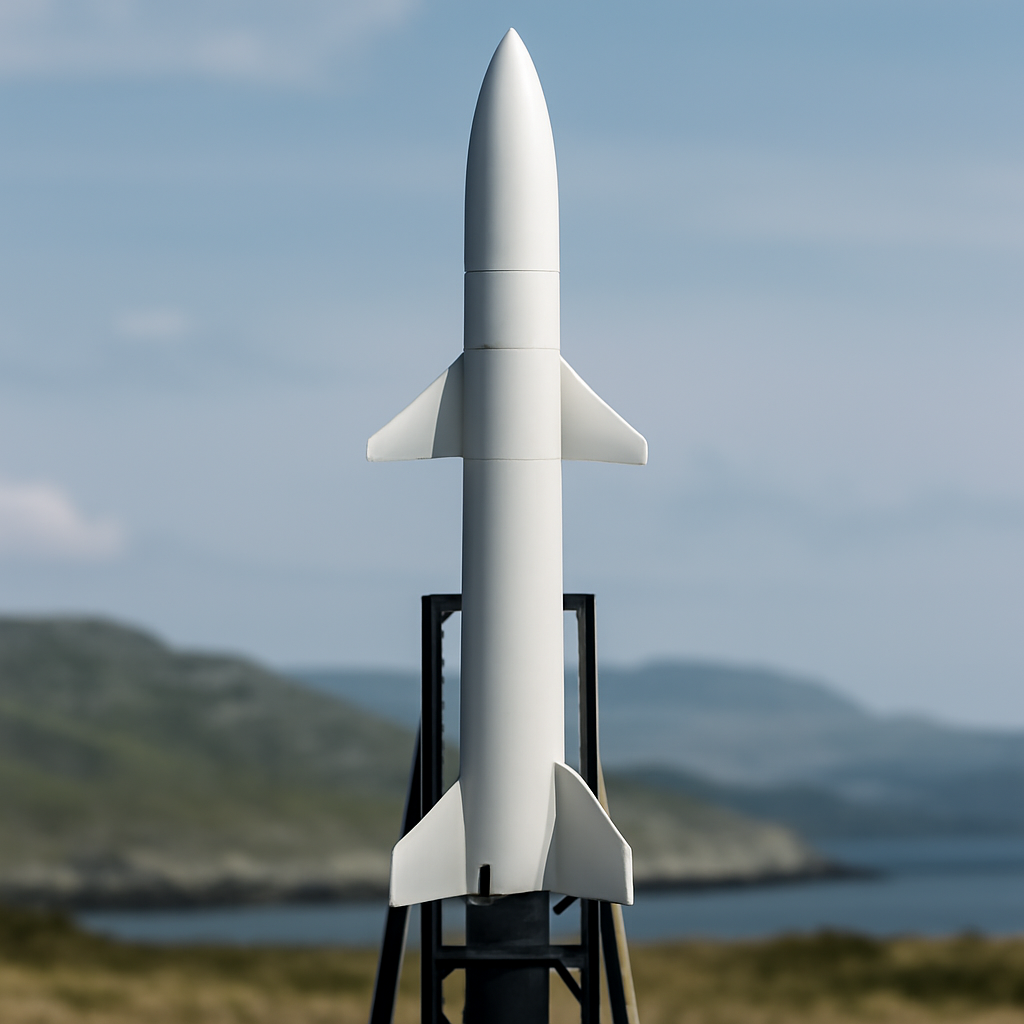
On 22 June 2026 the United Kingdom’s Ministry of Defence announced that three British‑designed long‑range strike weapons had completed flight tests at the Hebrides Range, a QinetiQ‑managed test site, under Project Brakestop — a rapid effort to field a cheap, ground‑launched deep‑strike capability for Ukraine.
Project Brakestop: requirements, timeline, and intent
Launched by the MoD’s Taskforce Kindred in November 2024, Project Brakestop challenged UK industry to deliver a ground‑launched weapon able to strike targets more than 500 km away while carrying a 225 kg warhead. The MoD set a baseline: range of at least 500 km, speed above 600 km/h, a warhead of at least 225 kg, a target unit cost of roughly £400,000 excluding the warhead, and the ability to produce at least 20 weapons a month within months of a production order.
A central condition was that the weapons contain no US components and use no US data. Reporting by Bloomberg via the Kyiv Post framed this requirement as intended to keep the systems free of third‑country restrictions when gifted to Ukraine. UK officials have said that independence would let them decide what to gift and how it is used without waiting on US approval.
The three finalists and how they differ
The competition drew 27 bids and moved quickly. After “Dragon’s Den”‑style pitches in February 2025, six firms received around £5 million each to build prototypes in seven months; by December 2025 the field had been reduced to three finalists. Each finalist meets the baseline differently:
- MBDA UK: The only established prime in the final three, and maker of Storm Shadow, entered Crossbow — a ground‑launched deep‑strike weapon. Crossbow completed firings in December 2025 and February 2026, with production targeted for 2026. The MoD says Brakestop munitions will be less precise than the Anglo‑French Storm Shadow but cost roughly half as much.
- MGI Engineering: An Oxfordshire firm founded by former Formula One technical director Mike Gascoyne, competing with TigerShark in its first defence contract. The company says TigerShark carries up to 300 kg of payload at speeds up to 750 km/h out to a range of 900 km, and uses an Auterion‑integrated navigation package built to work in GPS‑denied conditions. MGI describes a modular, open payload bay intended for rapid upgrades.
- Rotron Aerospace: Now owned by Nasdaq‑listed Ondas Inc., Rotron offers SkyLance, a propeller‑driven one‑way effector. Rotron says its UK‑designed propulsion reaches up to 1,200 km with a full payload, and further with a lighter payload; the company also says the programme has created over 160 UK jobs.

Audit-ready is a season. It shouldn't be.
Evidence in spreadsheets, controls drifting between audits, frameworks multiplying on flat headcount. Nubivance runs continuous compliance on Rapid7 Cyber GRC - SOC 2, HIPAA, ISO 27001, PCI, CMMC.
End the scrambleCost, production targets, and export‑control logic
All three effectors share a target unit cost of about £400,000 excluding the warhead, and the MoD required the ability to ramp to at least 20 units a month. The competing firms have indicated they could produce around 40 units a month within three to four months of an order.
The no‑US‑components/no‑US‑data condition is explicit: it is intended to avoid third‑country export restrictions on systems gifted to Ukraine. The MoD has framed this independence as a way to act without having to wait for US approval — a constraint the reporting links to prior delays in Ukrainian strikes on certain Russian targets.
Follow‑on contracts, testing, and related UK programmes
On 22 June 2026 follow‑on contracts worth around £15 million each were awarded to the three suppliers. The contracts fund 15 improved effectors from each supplier alongside launchers and support vehicles; further UK trials are planned, followed by overseas testing including in Ukraine.
Brakestop sits alongside other Taskforce Kindred rapid programmes. Project Nightfall is a ground‑launched tactical ballistic missile carrying a 200 kg warhead beyond 500 km, targeting a £800,000 unit price and 10 systems a month, firing in salvos from ordinary vehicles and built to “shoot and scoot” in heavy jamming; the MoD has said Nightfall carries “minimal foreign export controls.” At the lower‑cost, higher‑volume end is Project Octopus, a Ukrainian interceptor drone design that Kyiv has agreed to share — intellectual property included — so the UK can mass‑produce it at thousands of units a month. The Brakestop announcement coincided with a broader UK support surge that included a £752 million aid package, 150,000 Ukrainian‑made drones, and more than 350 air‑defence missiles and radars funded through the Extraordinary Revenue Acceleration loan.
What this means for the MoD, Ukraine, and the suppliers
For the MoD: Brakestop demonstrates an intent to field affordable, export‑control‑free strike options rapidly, and to rebuild a munitions production capability the department says has been thin. The programme is also positioned to inform future British long‑range strike projects.
For Ukraine: The designers aim to deliver affordable mass — lower‑precision, lower‑cost munitions that can be produced and, through planned trials and production inside Ukraine, absorbed into Ukrainian industry and logistics.
For the manufacturers (MBDA UK, MGI, Rotron): Each has moved from contract to flight test in months rather than years, and each now faces the practical task of scaling production to tens of weapons per month while delivering launchers, support vehicles and improved effectors under the new £15 million follow‑on contracts.
Brakestop flew this month; the immediate next steps are additional British and overseas trials and the beginnings of scaled production. The programme’s headline constraint — keeping systems free of US components and data — remains the defining choice: it tightens who can help build these weapons while widening who the UK can hand them to. The project’s speed and its place alongside Nightfall and Octopus sketch a deliberate UK strategy to move quickly on fixed‑price, export‑control‑light weapons that can be produced in quantity and shared with Kyiv.