“When the lights went out, we learned where the switches were.” Who flipped the switch in Tehran — and what else did the blackout reveal? In January’s sweeping communications shutdown, Iran did more than block apps and foreign websites: authorities pulled the global internet’s plug, creating a two-tiered communications environment whose consequences extend far beyond intermittent outages.
The blackout was not a routine content takedown. Reports from internet-monitoring groups described one of the most severe, sustained communications shutdowns in Iran’s recent history, an event that cut ordinary citizens off from social media, messaging platforms and the global web for days. While previous shutdowns left Iran’s domestic intranet — the National Information Network (NIN) — running to preserve banking and administration, the 2026 action exceeded that pattern, producing a near-total communications freeze that exposed vulnerabilities in both civic life and international information ecosystems .
Technologists and researchers treating the blackout as more than a censorship maneuver found an unintended intelligence dividend: the disruption acted as a forced audit of digital infrastructure and influence networks. Analysts observed that numerous accounts tied to foreign influence operations vanished during the outage, suggesting centralized hosting or control points that became visible when Tehran’s links to the global internet were severed. “The blackout functioned as a forced ‘audit’ of active influence networks,” said Dr. Rachel White of Graphika, underscoring how opacity can suddenly give way to clarity under pressure .
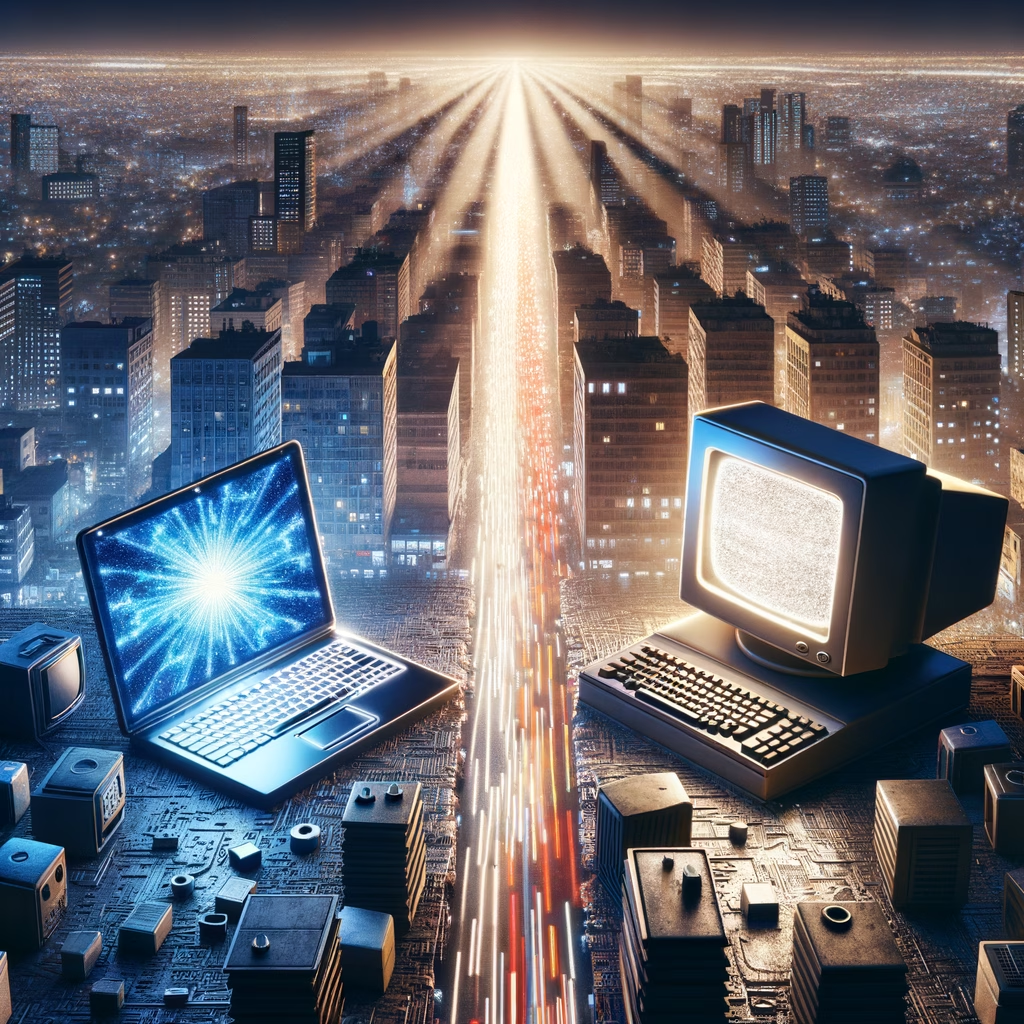
This is the practical meaning of a two-tiered internet. On one tier sit state-curated, intranet-style services intended to keep administrations and select industries functioning; on the other sits the open, global internet that enables dissent, journalism, commerce and cross-border digital communities. A two-tiered system permits governments to tune access — throttling or severing external links while maintaining internal services — and thereby target civic communication without entirely collapsing essential services. The 2026 shutdown, however, blurred even that distinction, demonstrating that a hardline tactic can inadvertently expose the anatomy of influence operations and surveillance architecture when the pipes go quiet .
Why this matters: the blackout was both blunt instrument and a revealing experiment. For domestic users it was disorienting and punitive — millions of Iranians found themselves isolated from news, family abroad, and verification tools at a moment of political sensitivity, a reality human rights groups flagged as an assault on freedom of expression. At the same time, digital researchers gained insight into the centralization of certain disinformation campaigns, evidence that those networks are vulnerable when the state severs international connectivity .
Different stakeholders read the incident through distinct lenses:
- Technologists: The blackout provided a rare “natural experiment,” revealing control points for coordinated inauthentic behavior and underscoring the need to map hosting locations and command infrastructure to better detect and counter influence campaigns. As Anil Dash of Glitch noted, identifying physical hosting and control points is crucial to building resilience against manipulation .
- Policymakers: The episode raises complex questions about how democratic societies should respond to state shutdowns that both violate citizens’ rights and intermittently reveal the mechanics of cross-border interference. It complicates the calculus of sanctions, diplomacy and platform governance .
- Users and civil society: The human cost is immediate: disrupted livelihoods, blocked access to emergency information, and an atmosphere of fear that chills free expression. Activists and journalists face heightened risk in an environment where connectivity can be weaponized against them .
- Adversaries and state actors: For regimes and covert operators the blackout is a double-edged sword — it silences dissent domestically while potentially masking the origins of influence operations abroad. Conversely, the interruption revealed that some foreign meddling depends on centralized infrastructure vulnerable to disruption .
There are policy and technical implications. Internationally, the blackout underscores the need for norms and tools to protect free expression online, and for contingency planning that preserves essential services and independent information flows during crises. For platforms and civil-society groups, the incident illustrates both the difficulty of attribution in the fog of digital conflict and the opportunities presented by infrastructure disruptions to better understand malign networks.
At the same time, responses require caution. Disrupting centralized influence infrastructure can produce collateral damage, accidentally silencing legitimate actors or creating instability in foreign political dialogues. Scholars and practitioners warn that measures to counter misinformation must avoid heavy-handed approaches that further erode trust in online spaces; “the fight against misinformation is not just about technology—it’s about democracy, human rights, and holding power to account,” Maria Ressa has observed in related discussions about media manipulation and free expression .
From a technical standpoint, resilience depends on diversity of routing, redundant communication channels, secure decentralized messaging, and pressure on vendors that enable censorship or state control. From a governance standpoint, it depends on multilateral dialogue about acceptable state behavior, sanctions for abuses that target civilian communications, and support for independent verification and human-rights monitoring during shutdowns.
The 2026 Tehran blackout should not be read as a one-off anomaly. Rather, it is symptomatic of a broader contest: the struggle to keep the internet global and open against pressures to fragment it into state-controlled enclaves. The two-tier model offers authoritarian states a template for managing dissent while maintaining nominal functionality — and that model, if left unchecked, threatens freedoms well beyond any single border .
If the blackout taught one lesson, it is this: the architecture of control can become the architecture of exposure. By severing links to the wider internet, Tehran inadvertently exposed the central nerves of influence and surveillance that normally run in shadow. Policymakers, technologists and defenders of free expression must decide whether to treat that exposure as an opportunity to strengthen global norms and resilience — or to allow the two-tier model to calcify into a permanent instrument of repression.
In a world where a single state’s action can silence millions and reshape foreign information campaigns, the central question remains: will the international community marshal the tools and the will to defend an internet that remains, at its best, a shared commons rather than a patchwork of closed gardens?
Source: https://www.schneier.com/blog/archives/2026/02/why-tehrans-two-tiered-internet-is-so-dangerous.html