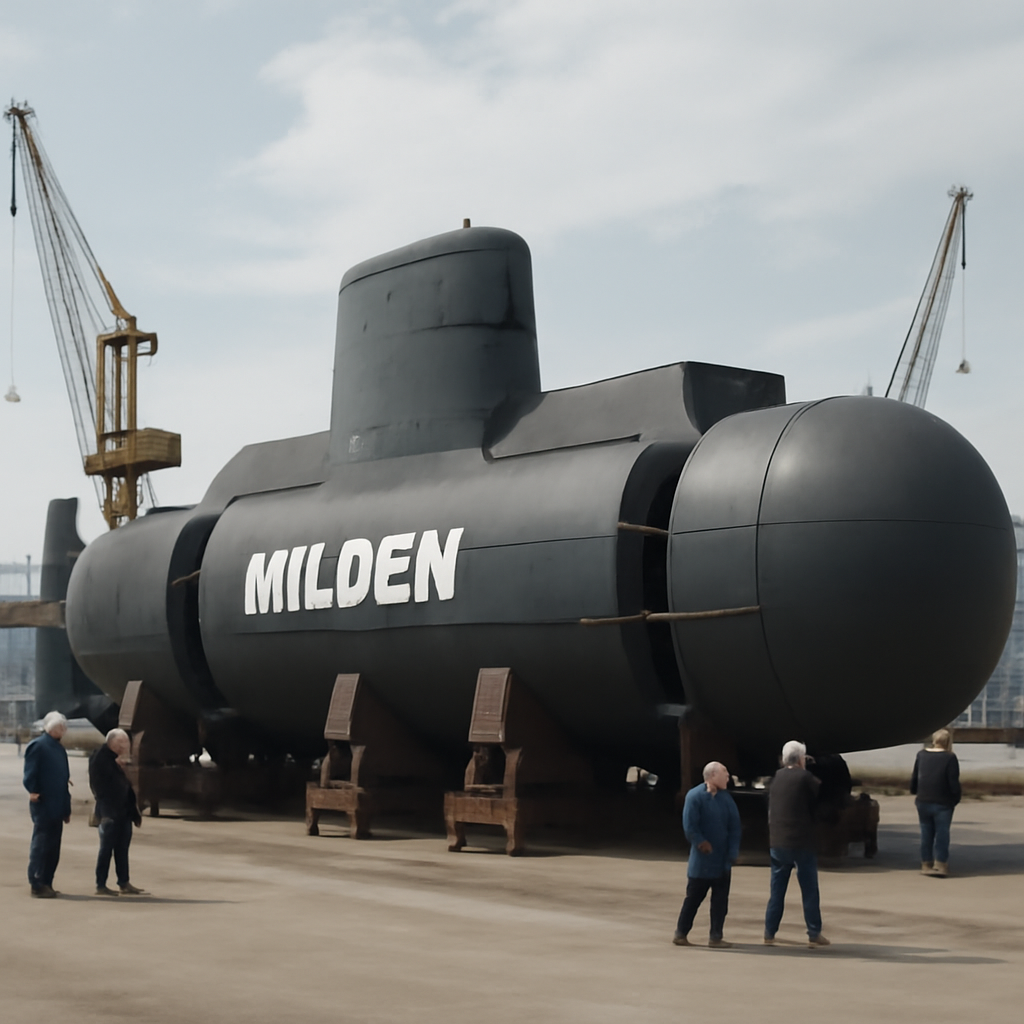
ASFAT lists the new MİLDEN submarine at "more than 80 metres" in length with a surfaced displacement of approximately 2,700 tonnes and a crew complement of 40 — a compact human footprint on a boat that otherwise sits near the upper end of contemporary non-nuclear conventional designs.
Dimensions, habitability and modular architecture
In late August 2026 ASFAT released a set of baseline dimensions and platform concepts after the first hull block’s public debut at TEKNOFEST Mavi Vatan, held at Gölcük Naval Shipyard from 20–23 August. The company gives MİLDEN a length of more than 80 metres, a beam of more than 7 metres, a draught of 6.8 metres and a surfaced displacement of approximately 2,700 tonnes. The program covers six boats and ASFAT names the first hull Atılay.
ASFAT describes a modular architecture intended to permit later upgrades and a complement of 40 personnel. The published figure for crew size is low for a vessel in this displacement band and the company frames the small team as consistent with an emphasis on heavy automation in both combat-system and platform-management functions.
Weapons payload and vertical-launch capability
ASFAT specifies a vertical launch capability for land-attack missions alongside support for special-forces tasks. Earlier disclosures attached to the programme list eight 533 mm torpedo tubes for the Roketsan Akya heavyweight torpedo, a submarine-launched Atmaca anti-ship missile and the Gezgin land-attack cruise missile.
Roketsan’s MİDLAS vertical launcher is specified for both hot and cold launches. Roketsan has separately identified an Atmaca UM land-attack variant with roughly 400 km range as an interim round until Gezgin matures, and has proposed a folding-fin Tayfun that would fit strike-length MİDLAS cells. ASFAT’s public specifications do not state the number of MİDLAS cells fitted to the design.

Audit-ready is a season. It shouldn't be.
Evidence in spreadsheets, controls drifting between audits, frameworks multiplying on flat headcount. Nubivance runs continuous compliance on Rapid7 Cyber GRC - SOC 2, HIPAA, ISO 27001, PCI, CMMC.
End the scramblePropulsion, endurance and sensors
ASFAT describes an air-independent propulsion (AIP) system intended to extend submerged endurance and lower acoustic and electromagnetic signatures. Propulsion is built around six proton-exchange membrane fuel-cell modules rated at 60 kW or more each, paired with a methanol reformer and lithium-ion batteries.
Turkish reporting on the first block put mission endurance at more than 50 days. Aselsan is named as the supplier of the sonar suite — bow, low-frequency flank and towed arrays — and the boat will use a non-penetrating optronic mast instead of a conventional periscope. The disclosed figures do not include diving depth, submerged displacement or range.
Materials, block construction and programme timing
The first hull block was presented publicly in August 2026 and Turkish reporting identified HY-100 class steel for the pressure hull; the block itself weighs roughly 30 tonnes. The T0 phase of the programme opened at Gölcük in December 2025. ASFAT general manager Mustafa İlbaş has stated a delivery target before 2030, with service entry projected in the early 2030s.
ASFAT has signalled commercial interest in Asian submarine customers, although the company has not yet secured export contracts and its immediate obligation remains delivering the first boat to the Turkish Naval Forces.
How the Turkish Naval Forces, Roketsan, and potential Asian customers will watch MİLDEN
- Turkish Naval Forces — Will track integration milestones and the delivery timeline: the stated delivery target before 2030 and service entry in the early 2030s set a near-term schedule for trials, weapons integration and crew training.
- Roketsan and weapons integrators — Must validate launcher interfaces and interim munitions: Roketsan’s MİDLAS hot- and cold-launch specification, the Atmaca UM interim land-attack range and the prospective Gezgin integration define a set of integration and maturation tasks between now and initial sea trials.
- Prospective Asian customers — Will watch performance and exportability: ASFAT has publicly signalled interest in Asian submarine buyers, so metrics such as endurance, automation (a 40-person complement) and vertical-launch capability will shape any future export conversations.
MİLDEN, as ASFAT presents it, positions Turkey in the market segment occupied by larger, conventionally powered attack submarines with vertical-launch capability: the company places the design above the Type 214 and Scorpène families and below the Japanese Taigei class, with the South Korean KSS-III offered as the closest conceptual analogue. The disclosure supplied concrete figures for length, surfaced displacement, draught, crew, propulsion architecture, weapons fit and key suppliers — but it also leaves central operational parameters, notably submerged displacement, diving depth and the MİDLAS cell count, unreported. With six boats planned, a public hull block now visible and a delivery target before 2030, the programme will move from specification to testing and integration in the months and years ahead.
Source: Quwa — ASFAT Reveals MİLDEN Submarine’s Specifications