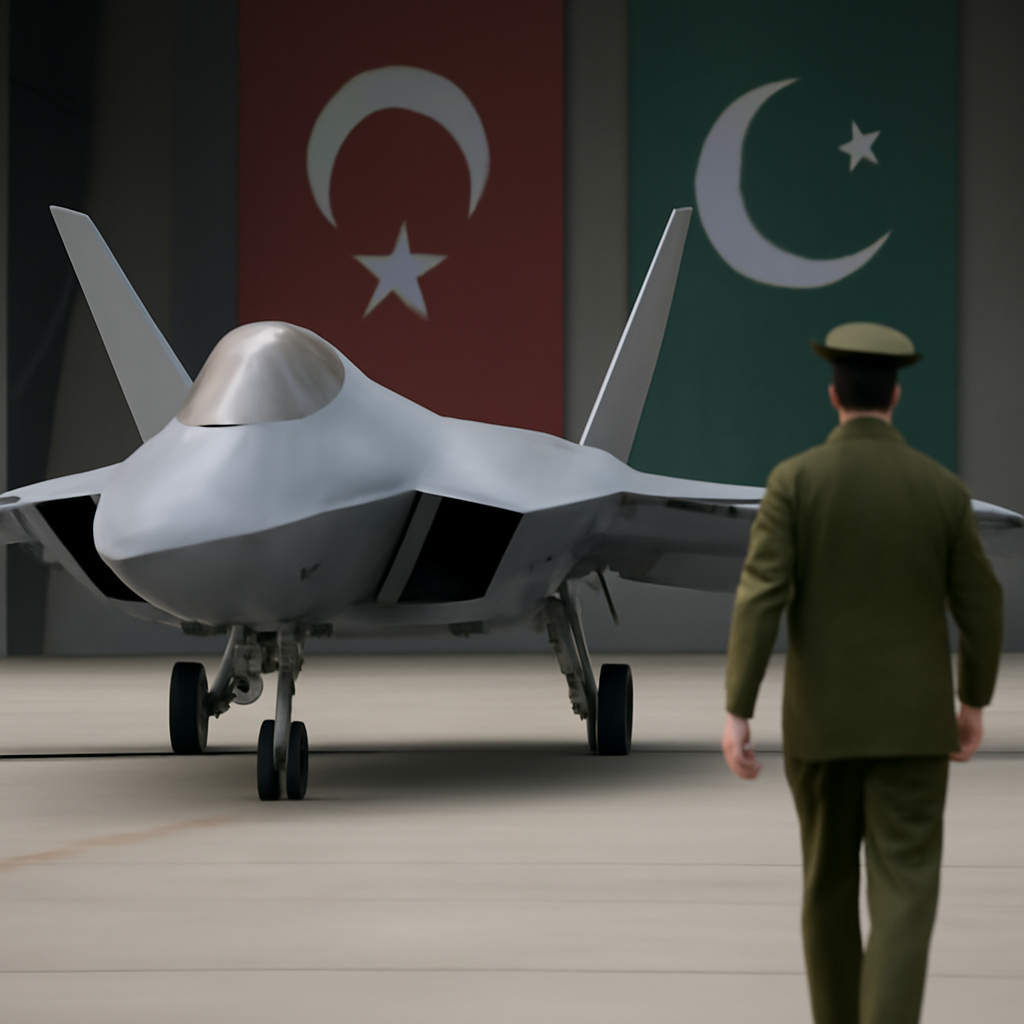
PNS Khaibar was commissioned in December 2025 — a concrete milestone in a decade-long Turkey–Pakistan defence relationship that now seeks a similarly tangible outcome for a fifth‑generation fighter program known as KAAN.
Sidhu’s Ankara meetings: who met, where, and what was discussed
Air Chief Marshal Zaheer Ahmed Baber Sidhu visited Ankara in May on an official invitation and met Turkish Defence Minister Yasar Güler and Turkish Air Force Commander General Ziya Cemal Kadioglu at Güler’s office. The delegation also visited the Turkish Air Force Headquarters. Pakistani reporting said KAAN delivery timelines were among the topics raised during the high‑level talks, which coincided with the EFES‑2026 Combined Joint Live‑Fire Exercise — an event in which Pakistan participated alongside other partner nations.
Two 2018 deals set different precedents: MILGEM delivered, T‑129 collapsed
Turkey and Pakistan signed two landmark defence contracts in 2018, each worth $1.5 billion. One covered four MILGEM‑class corvettes with technology transfer and co‑production at Karachi Shipyard; the other was for 30 T‑129 ATAK attack helicopters. The MILGEM program progressed: PNS Babur was commissioned in September 2023, PNS Khaibar in December 2025, and PNS Badr and PNS Tariq were built at Karachi Shipyard under the technology transfer arrangement.
The T‑129 effort did not reach delivery. The United States refused to issue an export licence for the helicopter’s LHTEC T800 engine — a decision the source links to Washington’s sanctions posture toward Turkey over the S‑400 purchase — and Pakistan repeatedly extended delivery windows before the DG ISPR stated in January 2022 that Pakistan had “moved on” and confirmed negotiations with China for attack helicopters.

This site is the portfolio.
OSINTSights runs on Cloudflare Workers, D1, R2, and Vectorize, with an AI pipeline on Hetzner ARM. Nubivance designed, built, and operates it. We do the same for clients.
See what we buildKAAN: repeated signals, no formal Pakistani contract as of May 2026
The KAAN fifth‑generation fighter programme has followed a more protracted path. In February 2022, TUSAŞ CEO Temel Kotil called KAAN a “Turkish‑Pakistani fighter programme.” By August 2023, Turkish Deputy Defence Minister Celal Sami Tüfekçi said 200 Pakistani engineers were already working on the program and that Ankara would formally discuss including Pakistan. In September 2024, President Erdogan personally urged ACM Sidhu to accept a larger Pakistani workshare in KAAN’s software integration, design, and development, and proposed shifting a bilateral aerospace Joint Working Group from quarterly to monthly meetings.
At the 8th Pak‑Turk Industrial Expo JWG in January 2025, Defence Minister Güler said an agreement for Pakistan’s official participation was nearing finalization; representatives from 32 Turkish and Pakistani institutions attended that meeting, hosted at Pakistan’s National Aerospace Science and Technology Park. Nonetheless, as of May 2026 no formal contract for Pakistan’s procurement or co‑production of the KAAN has been publicly announced. Turkey meanwhile has signed a 20‑aircraft contract for its own air force and a 48‑aircraft deal with Indonesia, and TUSAŞ CEO Demiroğlu has moved the delivery timeline forward to end‑2028 or early 2029.
Institutional scaffolding: working groups, committees, and embedded personnel
The institutional architecture supporting deeper ties is extensive. A semi‑annual Industrial Expo Joint Working Group has run since 2019; dedicated PAF–Turkish Air Force working groups were established in July 2025; a Joint Standing Committee on security and intelligence began in February 2025; and Turkish cadets are now training at PAF Academy Asghar Khan. These layers of engagement have produced embedded engineers, recurrent meetings, and shared exercises, yet have not produced the single announcement that would convert years of cooperation into a signed, financed co‑production agreement for KAAN involving Pakistan.
What this means for the Pakistan Air Force, TUSAŞ, and regional defence planners
- Pakistan Air Force (PAF): The PAF has tangible precedent in the MILGEM corvette program and visible participation at EFES‑2026 and in working groups; the lack of a formal KAAN contract as of May 2026 means Pakistan still awaits a clear pathway to co‑production and scheduled deliveries for a fifth‑generation platform.
- TUSAŞ and the Turkish defence industry: Turkey has repeatedly signalled readiness to deepen industrial ties and has committed domestically and to Indonesia for KAAN deliveries. TUSAŞ has publicly characterized KAAN as a joint programme and moved delivery timelines forward, but converting embedded collaboration and rhetoric into a financed Pakistan co‑production deal remains outstanding.
- Regional defence planners: The contrast between MILGEM’s delivery and the stalled T‑129 effort — affected by export licences for the LHTEC T800 engine — underscores how external export controls and third‑country relations can shape bilateral defence outcomes even when industrial arrangements exist.
The May 2026 Ankara meetings are the latest chapter in a relationship that has produced both executed transfers and unfinished projects. The elements for a Pakistani KAAN partnership — engineers on the program, regular working groups, high‑level encouragement and public claims of nearing finalization — are in place; what remains is the defining commitment: a public, signed contract that locks in procurement quantities, co‑production workshare, financing and delivery timelines. Until that announcement arrives, the KAAN programme will be judged, as the source notes, more by its drawn‑out trajectory than by the clear deliverables that marked Pakistan’s MILGEM corvettes.