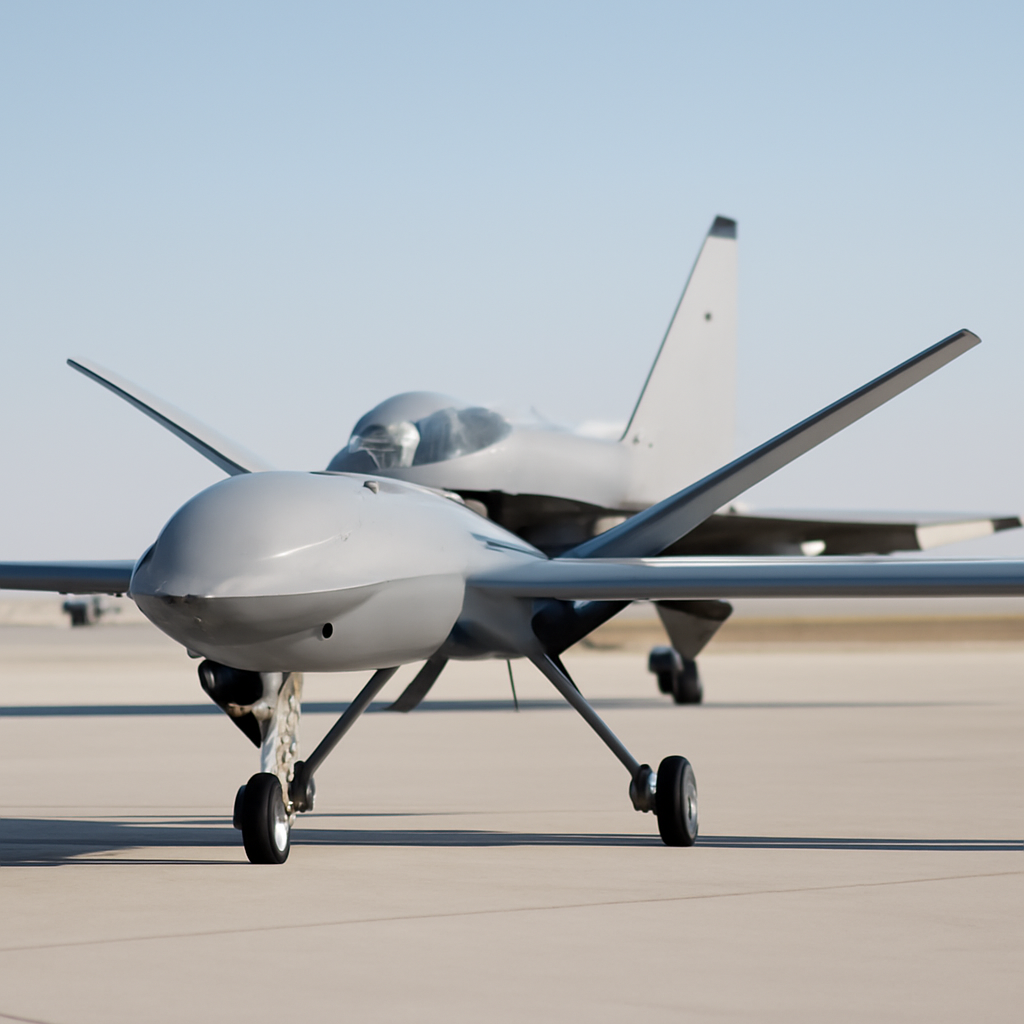
"The Kizilelma completed its taxi and takeoff autonomously," then joined a Leonardo M-346 in formation and was "handed over" to the jet's two-person crew, a test the partnering firms say marks a step toward crewed/uncrewed teaming in combat aviation.
Baykar and Leonardo’s K-SWARM live trials in Çorlu
Baykar and Leonardo reported completing the first live phase of their K-SWARM concept last month at Baykar’s flight and test center in Çorlu, Turkey. The flight-test campaign involved a Baykar Kizilelma uncrewed combat air vehicle (UCAV) and a Leonardo-owned M-346 Fighter Attack (M-346FA) variant; an Italian Air Force T-346A trainer acted as a chase aircraft. During the trials, the Kizilelma autonomously completed taxi and takeoff and then autonomously joined formation with the M-346. At that point, the jet’s two-person crew assumed full control of the UCAV and used a newly developed, fully integrated avionics suite to command formations.
Smart Fleet Autonomy, simulators, and the command chain
Baykar says the Kizilelma used "Smart Fleet Autonomy" algorithms developed by its Hardware-in-the-Loop (HIL) Laboratory for the exercises. The formations and maneuvers were executed by the UCAV autonomously after the M-346 pilots provided initial commands through a crewed/uncrewed computing system. An advanced radio-frequency data exchange system shared all data between the platforms, according to the companies.
Baykar and Leonardo accelerated the live trials by first running simulated missions, including on a Leonardo M-346 full-mission simulator in Venegono, Italy, and in Leonardo’s PC2LAB in Turin. The companies say these virtual tests let them validate algorithms, tactics and procedures before moving to flight.

The cyber insurance questionnaire just landed. Now what?
SOC 2, HIPAA, insurance renewals - someone has to own security strategy. Nubivance provides fractional CISO leadership without the full-time salary.
Get a security leadKizilelma’s progress and combat-oriented features
The Kizilelma is one of only a few fighter-type UCAV projects to have reached hardware. Baykar’s development work began in 2013 and the program was publicly revealed in July 2021. The UCAV made a very brief first flight in December 2022 after ground testing earlier the same year. Baykar and Leonardo describe the design as tailored for missions typically done by crewed fighter jets, and the aircraft is claimed to be supersonic in later versions and to possess a degree of reduced-observable characteristics.
In its definitive form, the Kizilelma is powered by a single Ukrainian-made Ivchenko-Progress AI-322F turbofan delivering close to 10,000 pounds of thrust with afterburner. Baykar has tested the UCAV with a Toygun electro-optical sensor and targeting system as well as an active electronically scanned array (AESA) radar. Late last year Turkey announced the Kizilelma used a Turkish-made Gökdoğan air-to-air missile to destroy a target drone — the companies characterized that as the first occasion a UCAV had launched a radar-guided air-to-air missile.
Days after that Gökdoğan firing, Boeing reported its MQ-28A Ghost Bat drone launched an AIM-120 AMRAAM in southern Australia. The Kizilelma is also eyed as a potential drone companion to Turkey’s next-generation TF Kaan crewed fighter.
What this means for technologists, procurement leaders, and air forces
- Technologists and security teams: The demonstration centers attention on autonomy engines, HIL simulation, and secure high-bandwidth radio-frequency data links. The use of Smart Fleet Autonomy algorithms and a crewed/uncrewed computing system will be watched for how they manage handovers and maintain pilot decision authority.
- Procurement leaders and exporters: Baykar’s work highlights an export angle the companies themselves note: Turkish platforms can be offered free of U.S. ITAR constraints. The firms point to potential pairings with TF Kaan or the lower-end Hürjet and to integrated weapons options as export advantages.
- Air forces and operators: The tests show a path toward commanders controlling UCAVs from tactical jets, but scaling that capability—to different aircraft types, larger formations, and more autonomous mission execution—remains the decisive operational question, the companies acknowledge.
Next tests, scaling challenges, and the remaining question
Baykar and Leonardo say a next set of K-SWARM tests is planned for the coming months and will introduce greater complexity and additional functions, which they say will need enhanced situational awareness and assets working "as one" toward mission objectives. The companies describe K-SWARM as aiming to harness AI to move uncrewed systems incrementally from remote piloting to autonomy, while asserting that human pilots will "maintain full control and decision-making" at all times.
Whether K-SWARM evolves from a technology demonstrator into an operational capability will depend on how the partners scale autonomy, data exchange, and formation control across platforms and missions. The companies have proposed pushing toward 'swarming' capabilities, but they also acknowledge the greater challenge that presents. For now, the next flights and the degree of autonomous mission execution they permit will be the immediate indicators to watch.
Source: TWZ — Turkey’s ‘Fighter Drone’ Teamed With M-346 Fighter-Trainer In Autonomy Trials