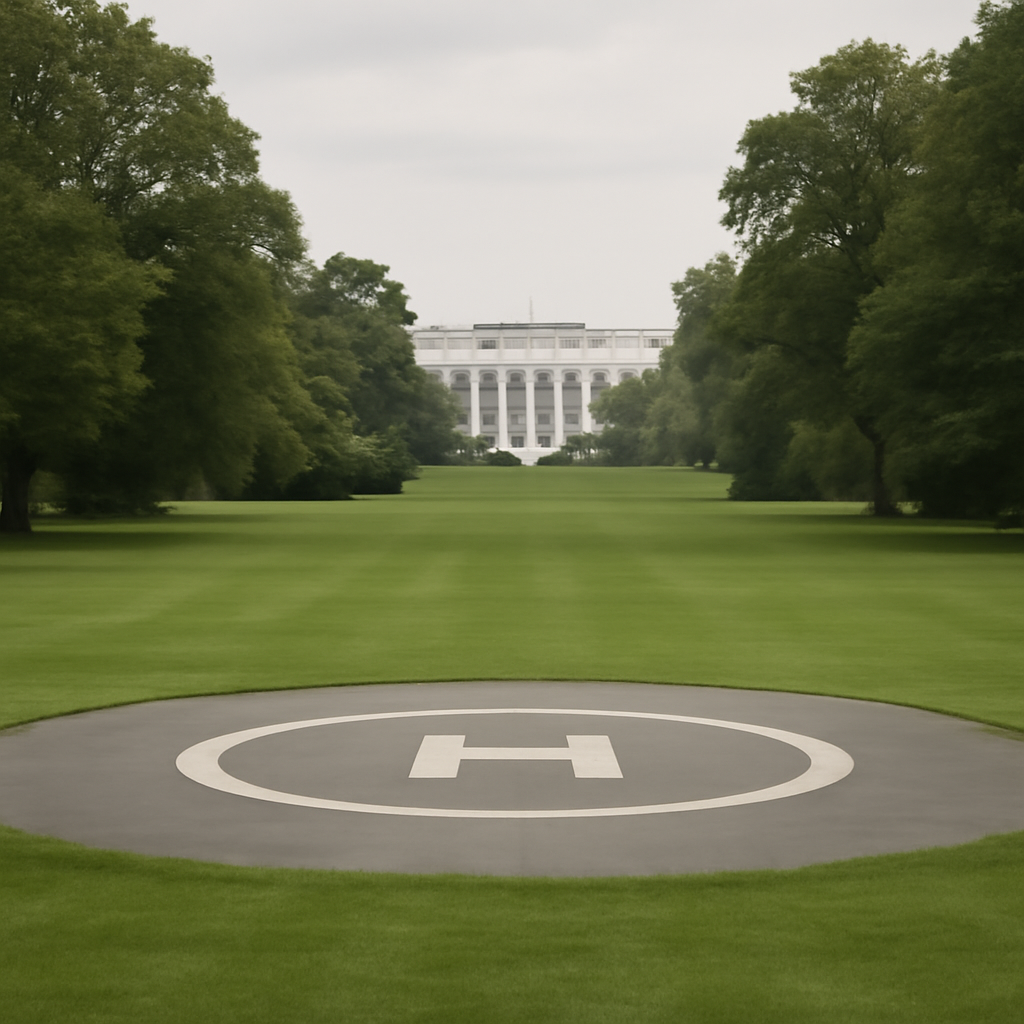
"For years, the White House has desperately needed a proper helipad on White House grounds that will allow the President to land safely and also protect the beautiful South Lawn grass from the fierce exhaust fumes of the incredible Marine One," White House spokesman Davis Ingle said, summarizing the administration's case for the project.
President Trump’s order: redo the helipad over appearance and slope concerns
President Donald Trump has ordered contractors to rip up weeks of work on the South Lawn helipad and start over, according to a Washington Post report cited by TWZ. The paper said the president was “frustrated with its appearance and questioning whether the slope of the White House lawn needs to be changed,” citing two anonymous people who discussed his private comments. Photographs obtained by The Washington Post show contractors taking apart work, including a 100-foot-wide granite presidential seal that had begun to take shape.
Sikorsky, Lockheed Martin, Clark Construction and the $5–6 million bill
When the project was announced nearly a month earlier, President Trump said the $5 million to $6 million construction cost is being paid for by Sikorsky, the Lockheed Martin subsidiary that builds the VH-92A Patriot. TWZ contacted Lockheed Martin, Sikorsky, and Clark Construction (the firm performing the work); Lockheed Martin and Sikorsky referred inquiries to the White House, and Clark Construction did not immediately respond. It is unclear whether contractors will charge additional costs for the redo or whether the timeline for completion will change.

This site is the portfolio.
OSINTSights runs on Cloudflare Workers, D1, R2, and Vectorize, with an AI pipeline on Hetzner ARM. Nubivance designed, built, and operates it. We do the same for clients.
See what we buildSouth Lawn slope, helipad safety guidance, and design choices
A central technical issue is the slope of the South Lawn. The White House has previously said the lawn “slants downward” and “slopes downward about 20 degrees in some places,” a degree of slant that the Post noted exceeds recommended helipad limits. Federal recommendations, cited in the reporting, say helipads should be flat for safety but do not need to be perfectly horizontal to allow water runoff. The area chosen for the new helipad is described as flatter than other places on the lawn, but the president reportedly wants a landing pad that sits level with the horizon — a preference that prompted crews to consider whether to change the lawn itself before rebuilding the pad.
Design: granite, a presidential seal, and a heated pad
Trump directed that the helipad be built of granite rather than simple concrete and paint, calling for “a beauty” with a carved presidential seal and eagle. He said he chose granite on learning that Sikorsky was footing the bill, calling granite “the strongest stone that we can like.” Photos published in recent coverage showed lettering spelling out “Seal of the President of the United States” on the under-construction pad. The project will apparently include a heated surface to reduce the need to shovel snow and ice from the landing zone, according to reporting and social-media images circulated in July.
Construction timeline, Marine One operations, and diplomatic scheduling
Contractors had been working around the clock to complete the project before Chinese President Xi Jinping's planned visit in late September, the Post reported earlier. The redo raises questions about whether that timeline will hold. In the interim, the president has used the Ellipse — a park south of the White House — as a temporary landing zone for Marine One. Pool reporting cited by TWZ recorded the president departing the Ellipse at 2:27 p.m. and boarding the helicopter shortly after on August 4, 2026, en route to Joint Base Andrews and then to the West Coast for events.
What this means for the White House, Sikorsky, and the U.S. Marine Corps
- The White House: Officials framed the project as both operational and cosmetic — a safer, hardened landing surface that also preserves the South Lawn. A White House official, speaking anonymously, said the administration is “making improvements and adjust[ing] accordingly” as the project continues.
- Sikorsky/Lockheed Martin: The company was described by the president as paying the estimated $5–6 million construction cost; however, reporting says it is not yet clear whether the redo will produce additional charges for the company or alter the originally stated timetable.
- The U.S. Marine Corps: The administration has already framed the helipad as a way to reduce damage caused by the new VH-92A Patriot, which the president described as “about two and a half times more powerful than the old ones.” The office noted that aging VH-3Ds are set to be retired sometime this year while VH-60Ns will continue in specific roles through at least 2030.
The immediate facts are straightforward: visible construction was disassembled after the president raised appearance and slope concerns; contractors and the White House are weighing whether to alter the lawn's grade; and key questions remain about additional costs and whether the September diplomatic timeline will be affected. The photographs and pool reporting anchor those developments, while the White House and contractors provide competing notes of intent and uncertainty.
https://www.twz.com/air/trump-orders-white-house-helipad-construction-redo-report