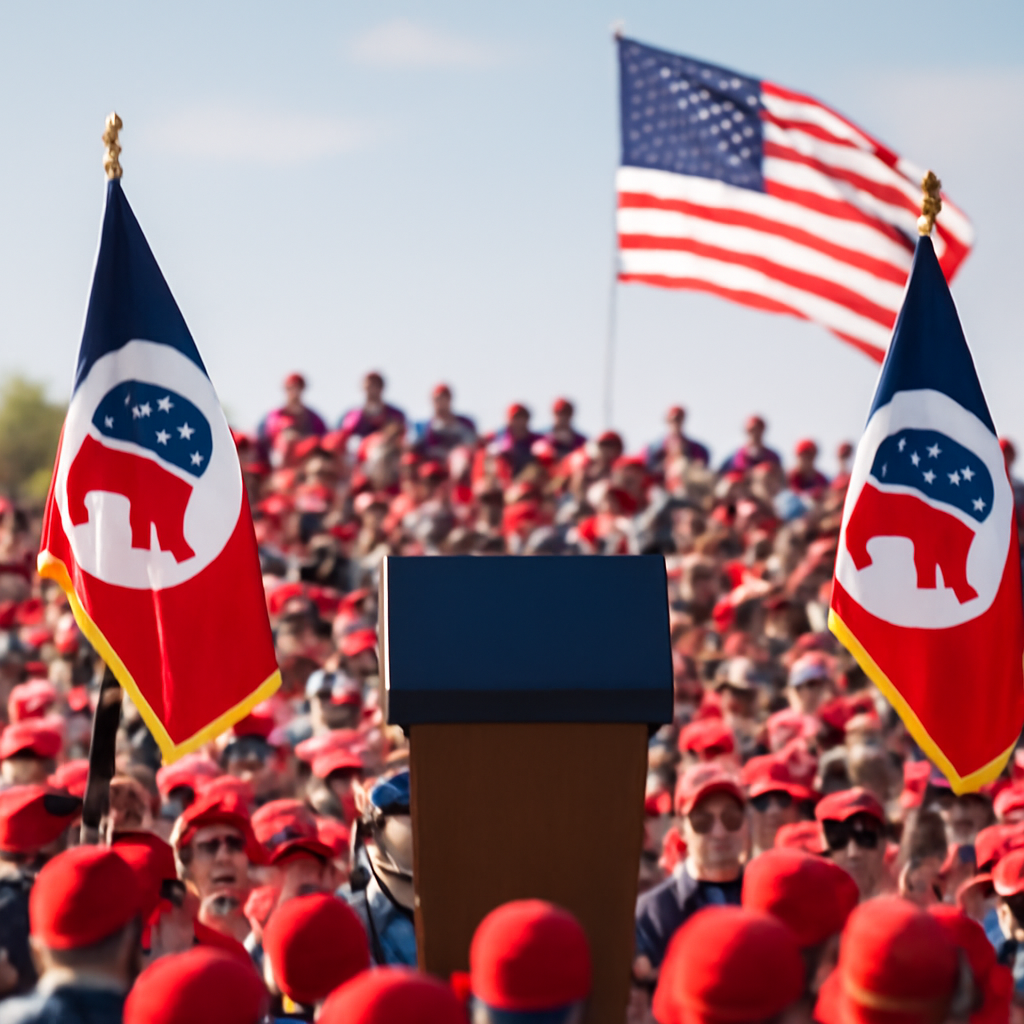
"The problem that we have is, they say that Trump does great when he’s on the ballot, but when he’s not on the ballot, his people don’t come and they don’t vote for senators, congressmen and other Republicans… So what I really want you to do is pretend, please, that I’m on the ballot. Just come and vote. It’s so important," President Donald Trump told supporters at a South Carolina rally, encapsulating the strategy that is driving Republican calculations as the United States heads into the November midterms.
Trump as party leader and turnout driver
The piece reports that despite being a lame-duck president with an approval rating near 39 percent, Donald Trump remains the dominant force within the Republican Party. He was the featured figure at an unconventional midterm Republican convention in Texas this month, where his celebrity and showmanship were used to draw low-propensity voters — those not normally highly motivated to vote — whom Republicans consider critical to their fortunes in November. The article says that, even at age 80 and after years of scandals and negative press, Trump "remains the best hope for Republican turnout."
Primary casualties: Massie, Greene, Tillis and Cassidy
The piece highlights a wave of departures and losses among Republicans who had opposed Trump: representatives Thomas Massie of Kentucky and Marjorie Taylor Greene of Georgia, and senators Thom Tillis of North Carolina and Bill Cassidy of Louisiana. All four, who spanned the ideological spectrum from mainstream moderate conservatism to MAGA-aligned populism, are "out" or about to be gone from Congress, the article reports — a development the piece links to the party coalescing around Trump.

Audit-ready is a season. It shouldn't be.
Evidence in spreadsheets, controls drifting between audits, frameworks multiplying on flat headcount. Nubivance runs continuous compliance on Rapid7 Cyber GRC - SOC 2, HIPAA, ISO 27001, PCI, CMMC.
End the scrambleTurnout math, redistricting and the midterm baseline
Over the last 20 years, the article notes, non-presidential elections in the United States have averaged 42 percent turnout, versus about 61 percent in presidential years. That low-turnout dynamic, the piece argues, incentivizes each party to focus on motivating its base: the party that can reach roughly 43 percent turnout will likely win. Republicans are banking on Trump both to raise "hundreds of millions" and — more importantly, the article says — to drive turnout.
Redistricting battles are also in play: the article reports that changes in many states have reduced the Democrats' structural advantage in the House by about 10 to 12 seats, a headwind that could amplify a successful national campaign by Republicans.
Democratic enthusiasm, DSA primary wins, and intra-party pressure
The article casts Democratic voters as highly motivated by opposition to Trump, noting that Democrats are "even more enthusiastic about opposing him" than Republicans are enthusiastic in support. It also cites recent primary wins by far-left Democratic Socialists of America (DSA) candidates who, the article says, espouse anti-capitalism and pro-Hamas positions — developments that "have not helped more mainstream Democratic candidates." Some DSA nominees, the article adds, are now disavowing radical statements to appeal to mainstream voters.
The piece names specific controversies: internet personality Hasan Piker has said the United States deserved the 9/11 attacks of 25 years ago, and Abdul El-Sayed, the Democratic Senate nominee in Michigan, called Piker's comments "dumb." At the same time, Democrats are portrayed as less tolerant of internal dissent than Republicans; Senator John Fetterman of Pennsylvania has been criticized by fellow Democrats for his slightly conservative foreign-policy views, particularly regarding Israel.
How Republican candidates, Democratic voters, and Congress are responding
- Republican candidates: Vulnerable figures such as Ken Paxton in Texas and Mike Rogers in Michigan are explicitly counting on Trump to mobilize voters and fundraise heavily; the article says many GOP House and Senate contenders "need Trump to make the election about him."
- Democratic voters: The article depicts Democrats as energized to oppose Trump, a dynamic that could counteract Republican turnout advantages. However, Democratic internal divisions — including the presence of DSA nominees and pressure on moderates like John Fetterman — complicate unified messaging.
- Members of Congress and moderates: The article notes Republicans are currently showing "more strategic tolerance for policy diversity" than Democrats, citing Senator Susan Collins of Maine as an example — she did not appear with Vice President JD Vance when he visited her state, and Vance nonetheless endorsed her.
Likely outcomes and immediate consequences
With less than two months until the midterms, the article forecasts a likely narrow Democratic majority in the House and a still-Republican majority in the Senate. That split, the piece argues, will set up a familiar dynamic: Democrats in the House would have subpoena power to pursue investigations into Trump's alleged scandals, while a Republican Senate majority would leave the president able to confirm new cabinet nominees in the event of turnover.
In short, the reporting concludes, Donald Trump may be a lame duck in name, but he is set to remain the center of American politics into 2027 — the person the parties build their strategies around and the figure who could determine whether turnout tips the balance in November.