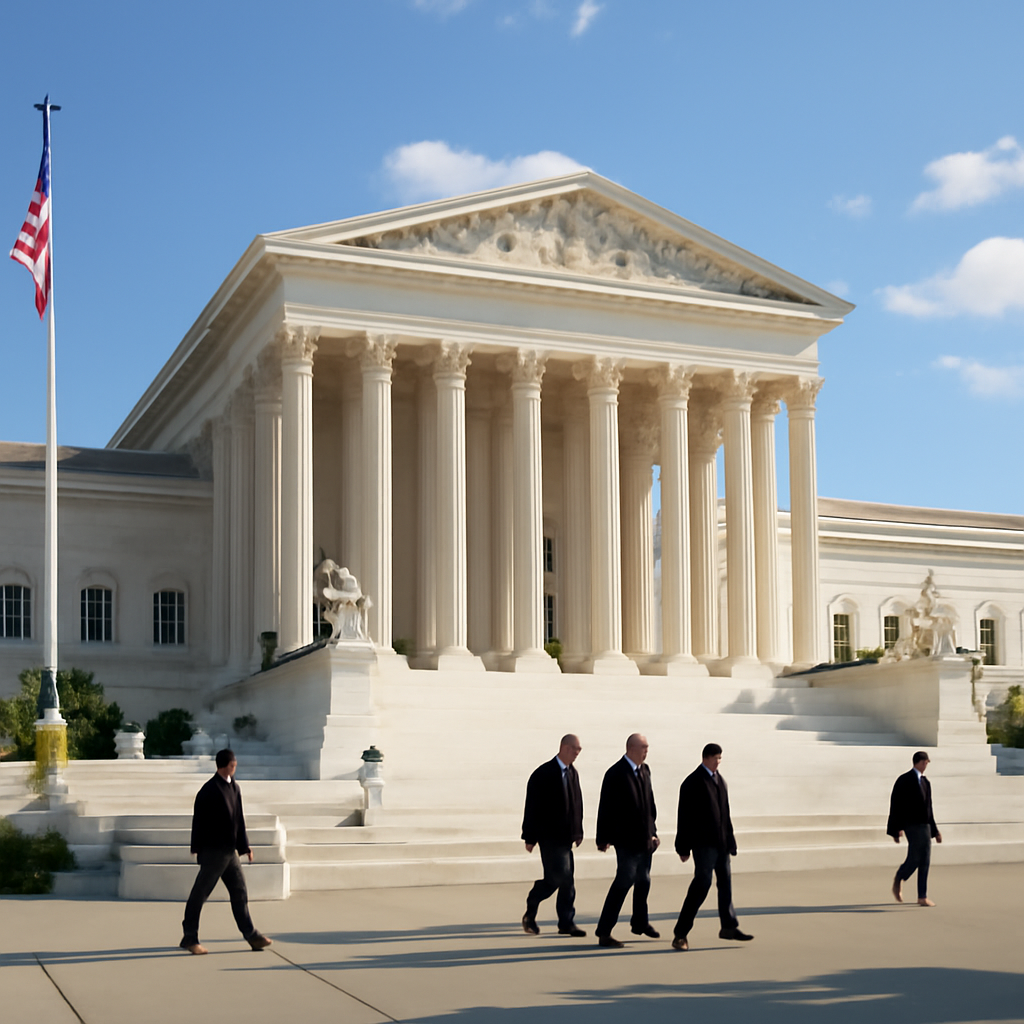
"The Order is an internal directive from the President to his subordinates mandating that certain agencies pursue certain policies," the Supreme Court wrote, dismissing one of two lawsuits that sought to block a set of Trump administration changes to U.S. Postal Service rules tied to mail-in ballots.
What the court decided and why the states were rebuffed
In a 6–3 decision, the Supreme Court held that the states lacked Article III standing to challenge portions of a White House executive order that directed the U.S. Postal Service to create so‑called "State Citizenship Lists" and that directed the Department of Justice to prioritize prosecutions of state and local election officials who "knowingly" issue ballots to ineligible, non‑citizen voters. The majority characterized the order as "an internal directive" that "neither requires nor forbids anything of anyone outside the executive branch," and emphasized that the sections at issue were prefaced by language saying transmission of lists would occur "to the extent feasible and consistent with applicable law."
The contested provisions: State Citizenship Lists and DOJ priorities
The executive order instructed USPS to begin creating "State Citizenship Lists" for each state, drawn from federal data, showing "voters who, according to federal data, are eligible to receive mail‑in ballots." The order itself cautioned that "An individual’s identification on the State Citizenship List does not indicate that the individual has been properly registered to vote in the State" and that "there may be State laws, not reflected in the State Citizenship List, that preclude voter registration, or the individual may choose not to be registered." Separately, another section directed the Department of Justice to prioritize investigating and prosecuting state and local election officials who "knowingly" allow instances of non‑citizen voting.

This site is the portfolio.
OSINTSights runs on Cloudflare Workers, D1, R2, and Vectorize, with an AI pipeline on Hetzner ARM. Nubivance designed, built, and operates it. We do the same for clients.
See what we buildLower courts had blocked the citizenship‑list provision; the Supreme Court split
Two federal courts previously found aspects of the order unconstitutional and issued injunctions, concluding the provisions were likely to result in federal intrusion on the constitutional authority of states to run their elections. Those lower courts threw out the citizenship‑list provision as unconstitutional. The Supreme Court majority, however, viewed the claimed harms as speculative because any transmission or use of the lists would depend on downstream, future actions by executive officials—"the true 'source of any injury' to the States would be the downstream action that the Secretary 'might take in the future' to implement" the USPS sections—adding dryly: "Emphasis on might."
The dissents: Kagan, Sotomayor and Jackson push back
The three remaining liberal justices — Elena Kagan, Sonia Sotomayor and Kentaji Brown Jackson — dissented across two opinions. Justices Sotomayor and Kagan argued that the majority's decision "merely postpones adjudication" and that "a commonsense reading of the executive order, corroborated by the government’s own representations, make clear that the respondent states face a sufficiently concrete and imminent injury." Sotomayor warned it was implausible to treat the list creation and the DOJ prosecution priority as unrelated, writing that "To pretend that the lists assembled [in one section] bear no relation to the prosecutions directed by [the second section] is to ignore the structure of the Executive Order and the Government’s words alike," and invoking the Court's recognition that people do not "lightly disregard public officers' thinly veiled threats to institute criminal proceedings."
Justice Jackson's separate dissent was sharper: she noted that "the District Court held that the President’s Order is unlawful," that the government did not defend the order's lawfulness before the Court, and yet the Court granted equitable relief to allow implementation on the basis that plaintiffs lacked a concrete injury because the government had not yet issued a final rule when the complaint was filed.
USPS rulemaking and the remaining injunction in Massachusetts
Although the Supreme Court dismissed the states' standing challenge to the executive order, the USPS regulations remain blocked under a separate nationwide injunction issued by a federal court in Massachusetts. Despite that injunction, the Postal Service moved to finalize the new regulations on Friday, underscoring an immediate tension between agency action and existing court orders.
How states, USPS, and DOJ will likely respond
- States (California and 23 others): Having filed suit, the states face a split judicial landscape—rebuffed at the Supreme Court for lack of standing on this portion of the challenge but vindicated in separate lower‑court rulings. They may continue litigation where injunctions remain in place and watch for any downstream implementation steps that the Supreme Court suggested would create a concrete injury.
- U.S. Postal Service: The agency has moved to finalize the new regulations despite the Massachusetts injunction, signaling an intent to press forward with rulemaking and potentially trigger the downstream actions the Supreme Court described as the "true 'source of any injury'."
- Department of Justice: The executive order's directive to "prioritize" enforcement against officials who "knowingly" issue ballots to non‑citizens was viewed by the majority as internal guidance that "does nothing" to states; how DOJ elects to prioritize investigations and prosecutions will be central to whether the states' predicted harms ever materialize.
The Supreme Court's ruling resolves one procedural hurdle while leaving major constitutional questions unsettled. The citizenship lists remain a flashpoint: they were enjoined by lower courts, yet the executive branch has signaled intent to finalize rules and to prioritize related enforcement. Whether the Secretary, the Postal Service, or the Justice Department takes concrete steps that convert the Court's hypothetical "might" into an enforceable action will determine whether the dispute returns to the judiciary and how the balance between federal directives and state control over elections is ultimately defined.