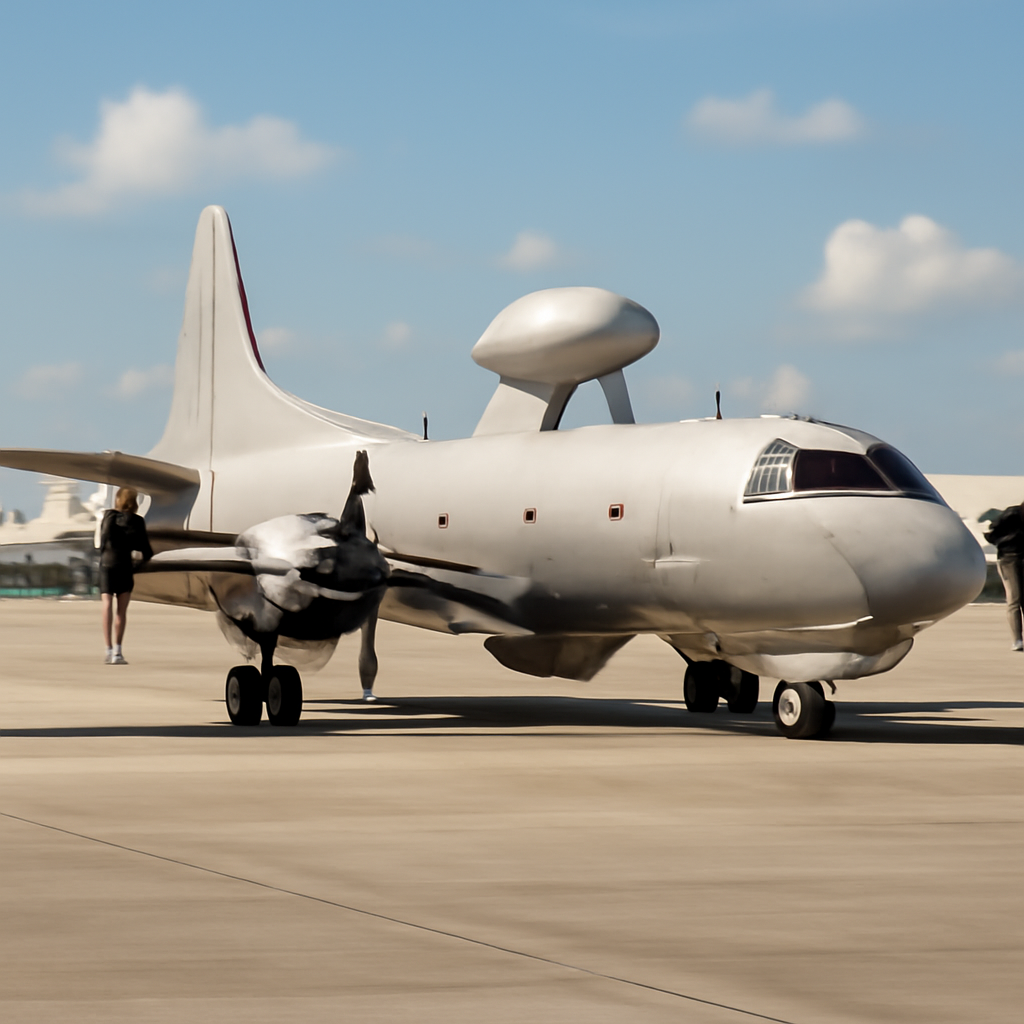
Spain awarded Airbus and Indra a €16-million, 18-month contract to study and define a new airborne signals intelligence capability built on the Airbus A321 airliner, with plans to convert three aircraft into crewed SIGINT platforms under the Santiago II initiative.
Santiago II: Airbus, Indra and the €16-million study
The Santiago II program is currently in its definition phase. Under an 18-month, €16-million ($17.9-million) contract, Airbus and Indra are developing the program’s conceptual design for three heavily modified A321s. The Spanish Ministry of Defense estimates the complete program at approximately €436 million ($489 million). The stated objective is a crewed platform “capable of collecting and processing intelligence across the electromagnetic spectrum.”
Indra is expected to supply much of the mission-system architecture. The company’s AirSign concept, unveiled in 2023, combines COMINT and ELINT sensors with data fusion, real-time signal analysis, communications, and command-and-control functions — the sort of integrated mission set Santiago II will need to host on an airliner-derived platform.
Why the Airbus A321 — space, power and mission scaling
Spain’s choice of the substantially larger A321 — part of the A320 family — signals a deliberate move away from smaller bizjet-derived SIGINT aircraft. The A321 provides significantly more room for antennas, processing hardware and crew, and the electrical and cooling capacity to support larger, more power-hungry mission systems. That extra volume and power budget are central to mounting multiple antenna arrays, receiver suites, operator consoles and the associated support infrastructure the program requires.
Airbus has previously explored multi-mission A320/A321 concepts — including an AEW&C version with conformal radar arrays and other special-mission variants — and the company already runs conversion work at its Getafe facility for the A330 MRTT, giving Airbus a conversion industrial base in Spain that Santiago II can leverage.

This site is the portfolio.
OSINTSights runs on Cloudflare Workers, D1, R2, and Vectorize, with an AI pipeline on Hetzner ARM. Nubivance designed, built, and operates it. We do the same for clients.
See what we buildRestoring the Reina del Espectro capability retired in 2014
The Santiago II fleet is explicitly intended to replace the capability Spain lost when its specially modified Boeing 707 SIGINT aircraft (TM.17-4) was retired in 2014. That 707, equipped with Israeli SIGINT equipment, was nicknamed Reina del Espectro (Queen of the Spectrum) and served in the 47th Mixed Air Force Group alongside four Dassault Falcon 20s (TM.11), which were used for navigation-aid calibration, remote sensing, and electronic-warfare training.
By fielding three modern, larger airframes rather than a single legacy 707, Spain aims to provide a substantially more modern platform with improved availability and the onboard processing and crewed mission-management capacity absent from the retired type.
How the A321s will complement the Predator B with L3Harris SOAR
Santiago II is intended to sit alongside Spain’s emerging uncrewed SIGINT capability. The Spanish Air and Space Force is introducing the L3Harris Scalable Open Architecture Reconnaissance (SOAR) system on its Predator B drones to give that fleet ELINT and COMINT collection capabilities. According to the program description, the two systems are likely to fill different niches: the Predator B offers a relatively persistent, lower-cost uncrewed collection option, while the much larger A321 will provide substantially greater payload capacity, onboard processing, and crewed mission-management capabilities.
Together, the manned A321s and the Predator B/SOAR drones are meant to create a layered airborne SIGINT architecture able to detect, classify, locate, and analyze electromagnetic emitters in support of a variety of operations.
What this means for Indra, the Spanish Ministry of Defense, and NATO partners
- Indra: an opportunity to supply core mission systems — building on its AirSign architecture — and to deepen domestic expertise in integration and signal-processing for large, crewed SIGINT platforms.
- The Spanish Ministry of Defense: a path to restore a national, crewed SIGINT capability while achieving an industrial objective of acquiring domestic integration control rather than buying a finished foreign system.
- NATO partners: a capability that, if fielded as described, “will likely be of considerable interest to other NATO partners in Europe” because the A321’s size and onboard processing promise persistent, high-capacity collection complementary to uncrewed options.
The Santiago II program has moved from concept to definition with a firm study contract; the next formal step will be a phase covering the modification and integration of the three selected A321 airframes. If the program stays on its projected course and budget, Spain will again operate a persistent, crewed airborne SIGINT presence — this time on modern, larger airliners engineered to host more antennas, more power, and far more onboard processing than the Reina del Espectro ever carried.
Source: The War Zone — Spain Picks Airbus A321 For New Electronic Intelligence Aircraft