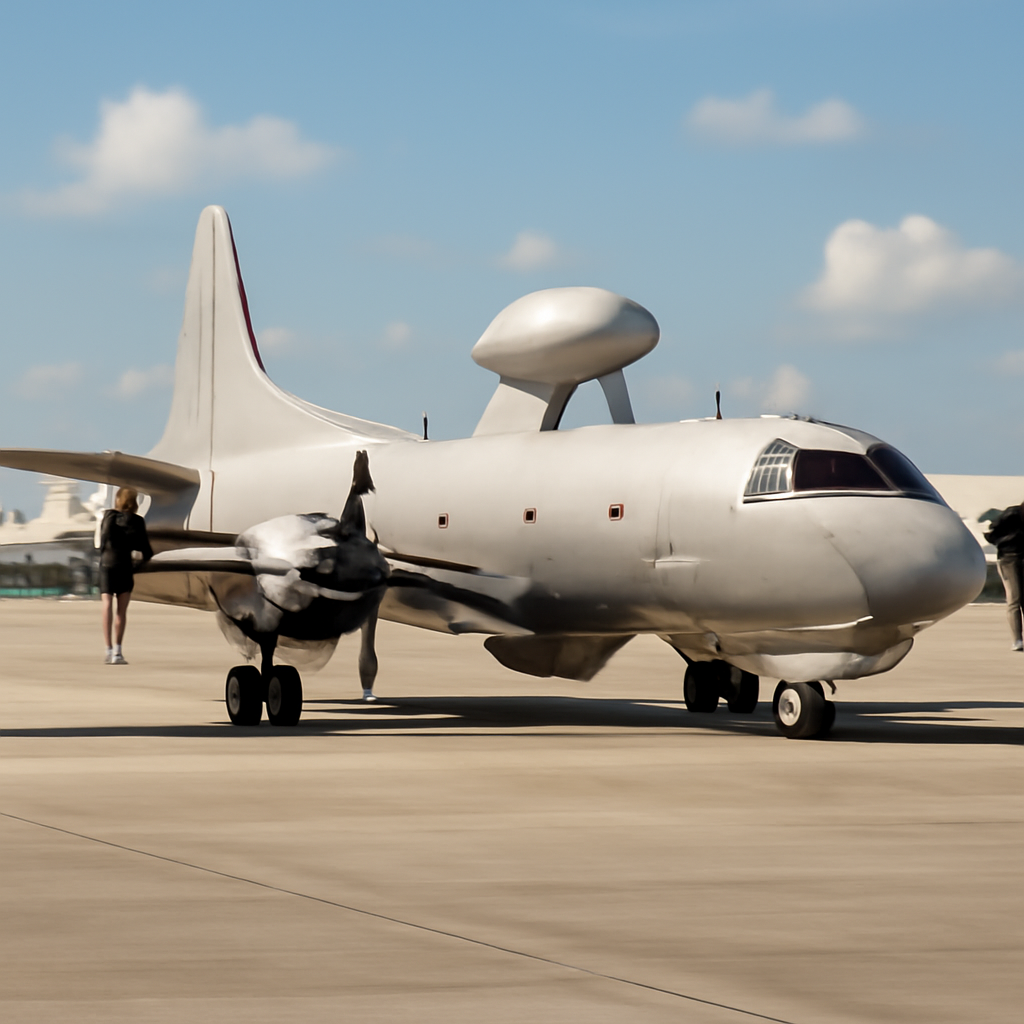
“Our Jacksonville-based P-3 AEW fleet has served as a cornerstone of America’s outer-layer border security,” CBP wrote in a brief social media announcement after retiring the type. The agency brought the final P-3 Airborne Early Warning (AEW) aircraft home on September 30, 2026, ending a unique chapter in U.S. law-enforcement aviation.
CBP retires the last P-3 AEW on September 30, 2026
U.S. Customs and Border Protection (CBP) officially retired its final P-3 AEW following a last flight from the National Air Security Operations Center Jacksonville (NASOC Jacksonville) in Jacksonville, Florida. CBP was the only operator of this AEW variant of the Lockheed P-3 Orion and is said to have been the only law enforcement agency to operate a dedicated AEW aircraft. By CBP’s account and other official signals, the AEW fleet peaked at eight aircraft; an earlier 2014 CBP release referencing an “11th and final” overhaul appears to have combined AEW and Long Range Tracker (LRT) airframes and stated CBP had 14 P-3s of all types at that time.
The P-3 AEW’s sensors, communications, and partnered LRTs
The AEW Orions were visually distinguished by a saucer-like radar dome and were equipped with AN/APS-138 radars on the initial three airframes and later AN/APS-145 radars on subsequent and refitted aircraft. The AEWs carried EO/IR sensor turrets for closer visual investigation of radar contacts, and by the end of their careers they also had satellite communications links alongside VHF and UHF radios.
CBP paired AEW Orions with LRT variants configured for maritime surveillance; the LRTs used EO/IR turrets plus AN/APG-66 and SeaVue radars. The AN/APG-66 is a pulse-doppler radar effective at spotting and tracking aerial targets, while SeaVue provides surface search and synthetic aperture radar (SAR) imagery capable of detailed surface mapping day or night and through obscurants like clouds or smoke.

Audit-ready is a season. It shouldn't be.
Evidence in spreadsheets, controls drifting between audits, frameworks multiplying on flat headcount. Nubivance runs continuous compliance on Rapid7 Cyber GRC - SOC 2, HIPAA, ISO 27001, PCI, CMMC.
End the scrambleOrigins, modernization, and the shrinking Orion ecosystem
The agency’s AEW program began in the late 1980s when the then-U.S. Customs Service converted second-hand maritime patrol P-3s into AEW platforms. The first AEW started its career as a P-3B for the Royal Australian Air Force; other conversions came from ex-U.S. Navy airframes. CBP later upgraded airframes through a Service Life Extension Program (SLEP) in the 2010s that included new wings and tails and comprehensive teardown inspections.
The broader U.S. government P-3 user base has been contracting. The U.S. Navy has retired the Orion as a maritime patrol platform and fully divested EP-3 intelligence variants; the service retained a small number of P-3s for research and testing but those, too, have been moving toward retirement. The Navy’s last NP-3C at Scientific Development Squadron One (VXS-1) retired last month. The National Oceanic and Atmospheric Administration (NOAA) is replacing its two P-3 hurricane hunters with C-130J-based platforms. The shrinking operator pool has implications for sustainment and spares for remaining P-3 users.
Operational consequences: AEW demand, military support, and emerging alternatives
CBP’s P-3 AEWs carried wide-area surveillance missions extending beyond U.S. shores — across the Caribbean, the Gulf of Mexico, and into Central and South American transit zones — and supported other roles such as air-traffic coordination during Hurricane Harvey relief in 2017. With the AEW Orions retired, CBP still operates other crewed fixed-wing aircraft, MQ-9 drones, and fixed-site tethered aerostats with radars, but the agency no longer has a platform equipped with the AN/APS-145 AEW sensor.
Demand for airborne AEW is high. The U.S. military regularly augments counter-drug missions with Navy E-2s and Air Force E-3s; newer E-2D Advanced Hawkeyes have radars with stronger surface-search and track capabilities than earlier E-2 models or the P-3 AEW. That military support, however, is strained: the source cites heavy demand driven in part by the conflict with Iran and notes sustainment challenges within the Air Force’s E-3 fleet while replacement E-7 Wedgetail aircraft remain years away.
Longer-term technical shifts are in motion. The Air Force is investing to push air moving-target indicator (AMTI) tasks into space, with early operational satellites for that role not expected until 2028. General Atomics and Saab are developing an AEW configuration for the MQ-9B, though the source notes there are no known U.S. orders for that capability; such a drone would not replicate the look-down flexibility of modern crewed AEW aircraft. The source also notes it is possible CBP could access tailored data feeds from forthcoming space AMTI systems when they are operational, but that crewed or uncrewed aircraft will still be needed to investigate tracks using EO/IR and other sensors.
What this means for CBP, the U.S. Navy, and the U.S. Air Force
- CBP: Will need alternatives to replace wide-area manned AEW coverage; current plans for the LRT aircraft and their potential sunset were “not immediately clear,” and reporting indicates TWZ has reached out for more information.
- U.S. Navy: Remains a provider of AEW support to law-enforcement missions via E-2s, but its reduced Orion footprint narrows cross-service sustainment options for P-3 parts and expertise.
- U.S. Air Force: Faces sustainment pressure on E-3s and a multi-year horizon for E-7 replacements and space-based AMTI becoming early operational; pressure on airborne AEW capacity will likely persist.
CBP’s retirement of the P-3 AEW removes a distinctive, long-enduring sensor and command-and-control capability from the agency’s inventory. The immediate question — noted in the reporting — is how CBP will fill that capability gap, particularly for long-endurance, look-down radar coverage coupled with on-scene EO/IR investigation. TWZ has sought further details from the agency, and the future mix of aircraft, aerostat, drone, and space-derived feeds will determine how that gap is bridged.