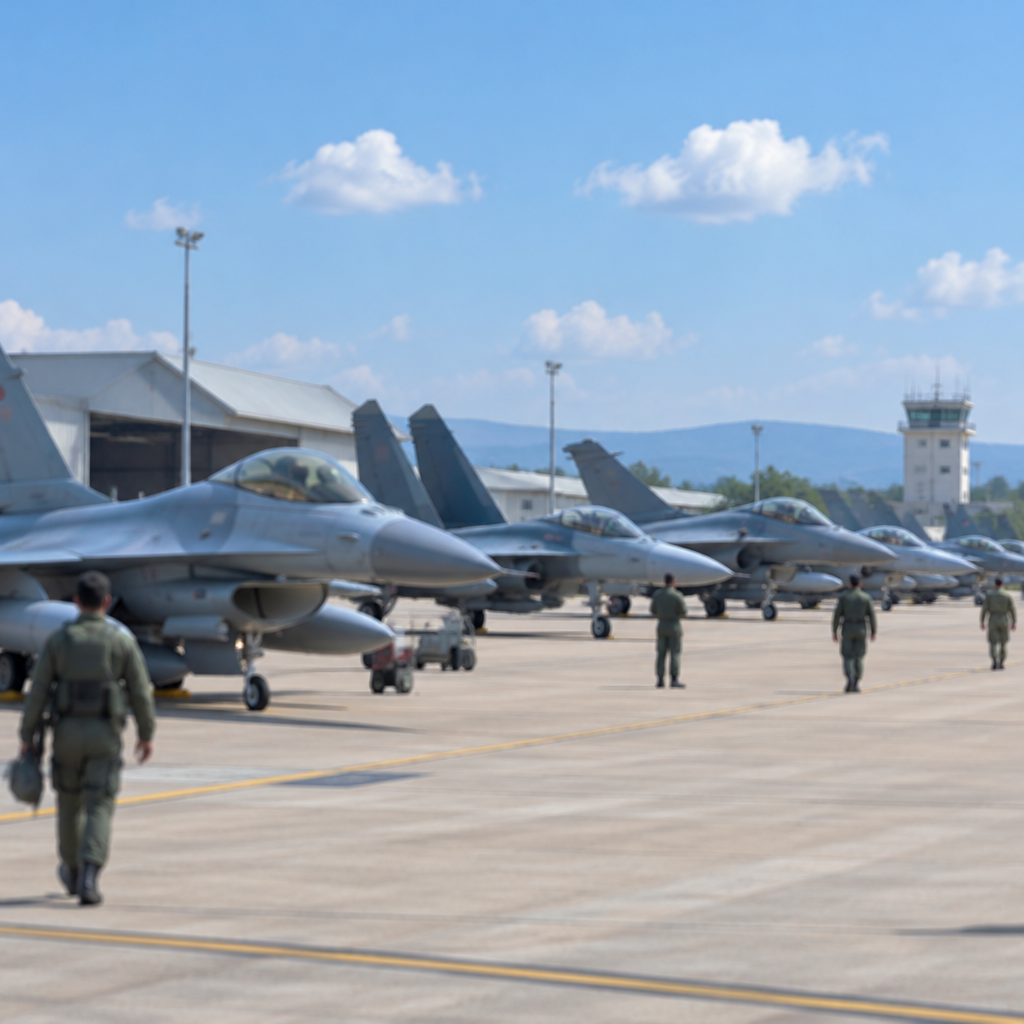
What is at stake is whether advanced fighters will be a reliable source of air power—or a chain of logistical burdens—for the Indonesian and Singaporean air forces that are racing to modernize.
Indonesia’s supplier diversification and strategic autonomy
Jakarta’s aircraft inventory today spans a wide range of origins: American F‑16s, British Hawk 109/209s, French Rafales, Russian Su‑27s and Su‑30s, and South Korean T‑50i trainers. Future purchases are likely to add the Turkish KAAN, South Korean KF‑21, and Chinese J‑10, with the Indonesian Air Force at one point expected to operate as many as eight different combat types from Western, Chinese, Korean, Russian, and Turkish suppliers.
That mix reflects a deliberate policy choice rooted in Indonesia’s “free and active” foreign policy principle: diversification gives Jakarta diplomatic flexibility and reduces the risk that any single supplier can leverage a monopoly to influence Indonesian defense choices. The decision also responds to history — notably the arms embargo imposed by the United States and its European allies from the late 1990s to the early 2000s — reinforcing a desire to avoid overdependence on one supplier.
Operational focus: counterinsurgency and munitions shortfalls
Indonesian defense officials have framed procurement against a practical operational requirement: generating sufficient air power to cover an archipelago spanning thousands of islands. Senior Indonesian military officials told the author that, in the short and medium term, the air force expects to focus more on counterinsurgency operations than on air‑to‑air combat with external adversaries; that assessment has made interoperability a lower priority in some acquisition choices.
But acquisition without sustainment can be hollow. Data from the Stockholm International Peace Research Institute (SIPRI) shows Indonesia has acquired relatively few air‑to‑air missiles over the past 25 years: for example, just 36 U.S. AIM‑120C AMRAAM missiles for its F‑16 fleet. Such limited inventories raise serious questions about the ability to sustain air combat operations during a prolonged conflict with an external adversary.

Audit-ready is a season. It shouldn't be.
Evidence in spreadsheets, controls drifting between audits, frameworks multiplying on flat headcount. Nubivance runs continuous compliance on Rapid7 Cyber GRC - SOC 2, HIPAA, ISO 27001, PCI, CMMC.
End the scrambleFinancial and logistical burdens of over‑diversification
Each additional aircraft type imposes long‑term costs beyond the purchase price: separate maintenance arrangements, technical training pipelines, distinct spare‑parts inventories, weapons integration, and tailored logistical support. Without economies of scale, those demands drive up operating costs, stretch defense budgets, and can undercut the operational benefits diversification is intended to deliver. Interoperability challenges — for example, technical and operational barriers when Russian Sukhois or Chinese J‑10s operate alongside U.S. F‑16s or French Rafales — compound the problem.
Singapore’s U.S.‑centric modernization and its trade‑offs
By contrast, the Republic of Singapore Air Force has concentrated on a narrower set of primarily U.S. platforms. Its F‑16s and F‑15SGs are established workhorses, and a planned fleet of F‑35As and F‑35Bs aims to add stealth and an ability to operate in contested environments. Singapore’s first F‑35 is scheduled for delivery by the end of 2026; the country purchased F‑35Bs in 2019 because their STOVL capability suits limited land space and enables dispersed basing to reduce reliance on vulnerable fixed airfields.
That concentrated approach simplifies training, integration with airborne early‑warning and command‑and‑control assets, and the development of common operating pictures — shortening the sensor‑to‑shooter cycle. But it creates a different vulnerability: heavy reliance on the United States for aircraft, advanced weapons, software, maintenance, and training support. U.S. export controls, political decisions, and supply‑chain disruptions could affect availability of equipment, upgrades, and munitions. The Singaporean F‑35Bs are being based permanently at Ebbing Air National Guard Base in Arkansas — a fact that, while not publicly tied to a U.S. condition of sale, could undermine Singapore’s original rationale for dispersed and locally resilient operations.
What this means for the Indonesian Air Force, the Republic of Singapore Air Force, and Washington
- Indonesian Air Force: Must balance strategic autonomy with sustainment. Diversification expands diplomatic options and helps meet geographic coverage needs, but it risks logistical fragmentation unless acquisitions are matched to funding, maintenance capacity, and weapons availability.
- Republic of Singapore Air Force: Gains high integration and advanced capabilities from U.S. platforms, but faces a strategic dependency risk — particularly if export controls, political decisions, or competing global demand for U.S. munitions limit access to parts, upgrades, or weapons.
- Washington: The United States’ role as a primary supplier to Singapore creates leverage over availability of platforms and support; that dynamic can affect a close partner’s operational independence without implying automatic policy control over that partner.
Both case studies underline a single, practical truth: military strength turns on the ability to operate and sustain platforms, not merely to buy them. Indonesia’s challenge is preventing strategic autonomy from calcifying into logistical fragmentation; Singapore’s is preserving operational independence within a deep dependence on U.S. systems. The immediate, concrete measures each must assess are the same ones they have already flagged — commitments vs. funding, maintenance capacity, and weapon availability — but how each balances those will determine whether its new fighters can be wielded as tools of defense or become an expensive, underused collection of airframes.