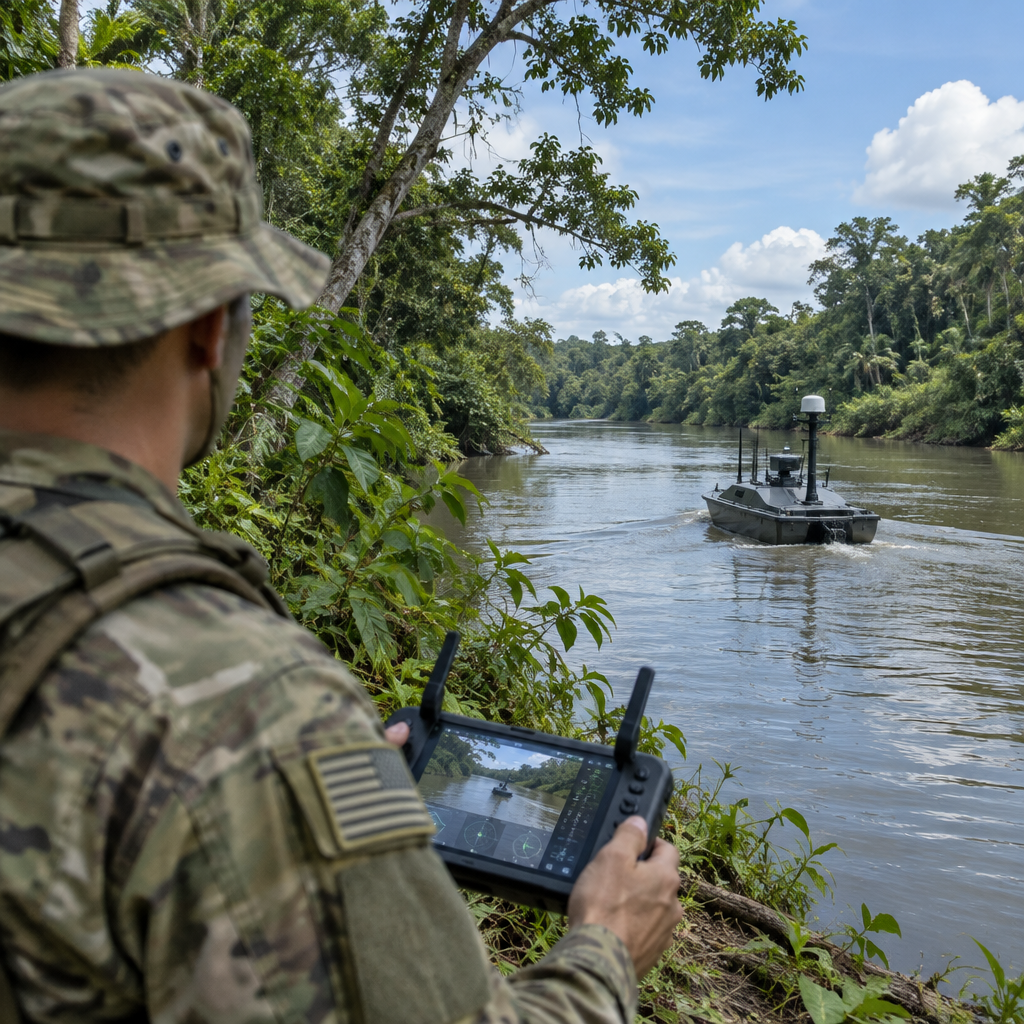
"We want to understand how criminal networks use rivers [to transport narcotics] and how they use the foliage to hide the sites where narco vessels are assembled," Gen. Francis Donovan said during an interview on Oct. 13.
Gen. Francis Donovan’s river-reconnaissance pitch
Gen. Francis Donovan, who took over US Southern Command in February of this year, described a concrete capability gap: rivers in South and Central America used by criminal networks for narcotics trafficking. He told Breaking Defense he is seeking a "unique river reconnaissance system, representing a tailorable mix of unmanned surface, air and sub surface autonomous platforms" — an integrated set of autonomous vessels and sensors designed to sail riverine environments, gather reconnaissance, and collect data on how illicit networks move and hide equipment.
SOUTHCOM Autonomous Warfare Command (SAWC) as the testbed and operations hub
SOUTHCOM stood up its SOUTHCOM Autonomous Warfare Command months before Secretary of Defense Pete Hegseth announced plans for a new 4‑star Autonomous Warfare Command (AUTOWARCOM) in September. SAWC is officially "dedicated to employing autonomous, semi-autonomous, and unmanned platforms and systems to counter threats and challenges across domains, linking tactical missions to long-term strategic effects." Donovan described SAWC as a place not only for SOUTHCOM to train and experiment but also for "other US and allied forces" and for industry and other federal agencies to bring platforms to an in‑theater facility based in Guantanamo Bay, Cuba.

Audit-ready is a season. It shouldn't be.
Evidence in spreadsheets, controls drifting between audits, frameworks multiplying on flat headcount. Nubivance runs continuous compliance on Rapid7 Cyber GRC - SOC 2, HIPAA, ISO 27001, PCI, CMMC.
End the scrambleCorsair USVs in Guantanamo and the Panama Canal
Donovan said Saronic-made Corsair unmanned surface vessels have been moved to Guantanamo, and that those vessels have been deployed "on either side of the Panama Canal." He said the unmanned ships are "assisting local forces in narco-terrorist operations and [supporting] the physical security of the [Panama] Canal." The general emphasized that testing and training are stepping stones to active use: autonomous systems "will be used to take the fight to the enemy. They are not just for testing anymore."
Data, MQ-9s, and a drive for domain awareness
SOUTHCOM is employing aerial unmanned systems, including MQ-9 systems, and Donovan stressed the centrality of data. "The critical issue is data, which can help us increase domain awareness," he said, adding that US partners in the Americas "need assistance with domain awareness at sea, land and air." He framed autonomous and unmanned platforms as tools to produce actionable data that can enable interdictions or other military operations, and as ways to reduce demand on higher-end platforms — for example substituting a "cheap platform" for a destroyer to maintain presence and then bringing in the destroyer only for a specific mission.
How US partners, local forces, and the Pentagon are positioned
- US partners in the Americas: Donovan said partners "need assistance with domain awareness at sea, land and air"; the envisaged river-reconnaissance and maritime systems are explicitly intended to provide that assistance.
- Local forces and law-enforcement partners: The General described Corsair USVs "assisting local forces in narco-terrorist operations" and supporting physical security tasks around the Panama Canal, signaling an operational role for unmanned platforms alongside local actors.
- The Pentagon and joint force planners: SAWC is "collaborating closely" with the Pentagon to integrate autonomous platforms and AI, and Donovan highlighted autonomy as a way to compete for and conserve joint resources by using lower-cost systems for prolonged presence.
Personnel mix and the command’s operational ambition
According to a SOUTHCOM spokesperson, SAWC has "attracted personnel" from multiple services and specializations, including USAF Pararescue (PJs), U.S. Navy SEALs and Riverine Surface Warfare personnel, U.S. Army Green Berets, USMC Ground Intelligence and Information Warfare Specialists, and Maritime ISR Officers. That mix underlines SAWC’s dual focus on experimentation and direct operational employment: Donovan framed the command’s ultimate goal as accelerating autonomous warfare across SOUTHCOM’s area of responsibility "for us to carry out our missions and to assist our partners."
The shift described by Donovan places a premium on fielding tailored, interoperable unmanned solutions for complex littoral and riverine environments while ensuring those systems feed the data pipelines that enable interdiction. SAWC’s expansions and the deployment of Corsair USVs to Guantanamo and the Panama Canal amount to a bet that unmanned systems can both reduce strain on high-end assets and be used in direct operations alongside partner forces. How quickly those experimental systems move from testing to sustained operations, and how data sharing with partners is implemented in practice, are the immediate operational questions left on the table.