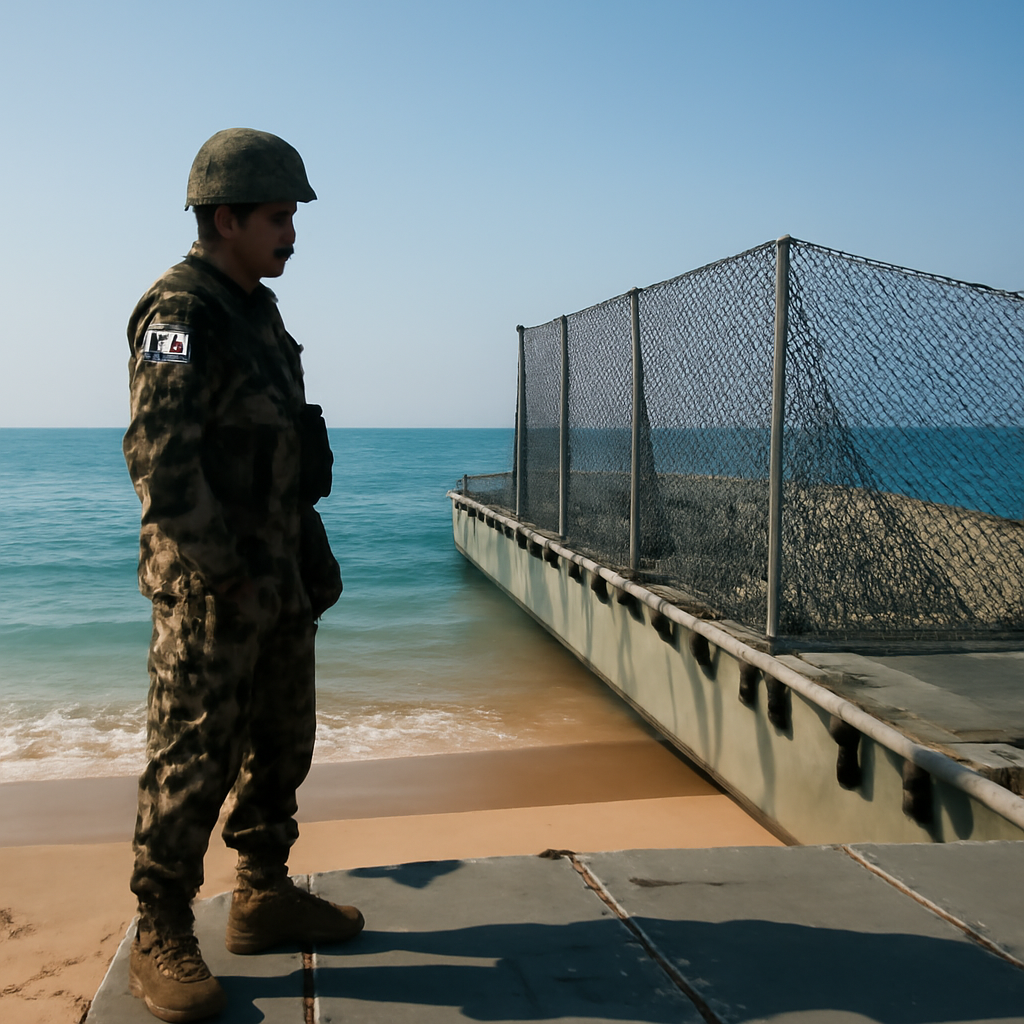
"Republic of Korea service members aboard an Improved Navy Lighterage System conduct a beach stabbing of the platform during Combined Joint Logistics Over-the-Shore 26 at Dogu Beach, Pohang, South Korea, July 9, 2026."
Images from CJLOTS 26 on July 9, 2026
Photographs posted to the Pentagon’s image distribution site show Republic of Korea service members aboard an Improved Navy Lighterage System (INLS) during a beach-stabbing operation at Dogu Beach, Pohang, on July 9, 2026. The images, credited to U.S. Marine Corps Lance Cpl. Matthew Borruso, depict a section of the floating causeway draped with what appears to be anti-drone netting.
What the Marines and U.S. Forces Korea said about the exercise
The Marines described the offload as “a Maritime Prepositioning Force exercise where 3rd Marine Logistics Group (MLG) distributes equipment from a created port of entry and provides support to III Marine Expeditionary Force units training throughout South Korea, testing and validating 3rd MLG’s ability to conduct integrated logistics operations in complex environments.” They added that “CJLOTS 26 is a combined exercise designed to integrate U.S. and Republic of Korea lighterage and ship-to-shore connector capabilities, improve combined readiness, strengthen the Republic of Korea-U.S. alliance, and expand combined maritime sustainment capacity during logistics operations.”
U.S. Forces Korea/Combined Forces Command stated the exercise “integrated five types of ground, maritime and air sustainment assets” and, “reflecting evolving battlefield conditions, the training also strengthened protection measures for sustainment nodes against threats such as hostile drone attacks.”

The cyber insurance questionnaire just landed. Now what?
SOC 2, HIPAA, insurance renewals - someone has to own security strategy. Nubivance provides fractional CISO leadership without the full-time salary.
Get a security leadAnti-drone netting as a passive defensive measure
The photographs show netting placed over one section of the INLS platform—presumably where cargo or a vehicle would be transferred. The concept, as described in the reporting, is straightforward: drones become entangled in nylon or mesh metal nets and are disabled, or are kept far enough from personnel that any detonation of carried munitions does not produce lethal effects. The source also notes caveats visible in the images: the netting is open on both ends and only covers part of the platform, leaving much of the causeway, the ship, and the wheelhouse exposed. The article questions how protective such an arrangement would be against highly maneuverable first-person view (FPV) drones but suggests it could provide some protection against lighter munitions dropped by so-called bomber drones.
Pentagon guidance and the broader trend
The appearance of netting at CJLOTS 26 aligns with recent Pentagon guidance. A handbook published by the Pentagon’s Joint Interagency Task Force 401 states: “Two proven ways to disrupt drones are shaping their physical environment and interfering with their signals. Obstacles such as fencing, netting, or over-head structures can alter flight paths, block common avenues of approach, and push drones into visible or unfavorable routes while also degrading control links, GPS (Global Positioning Systems), or navigation timing.” JIATF 401 was established last August to coordinate counter-drone efforts and accelerate fielding of new capabilities; earlier this year the task force called for increased use of netting, cables, and other passive physical defenses to protect critical infrastructure.
How the Republic of Korea, U.S. Marines, and logistics planners are responding
- Republic of Korea military: The images show ROK service members employing an INLS and, at least in that instance, using netting over the transfer lane—indicating experimentation with passive protections during ship-to-shore sustainment.
- U.S. Marines and logistics planners: CJLOTS 26 was explicitly designed to validate offload operations from a created port of entry while strengthening protection for sustainment nodes, suggesting U.S. units are incorporating counter-drone considerations into combined logistics training.
- Pentagon/JIATF 401: Through published guidance and earlier calls for passive measures, the task force is promoting netting and similar defenses as part of layered counter-drone strategies for sustainment and critical infrastructure.
Context: threats and parallel developments
The article places the exercise amid wider patterns of defensive netting use. It cites prior examples from Ukraine and reports of Dutch troops training with anti-drone “net tunnels” during Exercise Fighter Lion. It also notes instances in Lebanon and Israel where netting has been erected in response to FPV drone attacks, and reports that Taiwan has used anti-drone netting to protect air defense systems. The reporting further states that both China and North Korea have developed large arsenals of drones and that North Korea “has gotten assistance from Russia on drone technology as well as direct experiencing fighting Ukraine,” with the regime investing “significant resources into evolving its drone capabilities across all tiers.”
After initial publication, III Marine Expeditionary Force (III MEF) responded to the author’s pre-publication query, explaining the platform is owned by South Korea and noting that, while they were “not sure this is anti-drone netting,” the Marines “would not likely use such a bright color for such a device.” The story and headline were edited post-publication, according to the author’s note.
The visible use of netting on a ship-to-shore causeway at CJLOTS 26 is not definitive proof of a doctrinal shift, but it is tangible evidence that passive physical defenses are being tried in combined logistics settings where drones pose an explicit threat. Whether such measures will be widened, standardized, or adapted to counter agile FPV types remains a practical question for planners who face exposed approaches, limited cover, and the challenge of protecting ships, platforms, and shore nodes during amphibious sustainment operations.
https://www.twz.com/land/marines-used-anti-drone-netting-during-recent-logistics-exercise