NATIONAL HARBOR, Md. — The Navy League’s annual Sea Air Space conference has come to an end at scenic National Harbor outside Washington, DC. The show’s final day left a clear imprint: unmanned systems, autonomy and new munitions claims dominated the docks and show floor, where companies and model-makers arrayed hardware meant for sea, air and undersea operations.
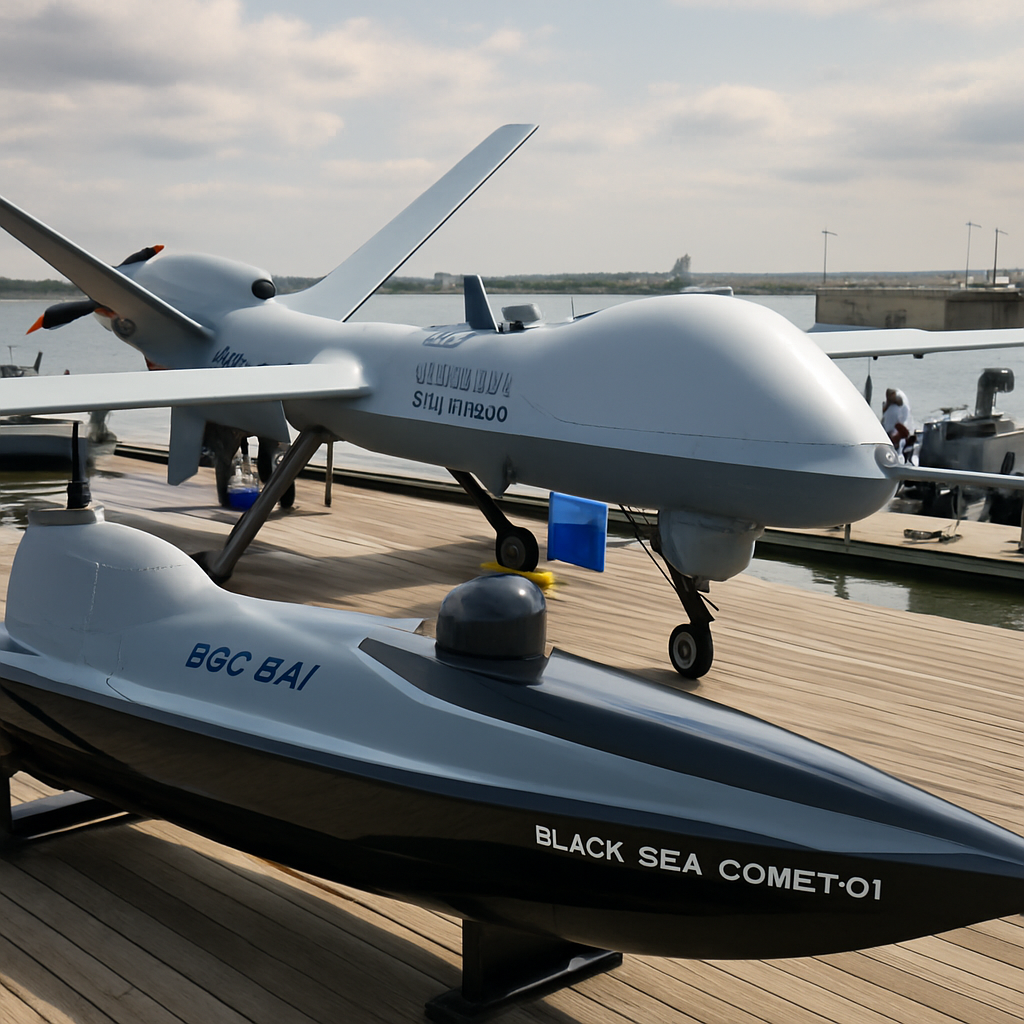
Dockside displays: The Black Sea Comet -01 and MQ-9B SeaGuardian
Outside the conference halls, the docks were staged with craft meant to be seen up close. Photographs catalogue the Black Sea Comet -01 43’ High Speed Interceptor tied up for show, and a General Atomics MQ-9B SeaGuardian drone was on view as well. A wider dockside view captured several naval systems positioned together for demonstration and photography, underscoring the event’s role as both trade fair and hardware gallery.
Unmanned surface and underwater systems filled the show floor
The conference emphasized unmanned systems across domains. General Atomics presented an Electromagnetic Unmanned Underwater Vehicle, while HII displayed Romulus, an autonomous ship. Ocean Aero exhibited a Triton autonomous vehicle capable of operating both underwater and on the surface. Leonardo DRS showed an Autonomous unmanned surface vessel integrated with a Maritime Mission Equipment Package, and Saildrone released a wingless Spectre USV. Anduril also exhibited its Dive XL nose at the show.

Audit-ready is a season. It shouldn't be.
Evidence in spreadsheets, controls drifting between audits, frameworks multiplying on flat headcount. Nubivance runs continuous compliance on Rapid7 Cyber GRC - SOC 2, HIPAA, ISO 27001, PCI, CMMC.
End the scrambleAir autonomy and robotic tooling: from VTOL fighters to welding “dogs”
Autonomy extended into the air domain and the factory floor. Shield AI’s X-BAT — described in photographs as an AI-piloted VTOL fighter jet — was staged ready for display. Schiebel displayed the PILLS unmanned rotorcraft, and a General Atomics MQ-9B SeaGuardian appeared among the aerial exhibits. Automation on the production side was visible too: Path Robotics’ robot “dog” carrying a welding torch was photographed on the floor, a reminder that autonomous and robotic systems were a theme across military and industrial applications at the event.
Weapons and munitions on display, and a procurement spotlight
Weapon systems and missile models occupied prominent booths. BAE Systems displayed the Archerfish mine disposal weapon alongside a Sting Ray torpedo. MBDA’s American arm showed the Meteor missile model, while IAI exhibited a Sea Demon affordable surface-to-surface cruise missile on the show floor. A procurement development also featured in the captions: the U.S. Naval Air Systems Command selected L3Harris to develop Red Wolf munitions for the Marine Corps’ Precision Attack Strike Munition program — a named selection noted among the exhibition captions.
Models, manufacturers and notable attendees
Model displays and corporate booths filled the interior halls. General Dynamics Electric Boat’s models of the Columbia Class and Virginia Class submarines were photographed; a Northrop Grumman surveillance plane model loomed over attendees. Companies with visible booths included UltraMarine, Saildrone and HII, and Leonardo DRS promoted its Maritime Mission Equipment Package. Qintel had a dramatically camouflaged model at its booth, and IAI, SNC and other vendors showed trainers and missile systems. The show also recorded moments of interaction: former Navy Secretary Carlos Del Toro was photographed visiting with sailors on the floor.
What this means for procurement leaders, technologists and sailors
- Procurement leaders: The U.S. Naval Air Systems Command’s selection of L3Harris for Red Wolf development is a concrete procurement signal; vendors and acquisition planners will watch similar announced selections and model displays for indications of program priorities.
- Technologists and system integrators: The breadth of unmanned surface, underwater and air systems — from the General Atomics UUV to Saildrone’s wingless Spectre and Shield AI’s X-BAT — points to growing emphasis on autonomy and integration with mission packages, which will drive interoperability and sensor-integration work.
- Sailors and operators: Displays ranging from the Archerfish mine-disposal system and Sting Ray torpedo to autonomous surface vessels and submarine models offered operators visual access to both current and conceptual tools likely to shape littoral and undersea operations.
The images from Sea Air Space 2026 make plain where effort and tradecraft converged on the show floor: autonomy across domains, visible munitions development, and an array of vendor models meant to answer service needs. As the conference closes, the hardware on display — from the docks to the booths — will be the baseline vendors and services point to as they seek the next contracts and demonstrations.