As of early 2023, there were just around nine series‑production Su‑57s in Russian service, a small fleet suddenly pressed into a new kind of fight by widespread drone and cruise‑missile strikes.
The images: Su‑57 with R‑73/R‑74 missiles and a mysterious pod
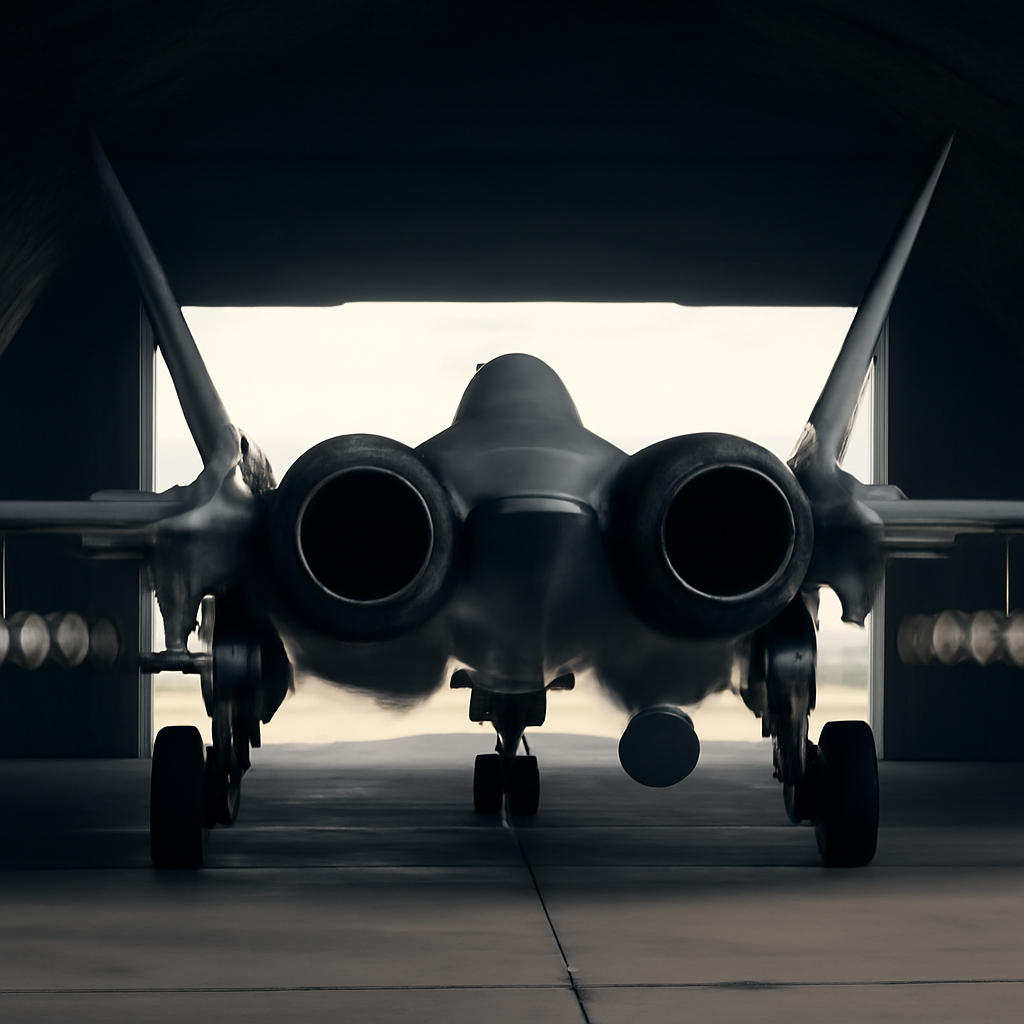
Two recently surfaced photographs show a Sukhoi Su‑57 parked inside a large shelter, viewed from the rear, carrying a pair of short‑range R‑73/R‑74 (AA‑11 Archer) series air‑to‑air missiles on pylons beneath its wings and a previously unseen pod mounted below the left engine nacelle. One image reportedly appeared on TikTok and both were reposted on X (formerly Twitter); in one picture teenagers are posed alongside the jet, including one sitting in the cockpit. Russian military bloggers have identified the loadout as configured to hunt Ukrainian drones.
Why the loadout points at drone and cruise‑missile defense
The external carriage of short‑range infrared missiles, together with a podded sensor under the nacelle, would be a logical configuration for close‑range engagements of small, low‑signature targets. The Su‑57’s internal weapon bays exist precisely to carry air‑to‑air missiles, so the visible, underwing R‑73/R‑74s are a notable departure — but also practical if older R‑73 stocks are plentiful and cannot be accommodated internally. Short‑range, high off‑boresight IR missiles such as the R‑73 and its successors have a track record as “drone‑killers,” and the R‑74 family (including the two‑band seeker R‑74M and the Russia‑sourced R‑74M2 optimized for the Su‑57) offers increased seeker range and off‑boresight capability useful in close encounters.

Audit-ready is a season. It shouldn't be.
Evidence in spreadsheets, controls drifting between audits, frameworks multiplying on flat headcount. Nubivance runs continuous compliance on Rapid7 Cyber GRC - SOC 2, HIPAA, ISO 27001, PCI, CMMC.
End the scrambleHow the Su‑57’s sensors and weapons fit the mission
The Su‑57 is the only operational Russian fighter of any meaningful number equipped with an active electronically scanned array (AESA) radar — the N036 system with five separate AESA arrays — linked to an integrated fire‑control suite that includes the 101KS electro‑optical system, the N036Sh IFF, and the L402 electronic countermeasures suite. AESA and infrared search‑and‑track (IRST) sensors are particularly valuable against small, low‑altitude threats, and the 101KS package includes an IRST forward of the cockpit, four ultraviolet missile‑approach warning sensors, two directional infrared countermeasures turrets, and an imaging IR sensor for low‑level flying.
Alongside those sensors, the Su‑57 has long‑range air‑to‑air missiles — the 124‑mile R‑37M and the 68‑mile R‑77‑1 — and standoff strike weapons such as the Kh‑69 (claimed to reach over 180 miles) and the Kh‑58UShK anti‑radiation missile (maximum range around 150 miles, depending on launch parameters). For closer work, the jet’s 30mm single‑barrel cannon (150 rounds) is available, though employment against slow, low targets from a fighter is challenging. The photographs also show a pod with a rear end different from the standard 101KS‑N; observers have suggested it could be a new version of the targeting pod or a variant optimized for air‑to‑air engagements, though its exact identity is unclear.
Akhtubinsk, the Moscow raid, and pressure on Russian air defenses
The shelter seen in the photos resembles hardened structures installed at Akhtubinsk in the Astrakhan region, an airfield more than 350 miles from the front line that was struck by Ukrainian drones in June 2024 — a public episode that raised complaints about the protection of Russian aircraft. Since then, Russia has begun to disperse and shelter key air assets, including measures extended to long‑range bombers. Yet Ukraine’s campaign — described in the reporting as “relentless” and focused on refineries, weapons production sites, and key military facilities — has pushed Russian air defenses across a wider geography. The large‑scale daylight raid on Moscow in June 2026, involving multiple Ukrainian drones and cruise missiles that struck several locations, underlined that fighters and layered assets are being brought into the defensive equation. Separately, fighters have been forward‑stationed on alert at the Engels bomber base, illustrating how airframes are being used to protect targets beyond traditional front‑line intercepts.
What this means for the VKS, Ukrainian forces, and air‑defense commanders
- Russian Aerospace Forces (VKS): The images point to an operational adaptation — using a high‑end fighter with advanced sensors to plug gaps in stretched ground‑based defenses — whether as routine deployments or as part of weapons trials.
- Ukrainian forces: The shift highlights the effect of long‑range drone and cruise‑missile strikes in forcing adversaries to reallocate prized assets, including Su‑57s and other fighters, into homeland air‑defense roles.
- Air‑defense commanders: The mixed employment of sensors, podded systems, and both internal and external weapons demonstrates a search for cost‑effective methods to engage low‑signature threats; decisions about where to allocate limited Su‑57s will hinge on whether fighters can reliably augment ground defenses against cruise missiles and kamikaze UAVs.
The photographs and their wider context form circumstantial evidence of a practical shift: Su‑57s — few in number but sensor‑rich — are being arrayed to meet a threat that ground systems alone cannot fully absorb. Whether the configuration seen is an operational baseline, an ad‑hoc expedient using available R‑73 stock, or part of controlled trials remains unproven; the images, the shelter type, and the strategic pressure of Ukraine’s long‑range campaign together point to a high‑end aircraft pressed into lower‑end defensive work.