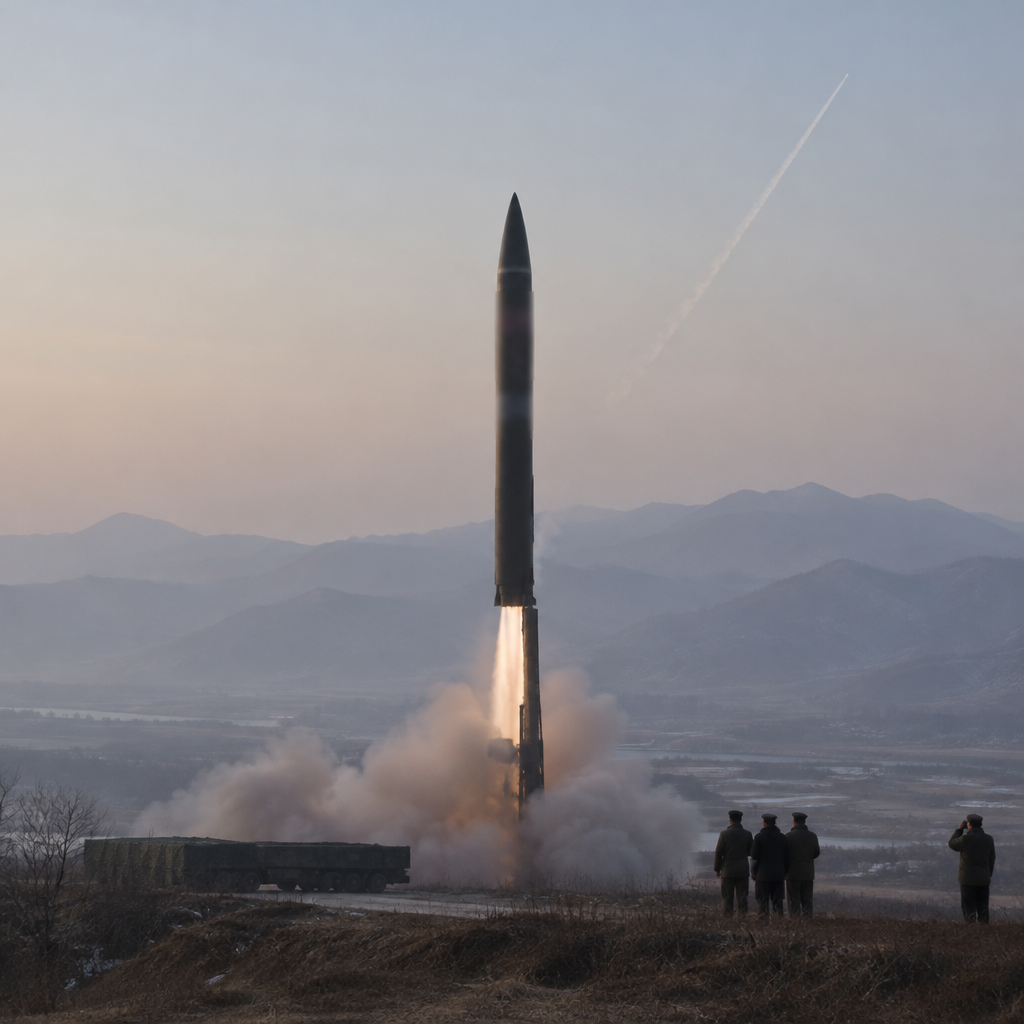
"Whenever we applied the wavelike trajectory mode to missiles, the enemy failed to track the targets from their first skip points," Kim Yo Jong declared, framing recent tests as both technical progress and an attempt to deny outside observers an accurate picture of flight behavior.
Kim Yo Jong’s claim and the recent launch timeline
North Korea conducted at least four sets of missile launches in recent weeks, according to published accounts gathered in reporting. On September 20, Pyongyang tested a missile that South Korean reporting suggests is an upgraded hypersonic variant captioned by KCNA as the "Hwasongpho-11Ma-1 flight trajectory." Two weeks later, on October 3, North Korea fired an intermediate-range missile into waters off its east coast; KCNA characterized that event as another hypersonic missile test and claimed a 1,000 km strike distance, a range that South Korea and Japan judged to be smaller. On October 12, South Korea’s Joint Chiefs of Staff reported multiple ballistic missiles of different types had been launched, with at least one flying more than 900 km. On October 14, KCNA credited test-firing two kinds of submarine-launched cruise missiles—apparently from the Hero Kim Kun Ok submarine, launched in 2023—though reporting also notes prior underwater launches came from a testbed rather than from an operational submarine.
The Hwasongpho-11Ma-1 and other missile advances
South Korean security analysts describe the Hwasongpho-11Ma-1 as likely combining a KN-23 (also referred to as Hwasong-11Ga) missile body with a hypersonic glide-vehicle-type terminal section, producing "a long-range precision-strike weapon designed to penetrate missile defenses through maneuverability while striking targets several hundred kilometers away." KCNA and North Korean leaders framed several tests as employing maneuvering and low-altitude modes; Kim Yo Jong additionally asserted that a tested missile "incorporated unspecified artificial intelligence capabilities intended to complicate interception" and called the October 3 weapon "strategic," a descriptor the reporting links to an implication of nuclear delivery intent.

Audit-ready is a season. It shouldn't be.
Evidence in spreadsheets, controls drifting between audits, frameworks multiplying on flat headcount. Nubivance runs continuous compliance on Rapid7 Cyber GRC - SOC 2, HIPAA, ISO 27001, PCI, CMMC.
End the scrambleHow Russia’s technical support is described in available reporting
Multiple security analysts and studies cited in the reporting connect North Korea’s rapid technical progress to closer Moscow–Pyongyang ties. The account says North Korea extended military assistance to Moscow following the invasion of Ukraine and, in return, received economic benefits and access to military technologies. A South Korean think tank estimated that Pyongyang’s arms sales and troop deployment generated more than $10 billion for North Korea—put in context against a GDP cited at roughly $27 billion—and that most payment came in the form of sensitive military technology, weapon parts, or other materials.
Specific Russian companies and technology vectors are named: Novator and Raduga are cited as potential contributors to development of new Hwasal-family cruise missiles. South Korean military intelligence, disclosed by Defense Minister Ahn Gyu-back at an October 2025 parliamentary Defense Committee hearing, hinted that Moscow may have supplied submarine nuclear-propulsion technology—possibly two or three propulsion sets from decommissioned Russian nuclear submarines—and potentially provided submarine noise-suppression technology. The reporting also notes Russia’s sharing of drone technology and raises the prospect that Pyongyang could obtain more advanced, possibly AI-enabled and jet-powered drones such as the Geran-5; North Korea’s Geumseong tactical attack drones are described as bearing a close resemblance to Russian (and Israeli) types, reinforcing a "strong possibility" of technology transfer.
How South Korea, Japan, and regional militaries are affected
- South Korea: South Korean agencies and analysts are tracking a suite of new capabilities—maneuverable hypersonic glide weapons, intermediate-range missiles with contested range assessments, submarine-launched cruise missiles, and possible submarine propulsion and noise-reduction technology—heightening concern over detection, tracking, and defense against lower-altitude, maneuvering trajectories.
- Japan: Japanese authorities, which disputed KCNA’s 1,000 km range claim for the October 3 launch, are similarly confronted with the challenge of assessing flight profiles that North Korean sources claim are deliberately designed to confound external tracking.
- Regional militaries: Navies and missile-defense forces face the prospect that operational submarine-launched cruise capabilities and quieter or nuclear-propelled undersea platforms, if supplied with foreign propulsion or suppression technology, would complicate surveillance and interdiction efforts.
The strategic consequence of Moscow–Pyongyang technical backing
The reporting’s through-line is simple and stark: advances in North Korean missile and undersea capabilities are concerning on their own; if Moscow has supplied components, designs, or propulsion sets as described, those transfers would reflect a rehearsed pipeline through which Pyongyang can shortcut development and accelerate operational fielding. The documented $10 billion inflow of technology and materiel and the named connections to Novator, Raduga, and specific platform types (Geran-5, Hwasal family, Geumseong drones) make clear what the author and cited analysts consider the plausible mechanics of that acceleration. If those mechanics are accurate, what were incremental technical steps become a faster, more worrisome trajectory toward deployable systems that are harder to detect and intercept.
That linkage is the practical crux: independent advances are one thing; external technical backing—especially in propulsion, noise suppression, cruise-missile technology, and glide-vehicle terminal sections—would alter the pace and risk calculus for neighbors and those tasked with collective defense.
Read the original story: https://thediplomat.com/2026/10/russian-help-would-make-north-koreas-missile-test-flurry-worse-news/