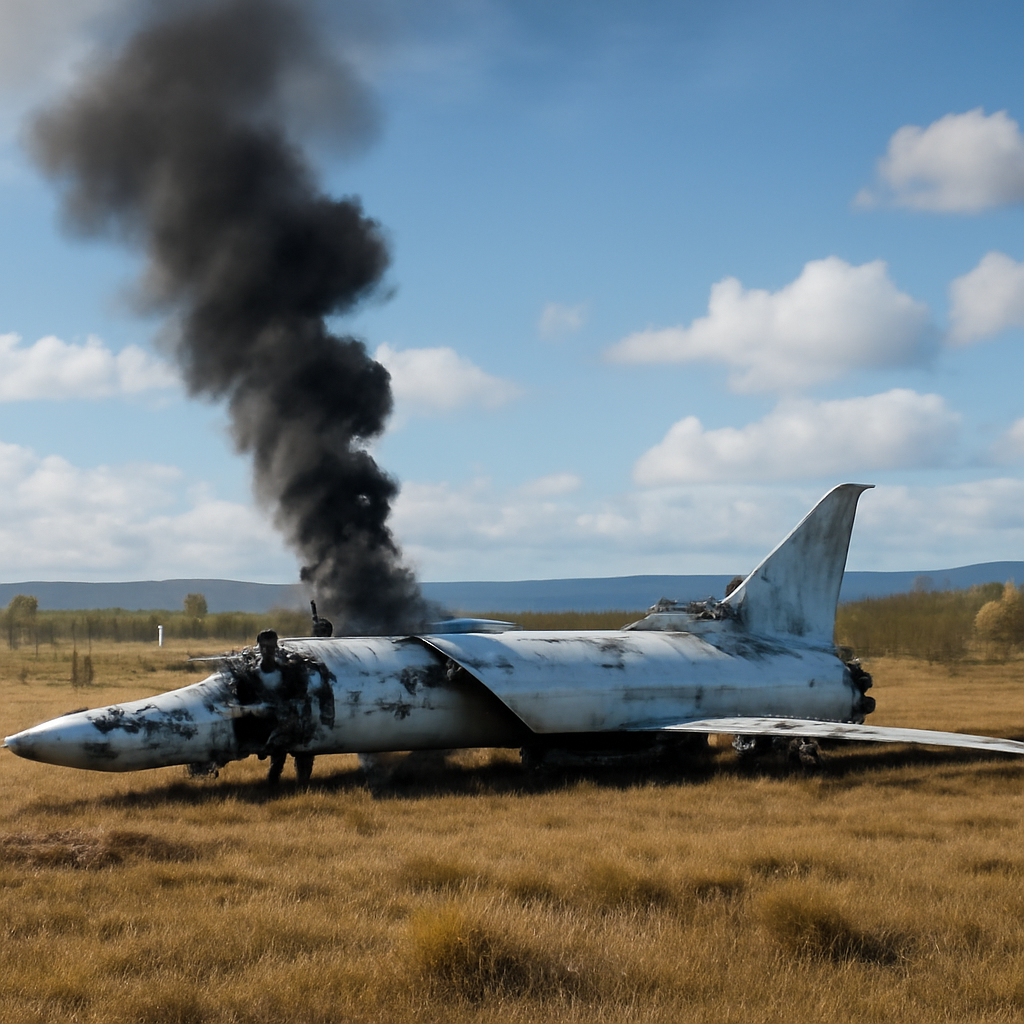
"the bomber was not carrying a combat load, all crew members ejected safely, and there were no casualties or damage on the ground," the Russian Ministry of Defense said after footage circulated showing a Tupolev Tu-22M3 Backfire-C entering a steep nose-down dive and slamming into the ground.
How the Irkutsk crash unfolded
Multiple videos shared on social media today show a Tu-22M3 plunge nose-first into the ground and produce a large plume of black smoke. The footage has not been independently verified, but Russian authorities confirmed the aircraft’s loss. The Ministry of Defense said the bomber crashed while making an approach to land in the Irkutsk region during a "routine training flight." The ministry added the aircraft was not carrying a combat load and that the crew ejected safely; it said there were no casualties or damage on the ground and that an investigation is underway.
Location, rescue and local accounts
The governor of the Irkutsk region, Igor Kobzev, located the crash in the Bokhansky district near the village of Kamenka. Kobzev said local people found the crew after they ejected and that the airmen were receiving medical treatment. Social-media posts and on-site footage posted after the event show the wreckage and smoke at the scene; a screenshot from the area indicates Belaya airfield — home to a heavy bomber regiment — sits in the wider Irkutsk region.

Audit-ready is a season. It shouldn't be.
Evidence in spreadsheets, controls drifting between audits, frameworks multiplying on flat headcount. Nubivance runs continuous compliance on Rapid7 Cyber GRC - SOC 2, HIPAA, ISO 27001, PCI, CMMC.
End the scrambleWhy a single Tu-22M3 loss matters
The Tu-22M3 remains a central platform for Russia’s Long-Range Aviation fleet, and the type has been used extensively in the war against Ukraine to launch cruise missiles in standoff strikes. The aircraft is associated in combat reporting with launches of Kh-22 and Kh-32 supersonic missiles repurposed for strikes against ground targets; those weapons, the source notes, are highly destructive though not highly precise and have resulted in significant numbers of civilian deaths. Because the Tu-22M3 has not been produced for decades, the source emphasizes that every airframe is precious: each loss reduces Long-Range Aviation capabilities and readiness.
Recent pattern: combat losses, strikes on bases, and prior accidents
The crash adds to a string of combat and non-combat losses described in the reporting. Ukraine has claimed combat kills of Tu-22M3 aircraft — notably, a reported shoot-down using a Soviet-era S-200 missile that resulted in a Tu-22M3 crash in the Stavropol region on April 19, 2024. On the ground, Ukrainian drone strikes have destroyed or damaged Tu-22M3s: one was destroyed on the Soltsy-2 airbase in August 2023, and in June 2025 an operation nicknamed "Operation Spiderweb" confirmed four Tu-22M3s destroyed on the ground and two damaged while at least four more were targeted across multiple airbases, including Belaya. Separately, the reporting lists non-combat accidents involving the aging bomber fleet in the Irkutsk region in August 2024, April 2025, and earlier this month in June 2026.
Operational and readiness implications for Long-Range Aviation and the 200th Heavy Bomber Aviation Regiment
Belaya, near Irkutsk, is identified in the reporting as an important Backfire base that accommodates the 200th Heavy Bomber Aviation Regiment. After the series of combat strikes and accidents, the source states that the Tu-22M3 fleet numbers around 50 active aircraft, with additional non-serviceable airframes that could be returned to service only after extensive overhaul. Given the type’s long out-of-production status, the loss of any serviceable airframe directly erodes sortie-generating capacity and the broader readiness of Long-Range Aviation.
How Igor Kobzev, the Russian Ministry of Defense, and local residents are responding
- Igor Kobzev (the governor of the Irkutsk region): Publicly identified the crash site in Bokhansky district, reported that local residents found the ejected crew, and confirmed the airmen were receiving medical treatment.
- The Russian Ministry of Defense: Characterized the mission as a routine training flight, confirmed there was no combat load aboard, emphasized no ground casualties or damage, and announced an investigation into the cause.
- Local residents: According to the governor’s statement, civilians in the area located the crew members after ejection and facilitated their medical attention. Social-media footage from local observers further documented the wreckage and smoke.
This crash, documented by social-media clips and affirmed by official statements, is part of a larger pattern of attrition for the Tu-22M3 fleet — attrition that the source ties to both hostile action and repeated accidents in the same Siberian region. The ministry’s announced investigation will be the next concrete record released; until it is published, the proximate cause of today’s approach-and-landing loss remains an open, official question.