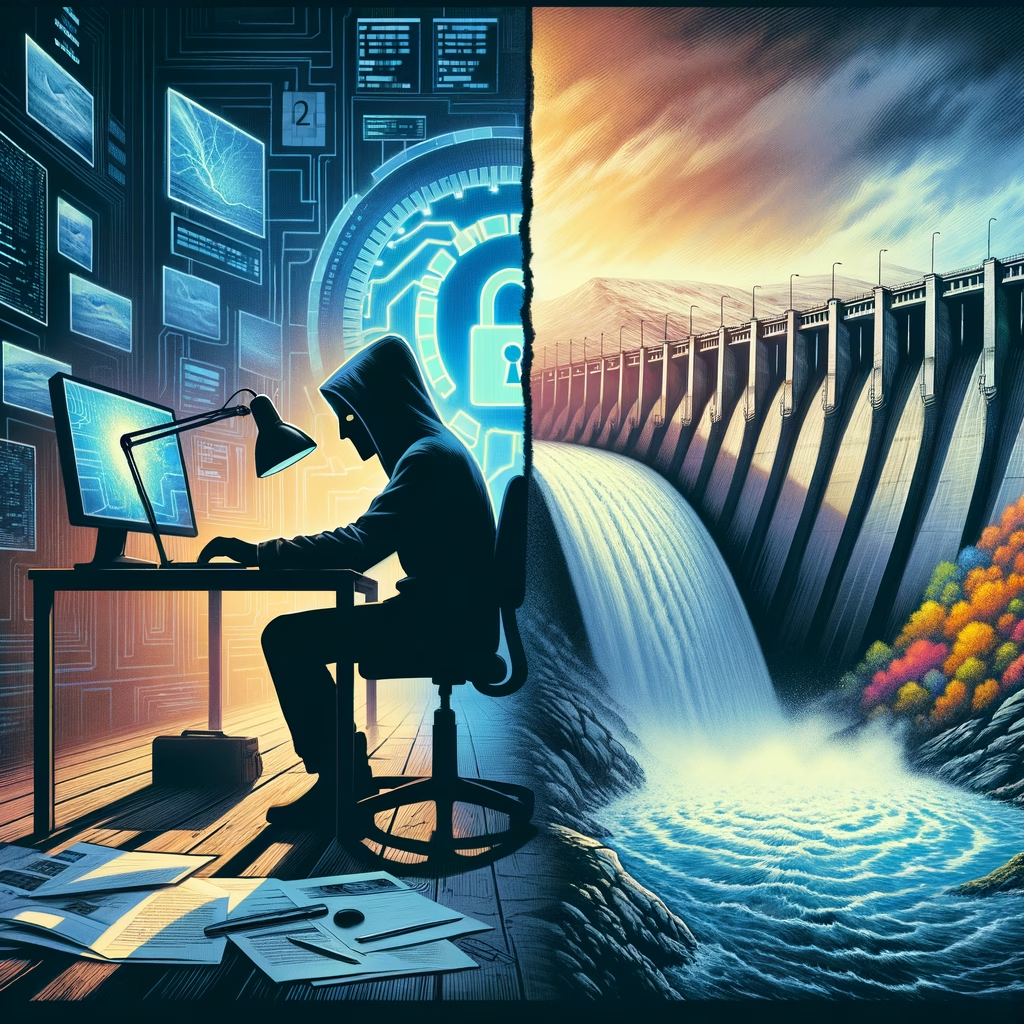
“Who watches the watchmen when their files are open to strangers?” That question has moved from philosophical provocation to urgent geopolitics this summer as U.S. court administrators and Norwegian emergency managers dealt with two alarming intrusions. Investigators and officials in both countries have publicly linked the incidents to Russian-linked cyber actors, a finding that spotlights how digital espionage and sabotage can threaten judicial confidentiality, public safety and international stability.
What happened
In the United States, federal court IT staff disclosed that intruders had maintained prolonged access to an aging case-management system. That access reportedly allowed attackers to retrieve sealed filings—documents normally hidden from public view because they contain personal data, law-enforcement techniques, classified material or witness-protection details. The breach raises immediate concerns about attorney-client privilege, witness safety and the integrity of ongoing legal proceedings. Beyond individual cases, the exposure erodes public confidence in the safeguards that courts rely upon to protect sensitive information.
In Norway, national security services reported that an attacker had manipulated operational controls for a dam’s floodgates. The intrusion was detected before a catastrophic release of water occurred, but the episode triggered evacuations, emergency reviews and an investigation into how industrial control systems were reachable and vulnerable. Norwegian officials and some international outlets have connected the operation to groups aligned with or tolerated by Moscow—another instance where the tools of cyberspace encroach on physical infrastructure.
Why Russian-linked cyber actors are implicated
Attribution in cyber incidents is always complex, but the pattern here—long-term footholds, targeted reconnaissance of high-impact systems and exploitation of outdated platforms—matches tactics previously attributed to Russian-linked cyber actors. Over the past decade these actors have ranged from espionage and influence campaigns to disruptive strikes against energy grids, communications networks and government systems. Their capabilities include patient persistence, meticulous reconnaissance and opportunistic use of legacy systems that lack modern defenses.
Context and implications
Both breaches expose a recurring vulnerability: the collision of strategic intent and technical debt. U.S. federal courts operate a patchwork of modern and legacy IT systems; many case-management platforms were built before today’s threat environment matured. Sealed filings exist to protect privacy, trade secrets and national-security material—when those safeguards fail, the consequences ripple beyond the immediate parties to affect public trust in the justice system.
Similarly, water management and other utilities frequently rely on industrial control systems and operational technology (OT) that were not designed with internet-era adversaries in mind. Those systems are often connected, directly or indirectly, to networks that increase their attack surface. The ability to manipulate a floodgate is not merely symbolic: it is an operational lever that can produce physical harm, prompt panic and be used to coerce or signal intent in a crisis.
Lessons for defenders
These incidents illustrate several concrete lessons for policymakers, technologists and operators:
– Legacy systems with weak segmentation and limited logging remain lucrative targets. Modernization should include not just patching but robust monitoring, continuous threat-hunting and strict identity controls.
– Cyber intrusions can quickly cross into the physical domain. Protecting operational technology requires dedicated defenses: network isolation where feasible, rigorous change controls, and anomaly detection attuned to OT command sequences.
– Attribution matters. When attacks are tied to nation-state actors, the incidents become diplomatic and strategic problems that demand coalition responses, evidence-based public statements and proportional measures such as sanctions or joint defensive actions.
Practical responses and trade-offs
Technologists recommend accelerated migration away from antiquated platforms, adoption of zero-trust architectures and enhanced logging to shorten the dwell time of attackers. For critical infrastructure, prioritizing air-gapping or robust segmentation, combined with OT-specific monitoring, can reduce the risk of remote manipulation.
But upgrading courts and securing dams costs money and political capital. Legislators, court administrators and utility managers must weigh transparency, judicial independence and fiscal realities. Internationally, diplomats must decide how and when to publicly attribute attacks to Russian-linked cyber actors and whether to pursue coordinated responses that could escalate tensions.
Broader risks
Attribution to Moscow-linked groups prompts difficult questions: were the operations state-directed, run by proxies, or carried out by independent criminal collectives operating from Russian territory? What were the attackers’ objectives—espionage, coercion, disruption or influence? There is also the danger of normalization: if incremental intrusions become a tolerated cost of geopolitical competition, courts and utilities will remain perpetually exposed to the next operation.
Conclusion
The twin incidents—sealed court files plundered and a dam’s controls tampered with—are not isolated technical failures but warnings. They underscore how strategic malice paired with technological neglect can undermine trust, safety and the rule of law. Responses will require domestic repair and reform, clearer international accountability, and a sober debate about acceptable risk from Russian-linked cyber actors. If institutions meant to safeguard liberty can be made to leak confidential records or to toy with floodgates, the next breach could reshape more than headlines; it could reshape public life itself.