"The new missile was first deployed by the enemy late last year and appears to represent the United Aircraft Corporation’s (UAC) initial venture into missile manufacturing," the Ukrainian Main Directorate of Intelligence (GUR) said in its public release.
Design and low-observable shaping attributed to UAC
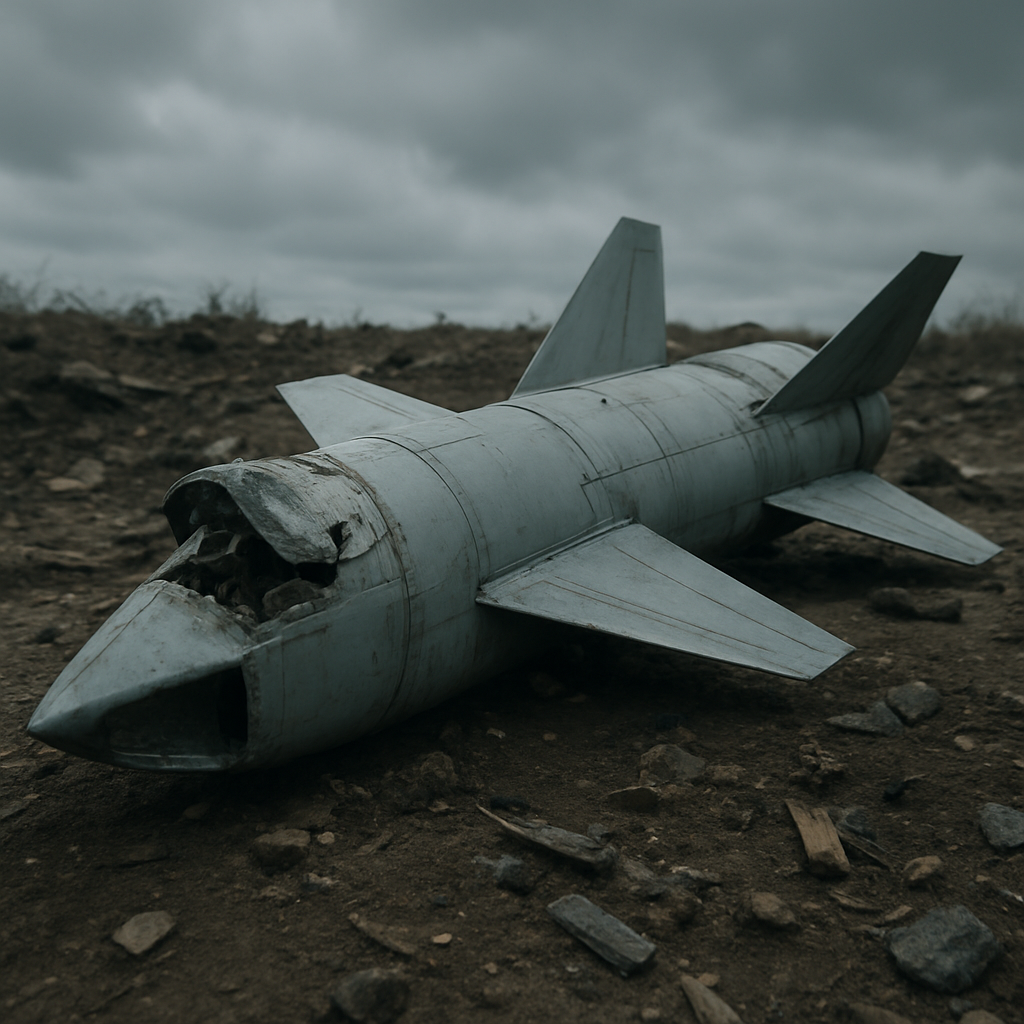
The GUR released an interactive 3D model and detailed component breakdown of the S-71K Kovyor (Carpet), an air-launched missile that Kyiv says has seen combat use since late 2025. The missile’s airframe is described as a low-observable shape with a trapezoidal cross section, a chined nose, pop-out swept wings, and an inverted V-tail. Imagery of wreckage shows a distinctive top-mounted conformal engine intake feeding a pentagon-shaped duct.
Construction materials are unconventional for a cruise missile: the airframe uses “a multi-layer fiberglass material with additional reinforcement,” while internal elements employ aluminum alloys. Notably, the published wreckage and imagery show no signs of radar-absorbent coatings such as radar-absorbent material — a choice the GUR implies may reflect cost-saving trade-offs.
Warhead, propulsion and basic flight performance
The S-71K integrates a repurposed OFAB-250-270 high-explosive fragmentation bomb as its warhead; the GUR specifies the bomb’s mass as 551 pounds. Propulsion is provided by a compact R500 turbojet engine produced by UAC. The missile carries three separate internal fuel tanks; the GUR assesses an operational range of up to 186 miles. Earlier reporting cited in the GUR release places the missile’s speed at about Mach 0.6 and an operational altitude up to 27,000 feet.

This site is the portfolio.
OSINTSights runs on Cloudflare Workers, D1, R2, and Vectorize, with an AI pipeline on Hetzner ARM. Nubivance designed, built, and operates it. We do the same for clients.
See what we buildForeign components and reliance on global supply chains
The GUR states that “the vast majority” of the S-71K’s electronic components are of foreign origin, listing items manufactured in China, Germany, Ireland, Japan, Switzerland, Taiwan, and the United States. Kyiv uses these findings to underline a broader point: “Continued access to foreign technologies and components allows the aggressor state to develop new weapons and scale their use in the war against Ukraine.”
The S-71K joins other Russian systems the GUR has examined that contain overseas components; the intelligence service previously documented foreign parts in a Shahed-136-type strike drone and in an S-70 Okhotnik-B UCAV recovered after friendly fire.
Platforms, testing, and the S-71 family
GUR materials say the S-71K was developed specifically with the Su-57 in mind and underwent captive-carry trials at the Russian flight research center in Zhukovsky in April 2024. The agency has not stated which platforms have employed the missile operationally in Ukraine. The GUR notes that while the S-71K is externally carried by launch aircraft, it could be fitted to other tactical jets — a necessary condition for large-volume employment if significant production numbers are ever realized.
The S-71 series reportedly includes a related variant, the S-71M Monokhrom. Described in Russian reporting as a kamikaze drone but characterized by the GUR as an air-to-ground missile with “human-in-the-loop” control capability, the S-71M is said to offer electro-optical sensors for day/night use and multiple warhead options, including shaped charges. Unlike the S-71K, the S-71M is reported to be capable of internal carriage in a Su-57 or S-70 UCAV — though published images show test rounds that appear less stealthy than the latest S-71K, and the GUR notes no folding tailfins have yet been observed, which would be required for internal bays.
What this means for Ukraine’s air defenses, UAC/Sukhoi, and foreign suppliers
- Ukraine’s air defense forces: The S-71K’s low-observable shape and tactical-range employment add another axis of threat to already strained air defenses, a point the GUR makes in assessing operational impact.
- United Aircraft Corporation (UAC) and Sukhoi: Kyiv frames the S-71K as UAC’s “initial venture into missile manufacturing,” highlighting an industrial shift toward lower-cost, smaller air-launched weapons tailored for tactical platforms such as the Su-57 and potentially the S-70 UCAV.
- Foreign component suppliers (China, Germany, Ireland, Japan, Switzerland, Taiwan, United States): The GUR’s analysis underscores how access to off-the-shelf technologies and components can be redirected into new weapon types, affecting how those supply chains are viewed in a wartime context.
The S-71K, as presented by the GUR, is neither a heavy strategic cruise missile nor an evolutionary dead end; it is a compact, lower-cost air-launched weapon that sacrifices some sophistication for volume and affordability. Kyiv’s public breakdown—complete with a 3D model and component list—frames the missile as a tangible sign that Russia is diversifying its inventory to fill wartime needs. The immediate questions left by the facts released are operational scale and platform breadth: how many S-71Ks can UAC produce, and which aircraft beyond the Su-57 will routinely carry them in combat? Those answers will determine whether the Kovyor remains a niche capability or a broader tactical challenge.
https://www.twz.com/air/russias-stealthy-s-71k-air-launched-missile-seen-in-unprecedented-detail