“New satellite images show that Russia is increasing its armament in [the] vicinity,” a joint Nordic-Baltic investigation reported this week — and those images, the investigation and multiple follow-ups lay out a sustained Russian effort to build infrastructure capable of hosting tens of thousands of troops along Norway’s and Finland’s borders.
Satellite evidence and the Nordic-Baltic media investigation
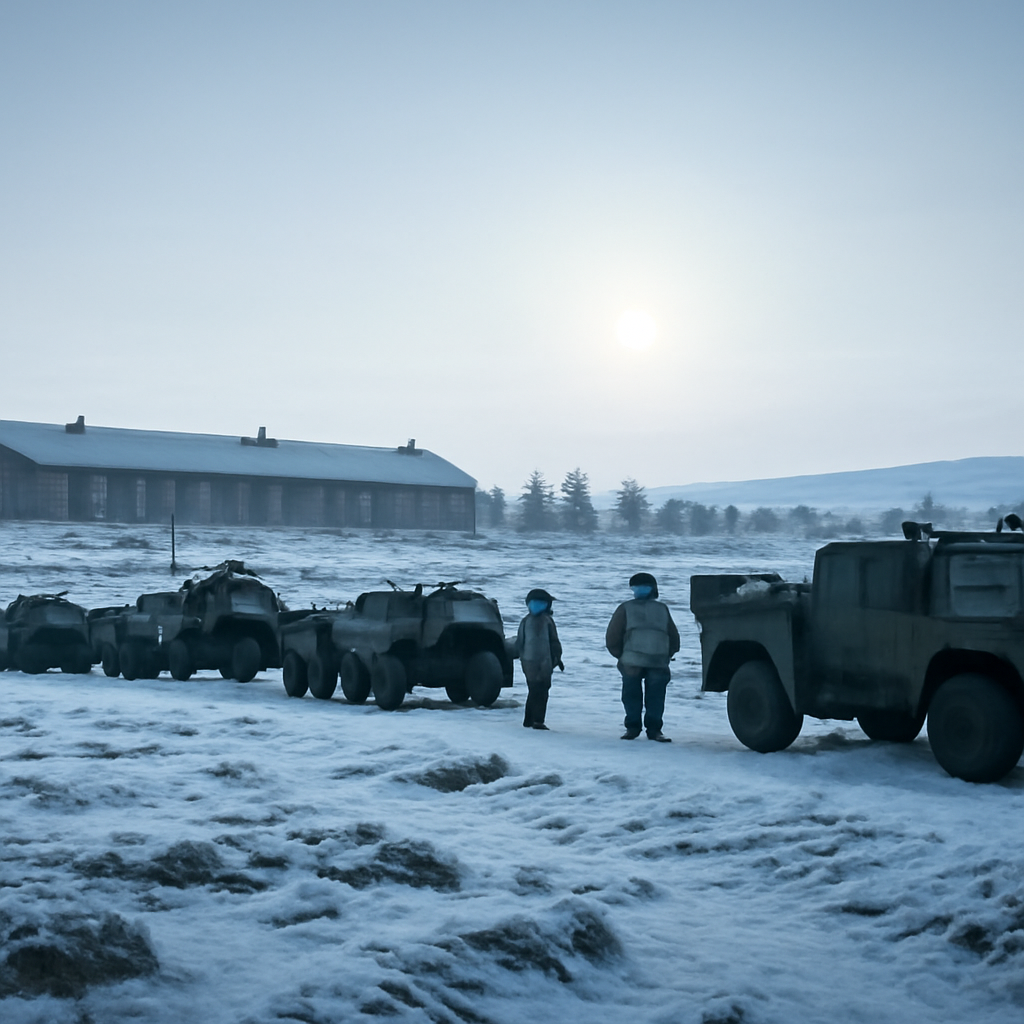
A coalition of Nordic and Baltic news outlets published satellite imagery and analysis this week showing new barracks, long lines of military vehicles and ammunition storage on Russia’s side of the Finnish and Norwegian borders. The joint report said Russia is “preparing for 80,000 soldiers,” a figure Thomas Nilsson, head of Sweden’s military intelligence service (MUST), called “a threat that we should take seriously.” The investigation also included an estimate that the developments could enable deployments of up to 115,000 military personnel across the Northern European and Baltic regions.
Novaya Vilga: a new garrison near Finland
Finnish public broadcaster Yle reported separately that Russia is expanding a base at Novaya Vilga, located about 100 miles east of the Finnish border, to hold as many as 6,000 troops. Satellite data and on-the-ground reporting published this week were cited by journalists and amplified on social media by reporters such as Mika Mäkeläinen and accounts aggregating war reporting.

Audit-ready is a season. It shouldn't be.
Evidence in spreadsheets, controls drifting between audits, frameworks multiplying on flat headcount. Nubivance runs continuous compliance on Rapid7 Cyber GRC - SOC 2, HIPAA, ISO 27001, PCI, CMMC.
End the scrambleRussian posture versus current operational limits
The reporting places these preparations alongside assessments of Russia’s current military condition. The source describes Russia as “totally bogged down and suffering high attrition in Ukraine with little chance of moving masses of troops to the arctic at the moment.” At the same time, the joint media investigation and NATO sources note that Russia’s wartime mobilization and economic posture during the Ukraine conflict could be leveraged after any ceasefire to relocate forces, a scenario NATO says it must consider.
NATO response: FLF Finland and prepositioned Swedish forces
NATO on June 6, 2026 established Forward Land Forces (FLF) Finland to operate in Finland and Sweden. The FLF places a Swedish battalion battlegroup based in Boden, Sweden, and a Multinational Staff Element in Rovaniemi, Finland, under the command of the Supreme Allied Commander Europe (SACEUR) and NATO. NATO described the Swedish battalion battlegroup as “prepositioned in Boden, with capacity to operate in the North Calotte and, where necessary, rapidly reinforce the presence in northern Finland.” In 2026 Sweden’s contribution to FLF Finland will total around 600 personnel, with the option to expand to 1,200 if needed.
Gen. Alexus G. Grynkewich, U.S. Air Force general and SACEUR, framed the new force as part of a dual effort with Arctic Sentry to “defend our territory and ensure the Arctic and High North remains secure, especially considering Russia’s military activity and China’s growing interest there.” A NATO official told the reporting team that while the alliance assesses near-term conflict risk is low given the war in Ukraine, “Moscow could seek to expand westward into the Nordic and Baltic nations after a ceasefire with Ukraine.”
U.S. integration effort: NORTHCOM’s “Nordic Bridge” concept
U.S. Northern Command (NORTHCOM) has described a complementary initiative called Nordic Bridge. Air Force Gen. Gregory Guillot announced the concept during a recent SOF Week symposium; a NORTHCOM spokesperson told reporters that Nordic Bridge “seeks to enhance Arctic integration between U.S. Northern Command and U.S. European Command and enhance cooperation between NORAD and NATO in order to expand domain awareness, strengthen deterrence, and improve interoperability.” The spokesperson listed concrete measures: increased participation in each other’s training and exercises, increased data sharing (such as air pictures), and deconflicting conferences to maximize personnel availability and participation.
How Finland, Sweden, and NATO are responding
- Finland: Finnish Army Chief Pasi Välimäki told investigators, “We expect to have 80,000 soldiers on our border and that can be compared to the fact that we previously had 20,000,” signaling Finnish concern about the scale of nearby infrastructure growth and a need to prepare for larger force flows.
- Sweden: Sweden is supplying the lead battalion battlegroup to FLF Finland, prepositioning forces in Boden and planning a Multinational Staff Element in Rovaniemi — concrete steps to place troops where NATO judges rapid reinforcement would be most effective.
- NATO: The alliance has accelerated capability deliveries and command arrangements, saying it wants “real military capabilities to the alliance now, not five to ten years from now,” and placing FLF Finland under SACEUR command to bind the new units into NATO’s operational framework.
The pattern is plain in the facts presented: Russian construction of barracks and storage, satellite confirmation of equipment and lines of vehicles, and national and alliance responses to preposition forces and improve interoperability. Whether the newly built infrastructure will be populated from units now committed elsewhere remains an open operational contingency in NATO’s planning — a risk the alliance says it must keep squarely in view.