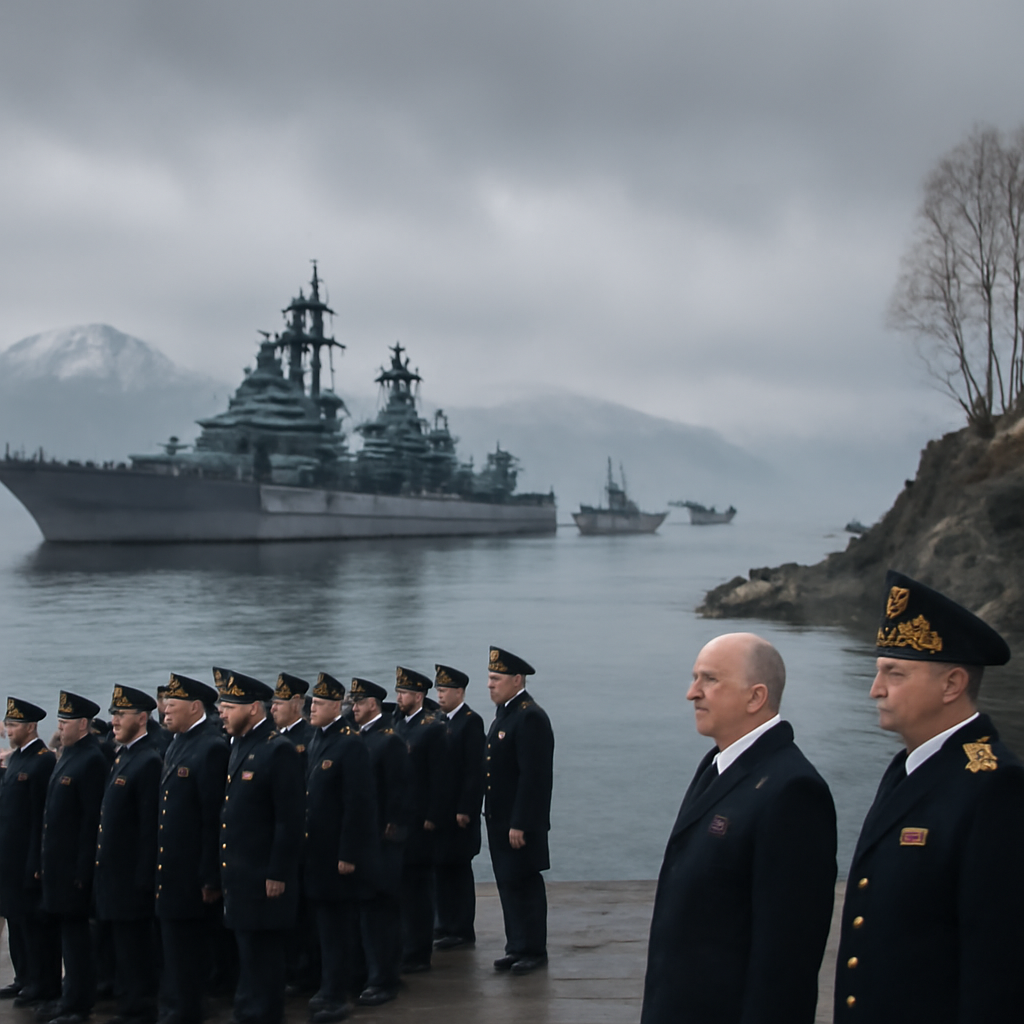
“Sixty surface ships, submarines and support vessels, 30 aircraft and uncrewed systems and 13,000 personnel” gathered for a Pacific Fleet exercise that wrapped on 12 August — and Vladimir Putin turned up days later on 13 August to visit the Southern Kuril island of Iturup.
Putin’s visit to Iturup and the Kuril posture
Putin’s trip to Iturup was described in the source as the first visit by any senior Russian official since the war on Ukraine began. It arrived against a backdrop of long‑running dispute: Russia has controlled Iturup, Kunashir and nearby islands since World War II while Tokyo disputes that claim. Since February 2022 the two sides have ‘dug in their heels’: Russia has withdrawn from dialogues and terminated visiting arrangements for former Japanese residents, while Japan has designated the Southern Kurils as ‘illegally occupied territories’. The visit prompted a sharp rebuke: Japanese Foreign Minister Toshimitsu Motegi called in Russia’s ambassador for a ‘frank exchange of views’, and Prime Minister Sanae Takaichi called the visit ‘absolutely unacceptable’.
Large-scale naval drills and the defensive logic
The exercise Putin observed ran from 4 to 12 August and resembled prior June exercises in 2024 and 2025: a theatre-level defence of the Kuril arc against a simulated enemy task group. The Pacific Fleet put significant assets on display for that rehearsal — the 60 surface ships, submarines and support vessels, 30 aircraft and uncrewed systems, and 13,000 personnel noted above — an activity the source describes as Russia’s largest maritime activity so far this year.

The cyber insurance questionnaire just landed. Now what?
SOC 2, HIPAA, insurance renewals - someone has to own security strategy. Nubivance provides fractional CISO leadership without the full-time salary.
Get a security leadVilyuchinsk, Borei submarines and why the Kurils matter
The account links these movements to a specific strategic problem: the Pacific Fleet has shrunk since the late Cold War, yet its contribution to Russia’s nuclear posture has not declined proportionally. The Pacific is increasingly the destination for modernised nuclear‑armed ballistic‑missile submarines (SSBNs): five Borei‑class SSBNs stationed at Vilyuchinsk on the Kamchatka peninsula represent 40 percent of the SSBN fleet and are the newest 40 percent. For the Pacific Fleet, the priority is protecting those SSBNs — an effort made harder because the Vilyuchinsk base faces the Pacific rather than the more sheltered Sea of Okhotsk. Budget constraints, geography and the superior anti‑submarine warfare capabilities the source attributes to the Japanese military and the US Navy all feed into Moscow’s drive to consolidate a defensive perimeter along the Kurils.
US carrier rotations and a thinning Western Pacific presence
In Southeast Asia the source documents a related strain in naval posture: the USS George Washington carrier strike group transited the Strait of Malacca around 12–13 August en route from the South China Sea to the Arabian Sea to relieve USS Abraham Lincoln, leaving the Western Pacific without a full‑size US carrier strike group. The only US capital ship cited as present in the region was amphibious assault ship USS Tripoli in port at Sasebo, Japan — a vessel described in the source as having about half the displacement of a carrier, roughly one‑third of George Washington’s embarked air wing and lacking an organic airborne early‑warning and anti‑submarine warfare screen.
The source notes operational pressures behind the move: Abraham Lincoln had reached a record 250 consecutive days at sea with no port calls since December and was reported to have strained supplies and low crew morale. The official explanation is a routine swap; in practice, how long the Western Pacific will be without the region’s most visible US naval presence is tied, in part, to the course of the Iran war that the source says has been ongoing since February.
NZSIS on China, space infrastructure and Purple Mountain Observatory
On 13 August the New Zealand Security Intelligence Service (NZSIS) published an annual threat assessment that identified China as the only state conducting espionage against New Zealand ‘at scale’ and highlighted coercive methods. NZSIS warned that China’s national security laws can compel private Chinese businesses based in China to cooperate with intelligence services, creating risks for New Zealand firms that engage with them.
The assessment singled out efforts targeting the space sector. NZSIS described an incident in which Chinese government‑linked entity Purple Mountain Observatory sought to install ground‑based space infrastructure in New Zealand — hardware used for tracking satellites and orbital debris — through cooperation with an unsuspecting local company. The report emphasises why New Zealand is attractive for such activity: it hosts the world’s only private orbital launch range on the Mahia Peninsula, operated by New Zealand‑founded, now US‑headquartered Rocket Lab; Rocket Lab has launched satellites for customers including the US Department of Defense, the National Reconnaissance Office, Space Force and NASA, and has partnerships with Globalstar. NZSIS said New Zealand is a good place to ‘track satellites passing over the Asia–Pacific in a variety of orbits, with minimal radio frequency interference and visual impediments.’
The Chinese embassy in Wellington denied the allegations, calling the report the work of ‘anti‑China forces’ and suggesting it ‘may well itself be a product of foreign interference’. NZSIS also warned that New Zealand’s proximity to Antarctica and its role as a gateway (notably Christchurch) make it a target, and cautioned that ‘our relatively small economies and government systems’ can become ‘overwhelmed by the growing number of security challenges we collectively face’.
What this means for Japan, the US Seventh Fleet, and New Zealand’s space sector
- Japan: expect continued diplomatic pushback and heightened vigilance around the Kuril arc. Tokyo has already summoned Moscow’s ambassador and publicly rejected Putin’s visit as ‘absolutely unacceptable’. The combination of maritime drills and Russian political signalling raises the priority of monitoring the Kurils and adjacent seas.
- The US Seventh Fleet: the carrier absence underscores a persistent operational juggling act. With Abraham Lincoln’s extended deployment and George Washington rotating through other theatres, the Seventh Fleet faces constrained carrier‑strike availability — an outcome the source situates against recent rhetoric from Under Secretary of Defense for Policy Elbridge Colby urging more ships in the water.
- New Zealand’s space sector and government: the NZSIS findings put offers for foreign space infrastructure under a new spotlight. Companies and regulators that partner with overseas entities — including those from China — must weigh commercial opportunity against the national security risks NZSIS describes, particularly where foreign national laws could compel cooperation with intelligence services.
Three distinct threads run through the fortnight’s reporting: Russia reinforcing a maritime defence tied to its SSBNs; US carrier availability stretched by long Middle East deployments; and New Zealand grappling with espionage risks aimed at its expanding space capability. Each is concrete and immediate in the source material — and each will be played out against operational calendars, diplomatic exchanges and the unresolved timeline of the Iran war.