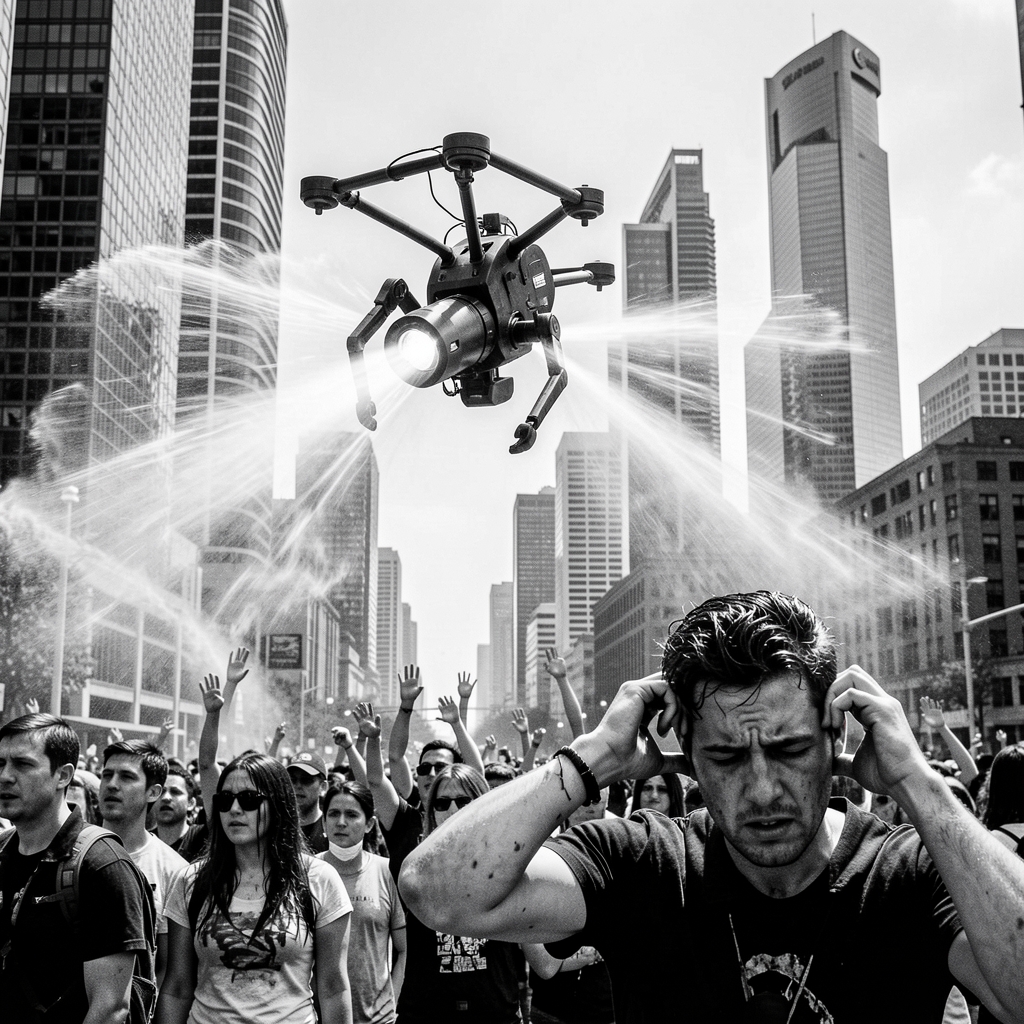
A robotic “dog” equipped with an acoustic device that produces intense, disorienting sound has been shown in public materials — a compact demonstration of a broader toolset used in psychological operations and crowd management. The device does not use force or barriers; it emits a deterrent tone designed to create auditory discomfort and prompt people to leave a location. The image and description raise immediate questions about where and how a tone-generating robot fits into the toolbox of public-order tactics.
What sound dispersers are and how they work
According to the source material, sound dispersers — sometimes called acoustic diffusers — are used primarily in psychological‑operations and crowd‑management roles. Rather than relying on physical force, these devices emit a deterrent tone. That tone is intended to create strong auditory discomfort and disorientation, encouraging individuals to move away from a given area.
The robotic “dog” demonstration
The item shown in the source is a robotic “dog” drone equipped with a sound disperser and is operated. The combination — a mobile, animal‑shaped robotic platform paired with an acoustic diffuser — illustrates one way the technology may be packaged and deployed. The source presents the platform as an example of an application of sound‑disperser technology.

Audit-ready is a season. It shouldn't be.
Evidence in spreadsheets, controls drifting between audits, frameworks multiplying on flat headcount. Nubivance runs continuous compliance on Rapid7 Cyber GRC - SOC 2, HIPAA, ISO 27001, PCI, CMMC.
End the scrambleWhy the combination matters
- Effect over force: The core fact from the source is that sound dispersers aim to deter movement through auditory discomfort rather than by physical barriers or kinetic means. That mode of influence changes the character of an intervention from physically coercive to sensory and psychological.
- Mobility and placement: The source shows the sound disperser mounted on a robotic “dog,” which signals a platform that can be positioned where the deterrent tone will be heard. The pairing of mobility and an audible deterrent concentrates the device’s effects in space and time.
- Behavioral effect: The stated intent of the device is to produce strong auditory discomfort and disorientation that encourages people to move away. Any evaluation of such devices therefore rests on two linked facts from the source: the nature of the stimulus (a deterrent tone) and the behavioral objective (prompting retreat from an area).
Questions and perspectives to consider
The source material is spare, but the facts it contains point to several practical considerations for different stakeholders.
- Technologists: The source shows integration of an acoustic diffuser with a mobile robotic platform. Questions for designers and engineers include how to direct or limit the sound, and how the platform’s mobility shapes where and when the deterrent tone can be applied.
- Policymakers and regulators: Given that the devices are described as tools of psychological operations and crowd management, policymakers face questions about appropriate uses, permissible environments, and oversight whenever auditory deterrence is deployed to influence behavior.
- Users (operators and teams): For those who would operate such systems, the facts suggest an operational focus on achieving movement through auditory means rather than physical containment. That distinction raises practical concerns about measurement of effectiveness and assessments of harm or discomfort.
- Adversaries and subjects: Because the device’s stated effect is auditory discomfort and disorientation, those subject to it would experience sensory impact as the primary mechanism of influence — a fact that shapes both immediate reactions and potential countermeasures.
The source does not provide technical specifications, legal analysis, or operational doctrine, and it does not include quoted statements from officials or manufacturers. What is clear from the material provided is narrow but consequential: sound dispersers are designed to generate a deterrent tone causing auditory discomfort and disorientation for the purpose of moving people away, and one demonstrated application mounts such a device on a robotic “dog” platform that is operated.
That combination — an audible, behavior‑shaping effect packaged on a mobile robotic chassis — compresses practical, ethical, and regulatory questions into an urgent field problem: how to balance non‑kinetic influence tools with safety, accountability, and public‑interest constraints. If a tone can persuade people to vacate an area without physical force, who decides when that tone is used, and what limits should govern its deployment?
https://china-defense.blogspot.com/2026/04/drone-application-of-day-sound.html