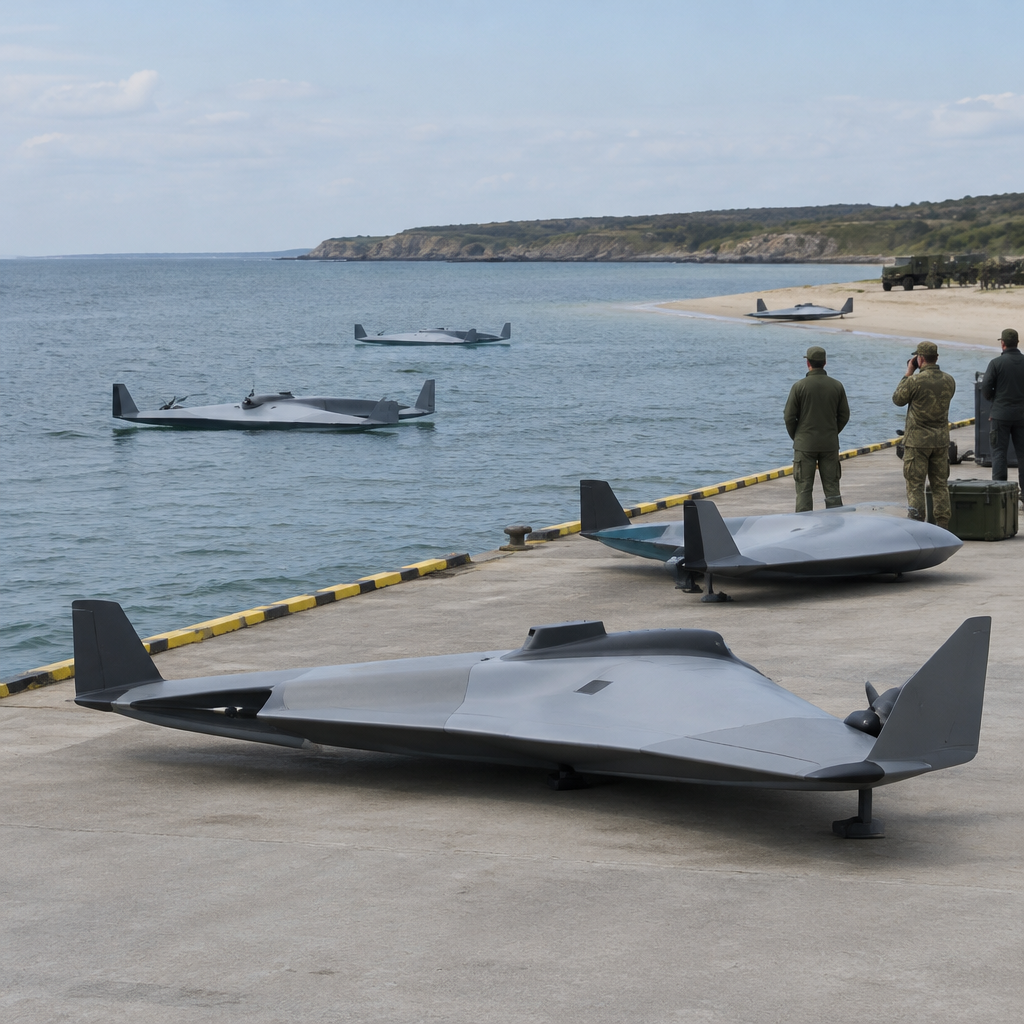
"A small fleet that will be deployed in the Middle East next year, doing multi-domain perception," Regent CEO Billy Thalheimer wrote on X, announcing a sale of his company's Squire Seaglider drones to an unnamed U.S. government customer.
Billy Thalheimer, Regent, and the unnamed U.S. government customer
Regent publicly disclosed that it has reached a deal to sell an unspecified number of autonomous Squire Seagliders to a U.S. government customer, CEO Billy Thalheimer said in a post on X. Thalheimer declined to name the customer, the number of drones involved or the value of the contract; Regent's communications arm likewise declined to provide those details when asked. The company said the electric-powered craft will form "a small fleet" to be deployed in the Middle East next year.
The Squire Seaglider and wing-in-ground (WIG) design
Regent describes the Squire as a hydrofoiling wing-in-ground (WIG) effect craft. The Squire uses a hydrofoil to get airborne and then cruises in ground effect — "at an altitude of about one wingspan above the water" — to exploit the cushion of air between wing and surface for increased lift and reduced drag. Regent highlights that the design allows operation without a traditional runway.

This site is the portfolio.
OSINTSights runs on Cloudflare Workers, D1, R2, and Vectorize, with an AI pipeline on Hetzner ARM. Nubivance designed, built, and operates it. We do the same for clients.
See what we buildPerformance claims, autonomy, and payload
Regent's product description states the Squire "flies in ground effect below radar line of sight at up to 70 knots, with a planned range of more than 100 nautical miles and a 50-pound configurable payload for intelligence, surveillance and reconnaissance (ISR), logistics, search and rescue, and anti-submarine warfare." Thalheimer emphasized that the platform must "operate completely autonomously," saying Squire runs "on our in-house vehicle control software." He added that while flying between sites, "Squire can continue sensing," enabling what he called "Air and sea: multi-domain perception."
Integration, transportability, and related Regent programs
Regent has demonstrated the Squire's ability to plug into mission-management and multi-asset coordination systems: Thalheimer wrote the platform "can also be plugged into mission-management and multi-asset coordination autonomy systems, which we’ve already demonstrated with TAK and [Anduril’s] Lattice." On its product page, Regent shows a rendering of multiple Squires being loaded aboard a transport aircraft. Separately, Regent is working with the U.S. Marine Corps Warfighting Lab on a larger WIG craft, the Viceroy Seaglider, intended to carry 12 passengers or 3,500 pounds of cargo. In September the company announced an extension of that Marine Corps collaboration, "adding $5 million in mission dollars and bringing the total value of the partnership to $19.25 million to date."
CENTCOM operations, Task Force Falcon Strike, and the regional context
The Squire announcement arrived as the Pentagon said it has surged more than 25,000 unmanned and counter-drone systems to U.S. Central Command (CENTCOM). CENTCOM has established Task Force Falcon Strike, described by the command as "the first multinational attack drone task force." According to CENTCOM, the task force will "employ one-way attack drones consisting of unmanned systems from above, on, and below the sea operated by military support staff from the United States and regional partners." Aviation Week reported Thalheimer said Squires will perform an "underwater perception" mission, a likely reference to counter-mine work tied to CENTCOM's escort operations through the Strait of Hormuz and maritime actions supporting a naval blockade on Iran. CENTCOM declined to say whether the Squire WIG craft will be part of Task Force Falcon Strike.
Historical and operational perspective: WIG craft precedent and uncertainty
Regent and the reporting note that the WIG concept is not new but has had limited success in large-scale military use. The Soviet Union's ekranoplans are the most notable historical example, yet even those saw limited service. China has a WIG craft referred to as the "Bohai Sea Monster," which was spotted with apparent weapons hardpoints, and Iran has operated small WIG craft called the Bavar-2 as low-signature scouts and patrol platforms. DARPA's Liberty Lifter effort to create a large WIG craft completed without producing an aircraft. Given that history, Regent's deployment of autonomous Squires in a regional, potentially contested maritime environment represents a notable step in operationalizing the concept.
Regent said it will continue to integrate sensors and autonomy for "multi-domain perception" missions, and the company has signalled plans to deploy next year; beyond that timetable, the record contains few public specifics about numbers, cost, or precise tasking. The coming months will show whether a WIG drone fleet can add persistent, wide-area sensing and logistics options to operations already expanding under CENTCOM's surge of unmanned capabilities.
Original story: https://www.twz.com/news-features/regent-squire-wing-in-ground-effect-drone-to-patrol-middle-east-waters