"No need for panic, our smaller fighter aircraft have always been placed under cover at night – much of it hardened," retired RAF Air Marshal Greg Bagwell wrote on X on Nov. 25, 2026.
What the RAF is doing: Kevlar nets and sheltering at night
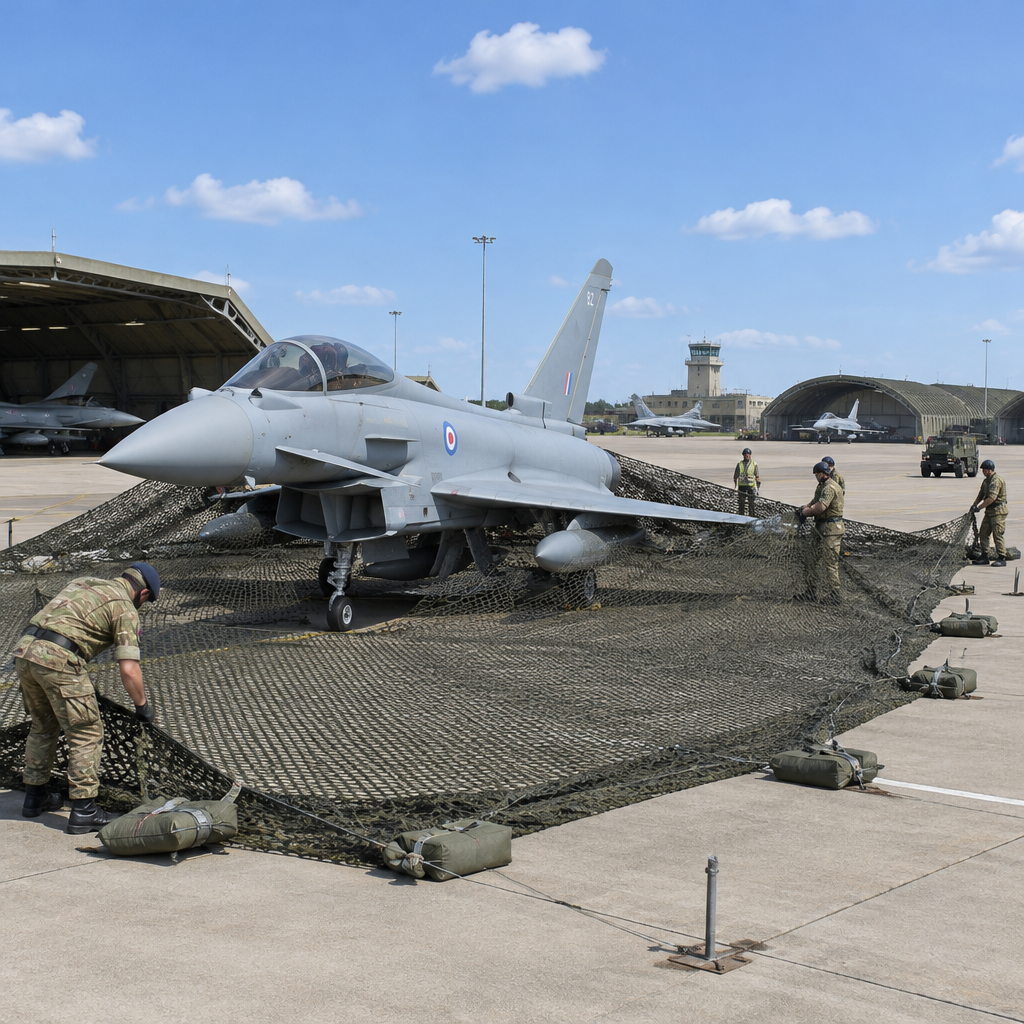
Faced with what British media described as an increasing drone threat, the Royal Air Force is putting in place additional passive defensive measures for aircraft left outside hangars or hardened shelters. The Times and Sky News reported this week that "troops have… been tasked with setting up Kevlar anti-drone nets, like those used in Ukraine, for planes that remain outside on the runway or elsewhere, unprotected at military bases in the UK."
Both publications also reported that RAF aircraft are being placed into hangars and hardened shelters at night because of the drone threat. The British Defense Ministry told TWZ that it is "investing an additional £470 million to strengthen security at military sites, including better physical protection, surveillance and counter-drone capabilities," and that it has already invested "£15 million in drone and counter-drone technology" and introduced restricted airspace over 44 critical Defence sites.
Operational constraints: large aircraft, limited hangarage
Retired and former commanders emphasized the practical limits that shape the RAF response. Bagwell noted that smaller fighters "have always been placed under cover at night" and that "it’s more challenging for larger aircraft, for which we don’t have enough hangarage." Retired U.S. Air Force Col. Troy Pananon, who commanded RAF Mildenhall from 2019–2021, made the same point about big aircraft: "moving aircraft into shelters at 'fighter bases is pretty typical, generally they don’t have that [capability] for big aircraft' like tankers."
That constraint helps explain interest in lighter, cheaper passive measures such as Kevlar canopies and netting. Pananon said "Kevlar canopies… would be interesting" but cautioned they are only one layer of defense within a broader set of measures that would include kinetic options, intelligence, and protection.

Audit-ready is a season. It shouldn't be.
Evidence in spreadsheets, controls drifting between audits, frameworks multiplying on flat headcount. Nubivance runs continuous compliance on Rapid7 Cyber GRC - SOC 2, HIPAA, ISO 27001, PCI, CMMC.
End the scrambleU.S. forces in England: measures unclear, security responses documented
It is not publicly known whether U.S. Air Force units based at RAF stations are installing the same netting. Two U.S. Air Force officials, citing operational-security concerns, declined to say whether the service was increasing passive defenses like protective netting in response to drone threats. One official told TWZ: "For operational security reasons we will not discuss specific force protection measures; however, we want to make clear that our Security Forces throughout the European Theater, in cooperation with our host nation partners, take a proactive integrated and layered approach to base defense."
Recent security moves at U.S.-hosted RAF bases are on the record. Earlier this month RAF Lakenheath and RAF Mildenhall were raised to Force Protection Condition Charlie reportedly in response to Iranian threats; Mildenhall subsequently evacuated a large number of KC-135 tankers and three CV-22 Osprey tiltrotors. A suspected drone incursion over Lakenheath on Nov. 13 triggered a security response that a civilian pilot later suggested may have been caused by a three‑ship formation of light aircraft flown nearby. British authorities are also investigating a September security incident at RAF Fairford that reportedly prompted the prompt departure of B‑1 Lancer bombers; British officials suspect Iran was behind the incident, and a U.S. indictment said the plot against Fairford was partly coordinated from an American jail by a dual Iranian‑Iraqi national.
Lessons drawn from Ukraine and broader U.S. policy moves
The move toward netting follows several high-profile examples used as justification in the reporting. TWZ pointed to Ukrainian practices and to Operation Spiderweb, in which coordinated drone attacks reportedly destroyed aircraft sitting on open flightlines in Russia. The Ukrainian Air Force has also acquired vehicles and other equipment to support dispersed operations for Western-supplied F‑16 fighters, according to the source.
Within the U.S. military, the source documents growing interest in similar passive defenses. Joint Interagency Task Force 401 issued guidance in January calling explicitly for increased use of netting, cables and other passive physical defenses to protect critical infrastructure. The U.S. Air Force has sought contractors to install netting at Tyndall Air Force Base to protect F‑35s, and senior U.S. military leaders have acknowledged the value of light protections: "There is value in some light protection against small, unmanned threats," Air Force Chief of Staff Gen. Kenneth Wilsbach told Breaking Defense, adding that "just nets that are up that keep a small, few‑$100 drone from getting next to a $2 billion aircraft. That actually works, [and is] really cheap."
What this means for the British Defense Ministry, the U.S. Air Force, and the Ukrainian Air Force
- British Defense Ministry and the RAF: will continue to expand passive and surveillance measures, backed by the announced £470 million investment and restricted airspace over 44 critical Defence sites, while rehearsing dispersal at locations such as RAF Brize Norton as part of readiness drills.
- U.S. Air Force and U.S. units in England: will maintain an integrated, layered defense posture in coordination with host-nation partners, but—per two USAF officials—will not disclose specific force-protection measures publicly; earlier evacuations and raised FPCON levels show concrete operational responses are already being used.
- Ukrainian Air Force: cited as an operational example whose experience with dispersal, netting-like protections and new sustainment vehicles for dispersed F‑16 operations is influencing Allied thinking about passive defenses for parked aircraft.
The RAF’s recent actions fit a wider pattern chronicled in the reporting: physical hardening and dispersal are being prioritized as affordable, quickly fieldable mitigations to blunt drone threats where full hangarage is unavailable. What remains open in the public record is how far those measures will be mirrored by U.S. units based at RAF stations; two U.S. Air Force officials declined to provide specifics when asked.
Source: TWZ – Drone Threats Prompt RAF To Install Netting At Bases To Protect Aircraft: Reports