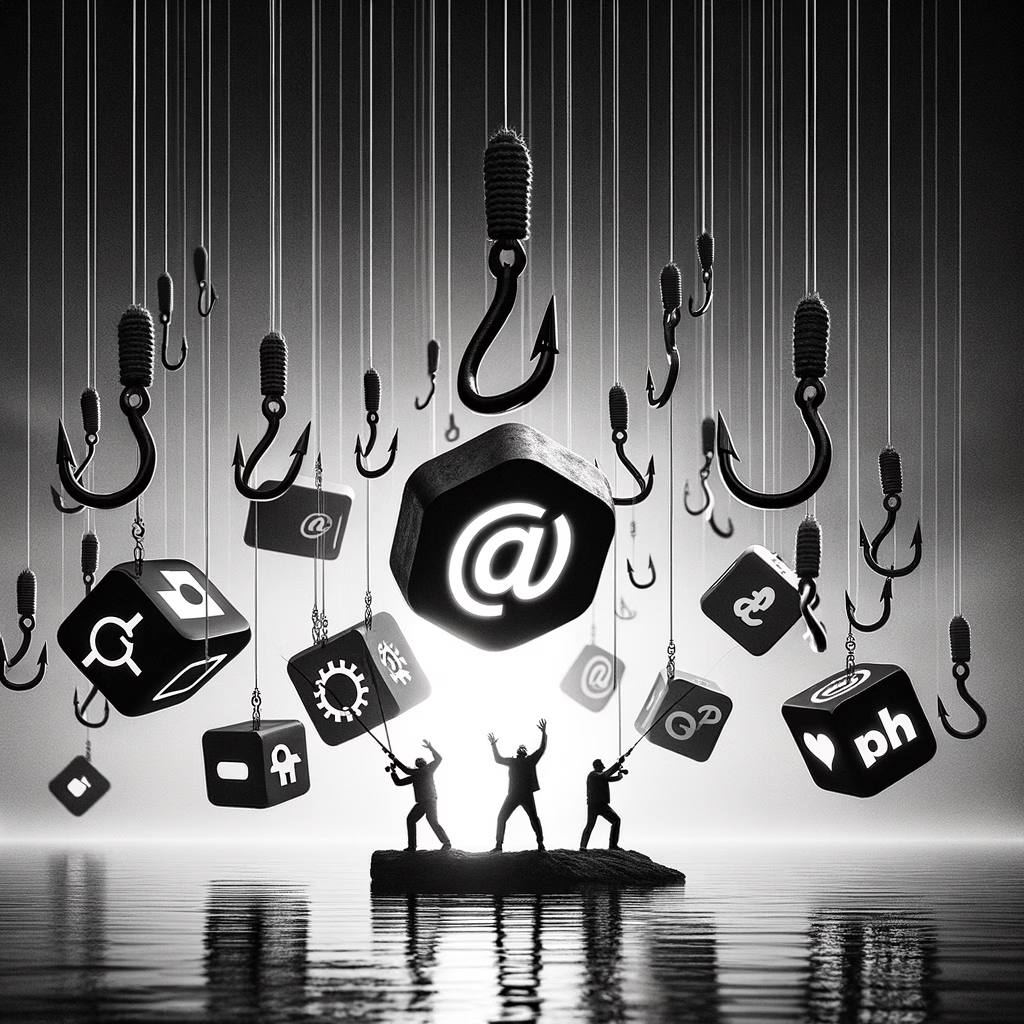
“How do you tell the difference between a login page and a lie?” That question has stopped being rhetorical. A dramatic surge in phishing-as-a-service activity — tracked under names such as Lighthouse and Lucid — is flooding the internet with credential-harvesting sites that look increasingly legitimate. Recent analysis by Netcraft found more than 17,500 phishing domains targeting 316 brands across 74 countries, illustrating how organized, subscription-based criminal services are turning online fraud into an industrialized business.
phishing-as-a-service: What it is and why it matters
Phishing-as-a-service (PhaaS) commodifies fraud. For a subscription fee, buyers get turnkey phishing kits: realistic templates mimicking bank and cloud-provider login flows, dashboard management, automated hosting, and easy rotation of domains and SSL certificates. The result is an ecosystem where attackers no longer need deep technical skills. Instead, they rent polished infrastructure and ready-made spoofed brand templates and scale campaigns rapidly with minimal friction.
This shift changes the threat profile in two key ways: scale and sophistication. Manual, artisanal phishing operations are being replaced by automated processes that register domains, provision certificates, spin up hosting, and rotate infrastructure to evade takedowns. These disposable, lookalike pages are harder to detect and remove, and they multiply the number of attack vectors defenders must monitor.
Operationally, PhaaS lowers barriers to entry and increases anonymity. One successful credential harvest can cover months of subscription costs; stolen credentials become currency on secondary markets. Larger PhaaS catalogs broaden potential yield, enabling specialization where developers maintain kits, operators distribute campaigns, and buyers monetize access through resale or account takeover.
Why this matters to organizations and individuals: brand impersonation damages trust, stolen credentials enable fraud and data theft, and the speed of modern PhaaS campaigns compresses the time between compromise and exploitation. The Netcraft figures — 17,500 domains and 316 brands — are an urgent signal that the problem is widespread and growing.
Technical defenses and operational changes
Security teams must assume their brand assets are being spoofed and adopt layered defenses:
– Strengthen email and web protections: implement DMARC/DKIM/SPF alignment, advanced email filtering, and real-time URL analysis that inspects links before a user clicks.
– Deploy phishing-resistant authentication: prefer hardware-backed or app-based multi-factor authentication (MFA) to limit damage from credential theft.
– Use user behavior analytics: detect anomalous sign-in attempts and unusual lateral movement after compromised credentials are used.
– Operationalize threat intelligence: ingest feeds that list active phishing domains and templates, and integrate those into security orchestration and automated blocking.
– Build automated takedown pipelines: coordinate rapid response between registrars, hosting providers, and incident responders to reduce domain lifespan.
Policy and regulatory levers
Policymakers face complex choices because the PhaaS economy spans jurisdictions. Effective measures could include mandatory incident reporting, stricter controls on rapid domain registration and automated SSL issuance, and incentives for registrars and hosting services to act swiftly on abuse reports. Enhanced public-private intelligence sharing and cross-border cooperation will be essential.
However, regulation must balance security with privacy, interoperability, and the administrative burden on legitimate businesses. Overly broad controls could hinder innovation or create privacy concerns, while weak policies will leave gaps the PhaaS industry will continue to exploit.
People are still the weakest link
End users remain the most exposed node. Even security-savvy people fall for realistic pages and urgent social-engineering lures. Practical, scalable defenses for users include:
– Verify links by hovering before clicking and typing URLs directly for sensitive sites.
– Use phishing-resistant MFA where available and avoid SMS-only second factors when more secure options exist.
– Treat unsolicited authentication requests or messages asking for credentials with suspicion and verify through other channels.
– Focus user education on high-impact behaviors — spotting unusual sender addresses, recognizing mismatched domains, and pausing before reacting to emotionally charged messages.
Education matters, but it must be realistic: training that relies on rote knowledge is less effective under real-world pressure than programs that build intuitive, repeatable habits.
Systemic mitigation: beyond the checklist
Mitigating phishing-as-a-service requires both technical controls and systemic change. Recommended broad measures include:
– Phishing-resistant authentication across consumer and enterprise services.
– Expanded takedown cooperation and automation among registrars, hosting providers, and incident responders.
– Public-private intelligence sharing focused on active PhaaS campaigns and template fingerprints.
– User-facing warnings and browser protections that make spoofing attempts easier to spot.
Obstacles remain: rapid domain churn, abuse of legitimate hosting platforms, varying legal frameworks across countries, and inconsistent incentives for registrars to act quickly all hinder takedown efforts. Meanwhile, attackers exploit psychological levers — fear, urgency, and curiosity — that reliably provoke clicks.
Conclusion: Treat phishing-as-a-service as a supply-chain risk
Netcraft’s findings are more than numbers; they signal a persistent, expanding threat that won’t be solved by a single patch or policy. When criminality is productized, defenses must meet the same level of professionalism. Organizations should treat phishing-as-a-service as a supply-chain risk touching marketing, legal, IT, and executive leadership — not merely a technical incident for security teams. The central question remains whether defensive efforts — funding, coordination, and policy — can match the systematic efficiency of subscription-based attackers. The answer will determine whether the next surge is blunted or paid for by more unsuspecting users.



