“I think of the DAWG as a pathfinder, they’re out there finding the best technology for us and working on integration,” Jules “Jay” Hurst, who is performing the duties of the Pentagon comptroller, told reporters today.
DAWG as a successor to Replicator and a testbed for “attritable” systems
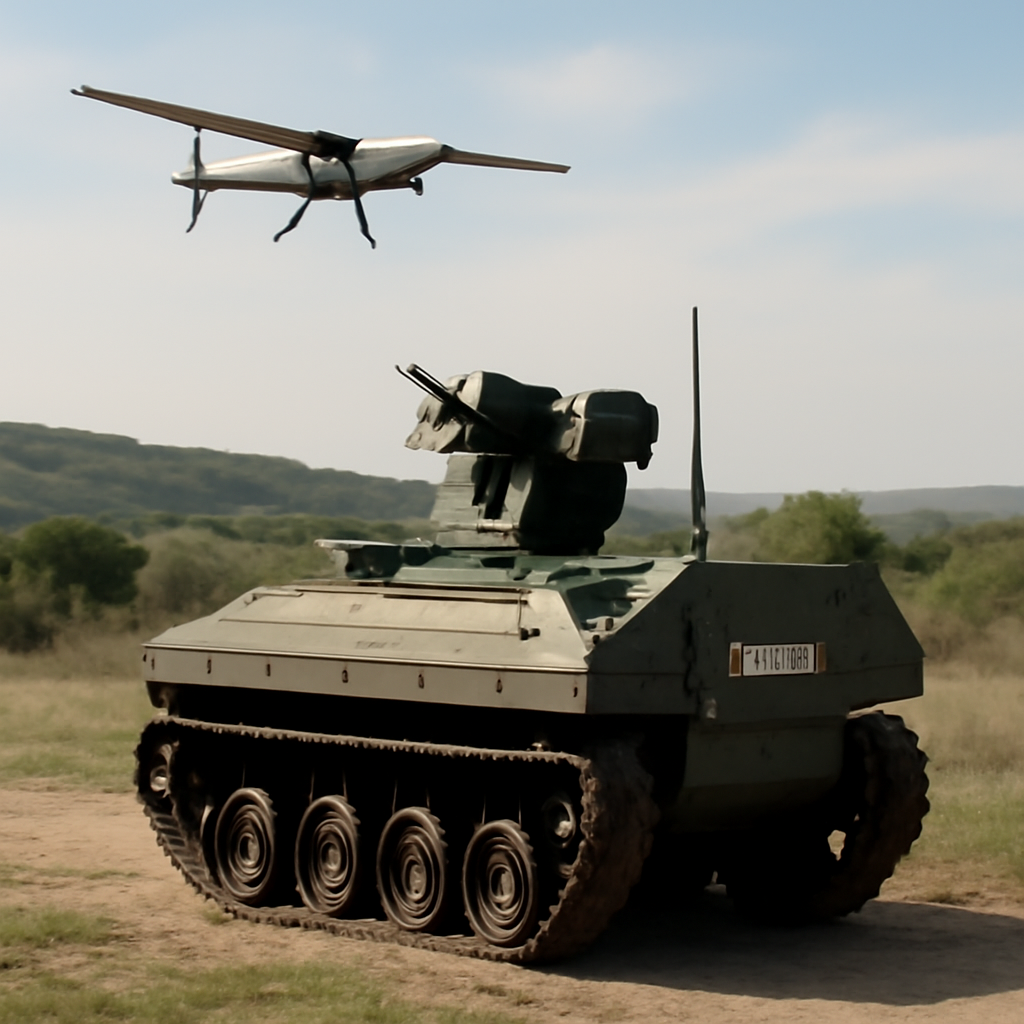
The Defense Autonomous Warfare Group (DAWG) has absorbed the Biden-era Replicator initiative and will accelerate development across a range of drone and autonomy efforts, focused in part on the low-cost, "attritable" platforms Replicator was designed to acquire for use in the Pacific. Pentagon officials describe DAWG as a live testbed: companies are “live right now, testing different systems and orchestration tools for autonomy, and they’re giving them live feedback,” Hurst said.
FY27 ask: $54.6 billion for DAWG, mostly in reconciliation
The Pentagon’s FY27 budget request seeks $54.6 billion in research and development dollars for DAWG — a change that represents a 24,070 percent increase over the $225.9 million DAWG received in fiscal 2026. Of that $54.6 billion, $1 billion is requested in the base budget and $53.6 billion is placed in the more flexible reconciliation pot. The department frames the placement in reconciliation as a way to gain obligation flexibility and to support one-time “plus up” investments in rapidly changing technology.

Audit-ready is a season. It shouldn't be.
Evidence in spreadsheets, controls drifting between audits, frameworks multiplying on flat headcount. Nubivance runs continuous compliance on Rapid7 Cyber GRC - SOC 2, HIPAA, ISO 27001, PCI, CMMC.
End the scrambleHow Pentagon leaders say the money will be used
Lt. Gen. Steven Whitney, the director for Force Structure, Resources and Assessment, said the funds will support rapid innovation and “the ability to spin and develop new capabilities.” The DAWG model, Whitney added, emphasizes incremental capability development rather than buying a single, long-term baseline: “It’s not that you’re buying one set baseline and you’re going to procure it forever. It’s an incremental capability.” Hurst echoed that view, positioning DAWG as a unit that not only sources technology but works directly with companies on integration and live testing.
Office of Strategic Capital: a parallel, large-scale ask
The FY27 package also elevates the Office of Strategic Capital’s (OSC) loan program. The Pentagon requests nearly $20.2 billion for OSC — $216 million in the base budget and $20 billion in reconciliation — a 1,247 percent increase over the FY26 $1.5 billion pot. OSC provides debt financing for critical technology manufacturing, and Hurst said that if OSC receives the total ask, it “could potentially spend the entire pot in one year.” He added that if suitable opportunities are limited, the office may delay obligating funds into future fiscal years, reflecting why the department engineered much of the request to rely on reconciliation flexibility.
What this means for companies, Congress, and Pentagon program managers
- Companies and technology teams: Firms working with DAWG are already in live testing and orchestration trials, and the proposed funding surge would deepen opportunities for integration and rapid iteration. Those companies will be closely watching whether reconciliation funds become available, because $53.6 billion of DAWG’s ask is tied to that mechanism.
- Congress and appropriators: Putting the bulk of DAWG and OSC dollars in reconciliation is a political calculation. The Pentagon notes reconciliation offers more flexible timing for obligations and suits high-priority, fast-moving technology investments, but the request is vulnerable to the dynamics of the mid-term election cycle; officials acknowledge future reconciliation prospects are dim if political control shifts.
- Pentagon program managers and war planners: DAWG leaders present the approach as a way to spin capabilities quickly rather than lock into a single procurement line. That model depends on steady access to R&D dollars and the ability to move from experiment to broader fielding — a transition that officials say will be funded largely through the reconciliation portion of the FY27 plan.
The DAWG and OSC requests sit inside a larger FY27 defense blueprint that the department says will total at least $1.5 trillion: $1.15 trillion in the base budget request and an additional $350 billion to be sought through reconciliation. Officials also flagged the possibility of a separate supplemental to cover operations in the Middle East. Pentagon leaders have characterized the FY27 DAWG ask as a “generational investment,” but they have also framed the choice to place most funds in reconciliation as a deliberate gamble — one that buys timing flexibility but hinges on whether Congress approves the larger reconciliation package.