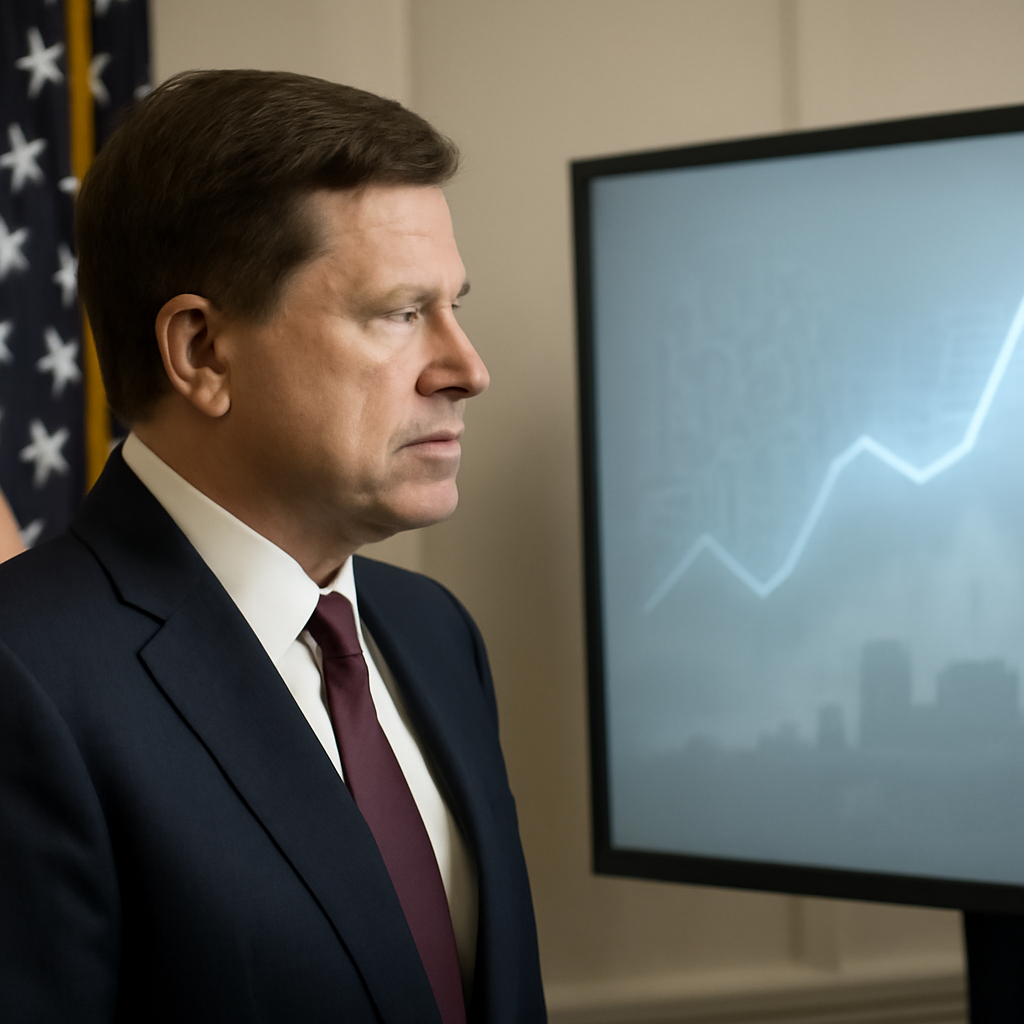
Emerging weapons manufacturers were called to the Pentagon this afternoon to meet with Defense Secretary Pete Hegseth, four sources told Breaking Defense — a tightly held, unannounced session that officials say focused on accelerating munitions production in the wake of the war with Iran.
Who was in the room at the Pentagon
Sources who were not authorized to speak publicly told Breaking Defense that invitees included Anduril, Castelion, CoAspire and Leidos. The meeting, convened by Defense Secretary Pete Hegseth, also included Deputy Secretary of Defense Stephen Feinberg, Undersecretary for Acquisition and Sustainment Michael Duffey, and Undersecretary for Research and Engineering Emil Michael. It is unclear whether other companies were present or whether some invitees were unable to attend.
Low-Cost Containerized Missiles and Castelion’s Blackbeard
The meeting followed framework agreements the Department of Defense announced in May with Anduril, Leidos, CoAspire and Zone 5 for the Low-Cost Containerized Missiles (LCCM) program, and a parallel agreement with Castelion described as intended to “scale low-cost hypersonic solutions,” specifically its Blackbeard missile. One source told Breaking Defense that the LCCM program was among topics discussed during the Pentagon meeting.

This site is the portfolio.
OSINTSights runs on Cloudflare Workers, D1, R2, and Vectorize, with an AI pipeline on Hetzner ARM. Nubivance designed, built, and operates it. We do the same for clients.
See what we buildFollow-up to White House summits and administration messaging
Today’s gathering at the Pentagon comes after a White House summit on Wednesday in which President Donald Trump met with defense primes to discuss munitions needs. Reuters reported that the initial message at the White House meeting was that weapons primes were not doing enough to hasten production times, though that tone softened as leaders emphasized cooperation.
The White House meeting was the second such gathering this spring; a March meeting brought President Trump together with seven defense firms — RTX, Lockheed Martin, Boeing, Northrop Grumman, BAE Systems, L3Harris Missile Solutions and Honeywell Aerospace. Following that meeting, President Trump posted on Truth Social: “They have agreed to quadruple Production of the ‘Exquisite Class’ Weaponry in that we want to reach, as rapidly as possible, the highest levels of quantity.” Breaking Defense notes it remains unclear whether that earlier meeting produced new formal agreements beyond the thresholds in previously announced framework agreements.
Funding constraints: $47 billion tied to reconciliation
The Pentagon’s effort to move framework agreements into firm contracts is constrained by funding. Breaking Defense reports that $47 billion of the department’s munitions request for fiscal 2027 remains tied up in the administration’s effort to add $350 billion to the defense budget through a party-line reconciliation bill. Pentagon officials and defense executives have repeatedly said funding is imperative to finalize contracts associated with the framework agreements.
How Anduril, Castelion, CoAspire and Leidos are positioned
- Anduril, Castelion, CoAspire and Leidos were all named as invitees to the Pentagon meeting and were listed in May framework agreements related to LCCM or hypersonic work.
- Castelion’s Blackbeard missile was specifically cited in the May “parallel agreement” to scale low-cost hypersonic solutions.
- Company responses to questions were limited: the Defense Department referred questions to the White House; the White House did not immediately return a request for comment; spokespeople for Leidos and Castelion deferred questions to the Defense Department; and Anduril did not immediately return a request for comment, according to Breaking Defense.
The meeting reinforces a Pentagon push — reported by Breaking Defense — to bring new entrants into the industrial base with an explicit message that if traditional defense players cannot meet warfighter needs, the administration will seek new players. How that message translates into contracts, production increases and executed deliveries will depend heavily on whether the funding now tied to the reconciliation bill is released.